







Question: Solve part (C) only if you know correctly!! 2-2 Flow in Porous Media: Darcy's Law A relationship often used to model fluid flow in porous
Solve part (C) only if you know correctly!!
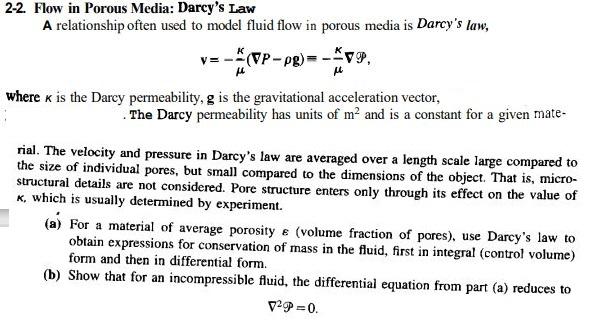
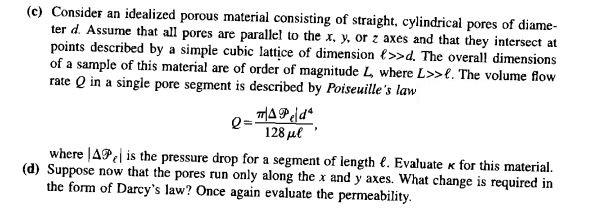
2-2 Flow in Porous Media: Darcy's Law A relationship often used to model fluid flow in porous media is Darcy's law, v=--(OP-pg)= -9, where K is the Darcy permeability, g is the gravitational acceleration vector, The Darcy permeability has units of mand is a constant for a given mate- rial. The velocity and pressure in Darcy's law are averaged over a length scale large compared to the size of individual pores, but small compared to the dimensions of the object. That is, micro- structural details are not considered. Pore structure enters only through its effect on the value of K, which is usually determined by experiment. (a) For a material of average porosity & (volume fraction of pores), use Darcy's law to obtain expressions for conservation of mass in the fluid, first in integral (control volume) form and then in differential form. (b) Show that for an incompressible fluid, the differential equation from part (a) reduces to V P=0. (e) Consider an idealized porous material consisting of straight, cylindrical pores of diame- ter d. Assume that all pores are parallel to the x, y, or z axes and that they intersect at points described by a simple cubic lattice of dimension >>d. The overall dimensions of a sample of this material are of order of magnitude L, where L>. The volume flow rate Q in a single pore segment is described by Poiseuille's law Q=Ped* 128 where AP is the pressure drop for a segment of length . Evaluate k for this material. (d) Suppose now that the pores run only along the x and y axes. What change is required in the form of Darcy's law? Once again evaluate the permeability. K
Step by Step Solution
There are 3 Steps involved in it

Get step-by-step solutions from verified subject matter experts
 Study Help