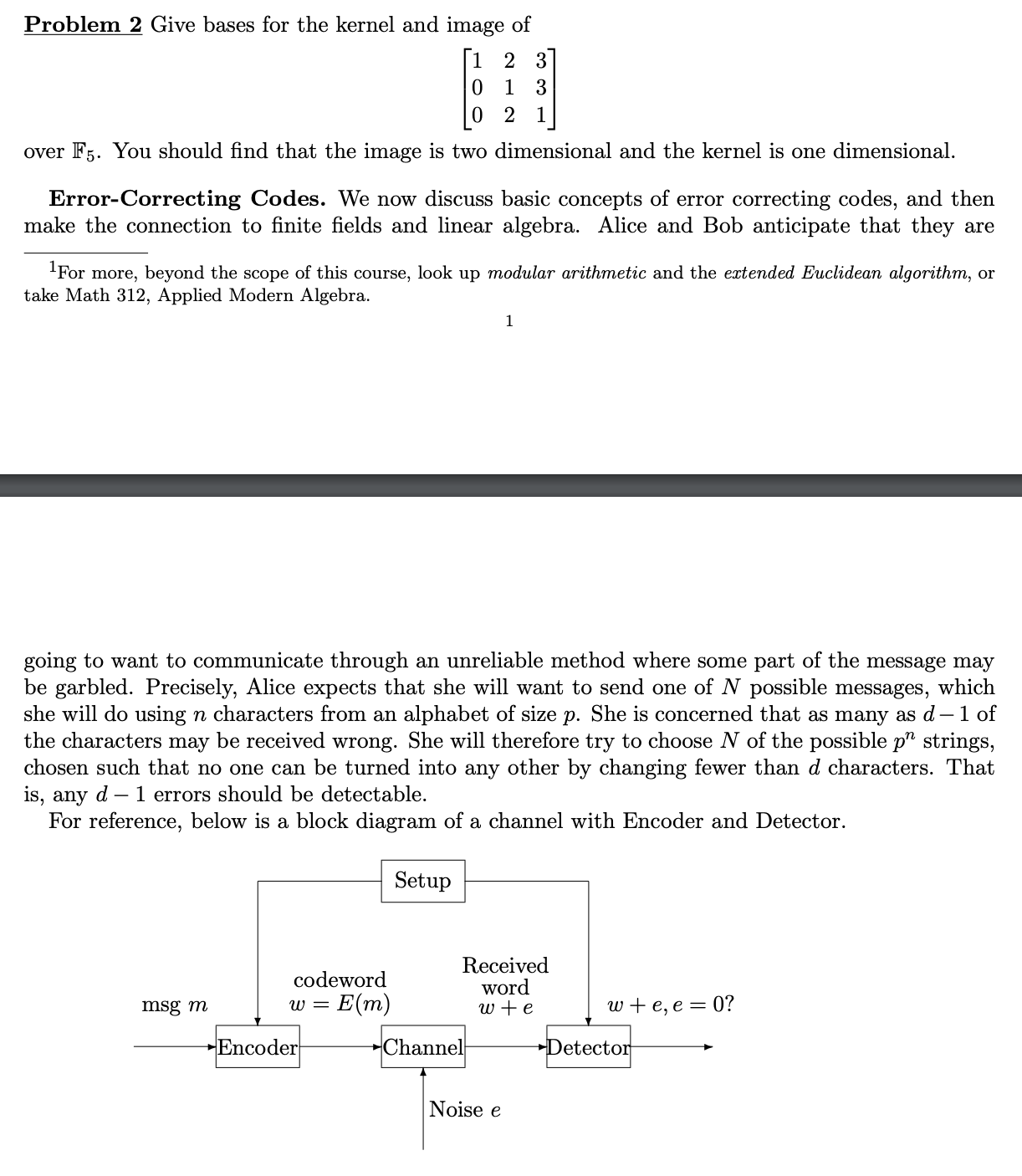
Question: Solve problem 2. Problem 2 Give bases for the kernel and image of 1 2 3 0 1 3 0 2 1 over F5. You
Solve problem 2.
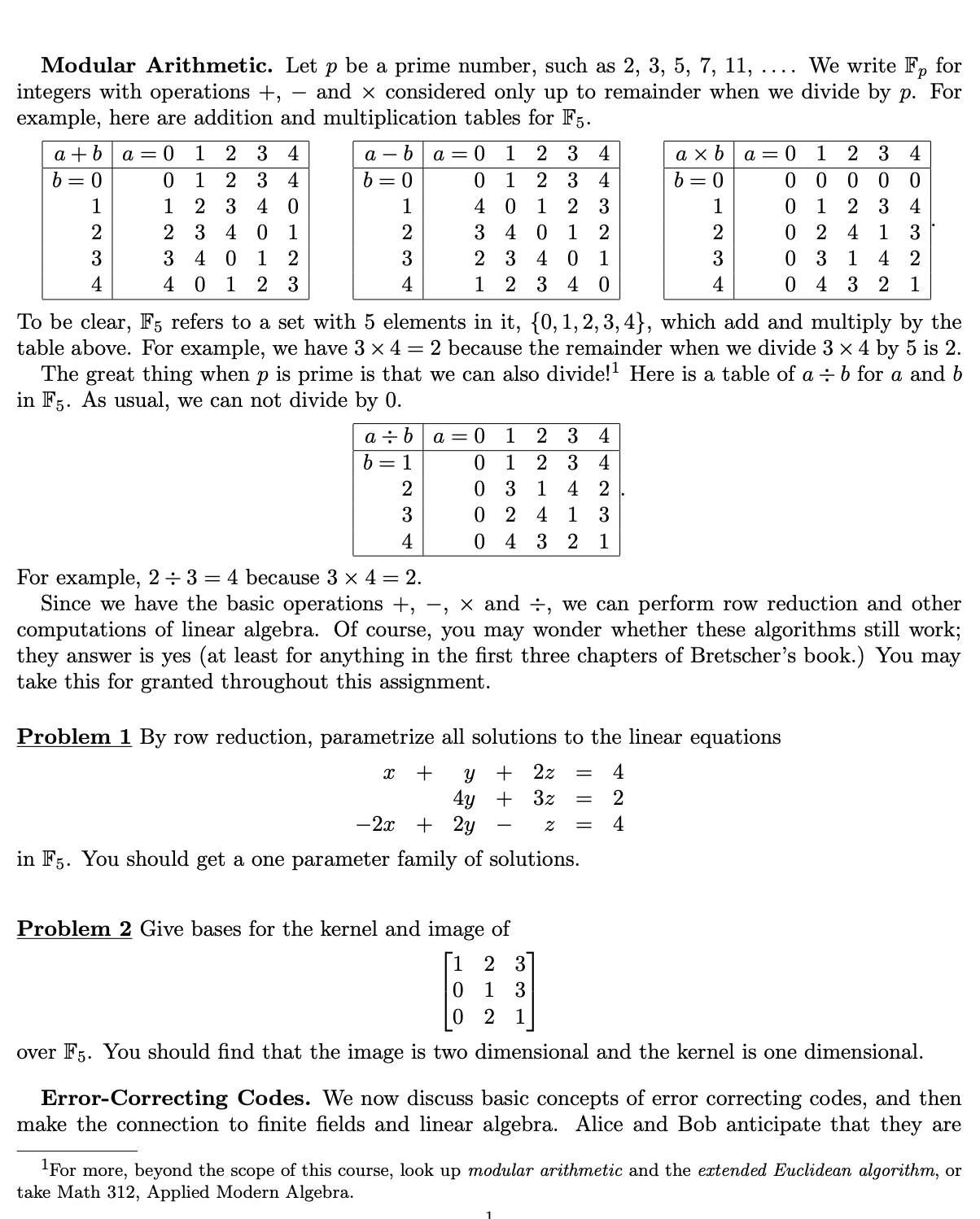
Problem 2 Give bases for the kernel and image of 1 2 3 0 1 3 0 2 1 over F5. You should nd that the image is two dimensional and the kernel is one dimensional. Error-Correcting Codes. We now discuss basic concepts of error correcting codes, and then make the c0nnection to nite elds and linear algebra. Alice and Bob anticipate that they are 1For more, beyond the scope of this course, 1001: up modular arithmetic and the extended Euclidean algorithm, or take Math 312, Applied Modern Algebra. 1 going to want to communicate through an unreliable method where some part of the message may be garbled. Precisely, Alice expects that she will want to send one of N possible messages, which she will do using 71. characters from an alphabet of size 19. She is concerned that as many as d l of the characters may be received erng. She will therefore try to choose N of the possible p\" strings, chosen such that no one can be turned into any other by changing fewer than d characters. That is, any d 1 errors should be detectable. For reference, below is a block diagram of a channel with Encoder and Detector. Modular Arithmetic. Let p be a prime number, such as 2, 3, 5, 7, 11, . . .. We write Fp fer integers with operatiOns +, and x considered only up to remainder when we divide by 39. For example, here are addition and multiplicatiOn tables for F5. To be clear, F5 refers to a set with 5 elements in it, {0, 1, 2, 3, 4}, which add and multiply by the table above. For example, we have 3 x 4 = 2 because the remainder when we divide 3 X 4 by 5 is 2. The great thing when p is prime is that we can also divide!1 Here is a table of a + b for a and b in F5. As usual, we can not divide by 0. For example, 2 + 3 = 4 because 3 x 4 = 2. Since we have the basic Operations +, , X and +, we can perfOrm row reduction and other computations of linear algebra. Of course, you may wonder whether these algorithms still work; they answer is yes (at least for anything in the rst three chapters of Bretscher's book.) You may take this fer granted throughout this assignment. Problem 1 By row reduction, parametrize all solutions to the linear equations a: + y + 22 = 4 43; + 32 = 2 2:1: + 2y z = 4 in F5. You should get a one parameter family of solutions. Problem 2 Give bases for the kernel and image of 1 2 3 0 1 3 0 2 1 over F5. You should nd that the image is two dimensional and the kernel is one dimensional. Error-Correcting Codes. We now discuss basic concepts of error correcting codes, and then make the cennection to nite elds and linear algebra. Alice and Bob anticipate that they are 1For more, beyond the scope of this course, look up module?" arithmetic and the extended Euclidean algorithm, or take Math 312, Applied Modern Algebra









 Study Help