







Question: solve problem 5.9 A metallurgical engineer is considering two mate- rials for use in a space vehicle. All estimates are made. (a) Which should be
solve problem
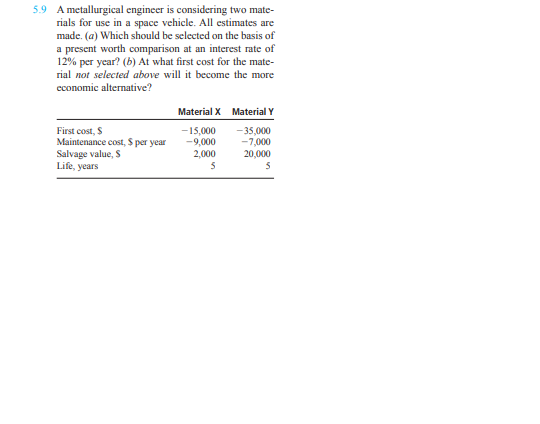
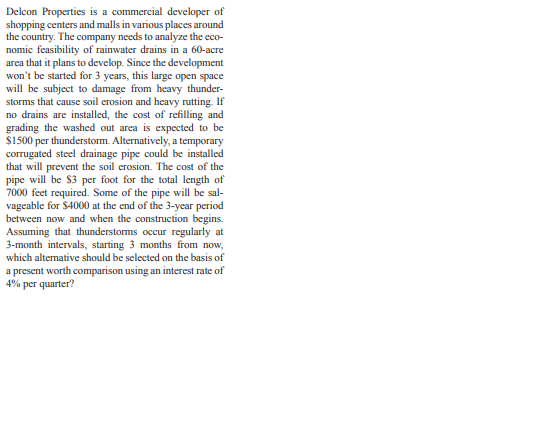
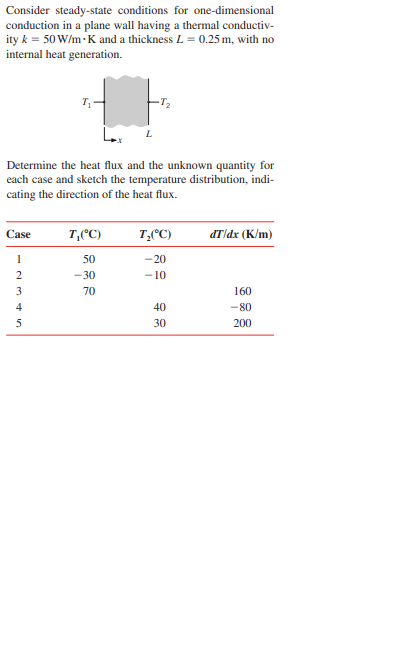
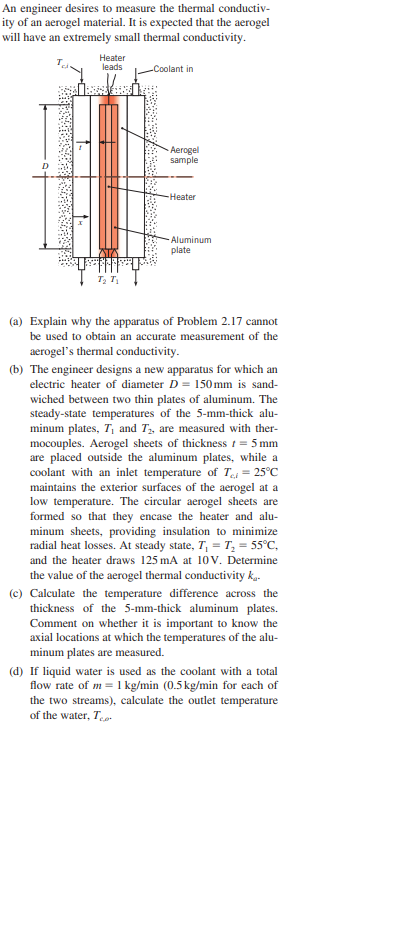
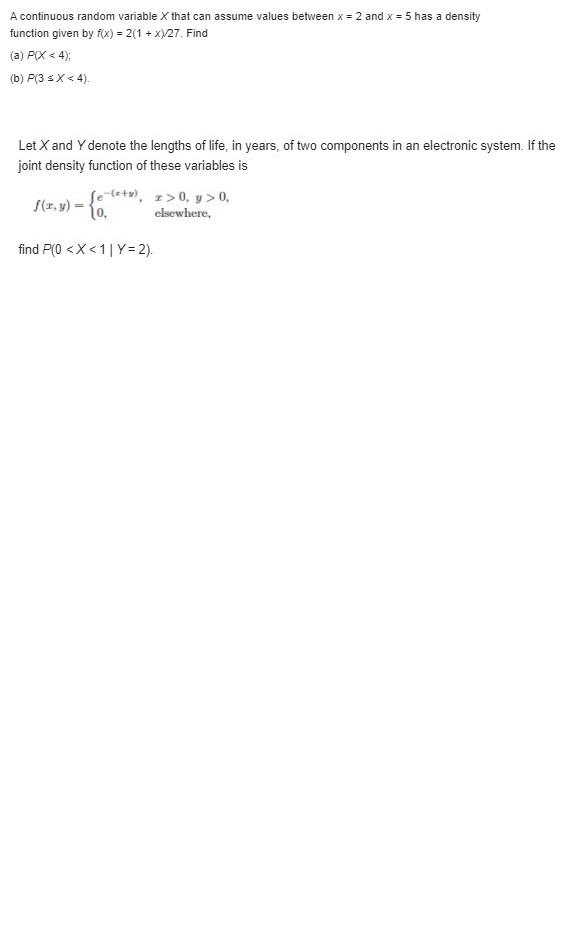
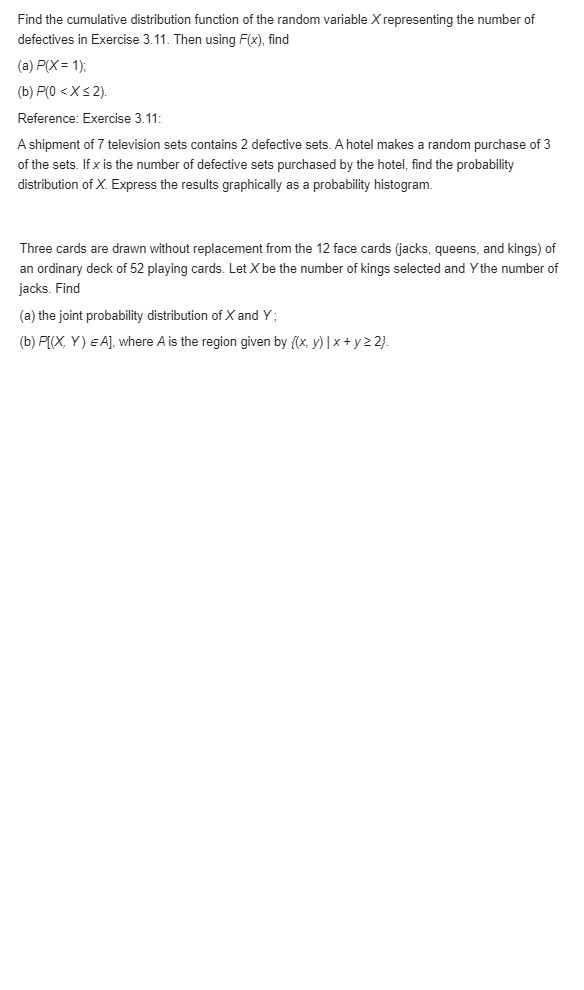
5.9 A metallurgical engineer is considering two mate- rials for use in a space vehicle. All estimates are made. (a) Which should be selected on the basis of a present worth comparison at an interest rate of 12% per year? (b) At what first cost for the mate- rial not selected above will it become the more economic alternative? Material X Material Y First cost, $ -15,000 -35,000 Maintenance cost, $ per year -9.000 -7,000 Salvage value, $ 2,000 20,000 Life, years 5Delcon Properties is a commercial developer of shopping centers and malls in various places around the country. The company needs to analyze the eco- nomic feasibility of rainwater drains in a 60-acre area that it plans to develop. Since the development won't be started for 3 years, this large open space will be subject to damage from heavy thunder- storms that cause soil erosion and heavy rutting If no drains are installed, the cost of refilling and grading the washed out area is expected to be $1500 per thunderstorm. Alternatively, a temporary corrugated steel drainage pipe could be installed that will prevent the soil erosion. The cost of the pipe will be $3 per foot for the total length of 7000 feet required. Some of the pipe will be sal- vageable for $4000 at the end of the 3-year period between now and when the construction begins. Assuming that thunderstorms occur regularly at 3-month intervals, starting 3 months from now, which alternative should be selected on the basis of a present worth comparison using an interest rate of 4% per quarter?Consider steady-state conditions for one-dimensional conduction in a plane wall having a thermal conductiv ity & = 50 W/m . K and a thickness _ = 0.25 m, with no internal heat generation. L Determine the heat flux and the unknown quantity for each case and sketch the temperature distribution, indi- cating the direction of the heat flux. Case I(C) I,(C) dT/dx (K/m) 50 -20 -30 -10 70 160 40 -80 30 200An engineer desires to measure the thermal conductive ity of an aerogel material. It is expected that the aerogel will have an extremely small thermal conductivity. Heater leads -Coolant in Aerogel sample -Heater Aluminum plate (a) Explain why the apparatus of Problem 2.17 cannot be used to obtain an accurate measurement of the aerogel's thermal conductivity. (b) The engineer designs a new apparatus for which an electric heater of diameter D = 150mm is sand- wiched between two thin plates of aluminum. The steady-state temperatures of the 5-mm-thick alu- minum plates, 7, and 72, are measured with ther- mocouples. Aerogel sheets of thickness r = 5 mm are placed outside the aluminum plates, while a coolant with an inlet temperature of Ty, = 25"C maintains the exterior surfaces of the aerogel at a low temperature. The circular aerogel sheets are formed so that they encase the heater and alu- minum sheets, providing insulation to minimize radial heat losses. At steady state, 7, = , = 55"C. and the heater draws 125 mA at 10 V. Determine the value of the aerogel thermal conductivity ke. (c) Calculate the temperature difference across the thickness of the 5-mm-thick aluminum plates. Comment on whether it is important to know the axial locations at which the temperatures of the alu- minum plates are measured. (d) If liquid water is used as the coolant with a total flow rate of m = 1 kg/min (0.5 kg/min for each of the two streams), calculate the outlet temperature of the water, Tes.A continuous random variable X that can assume values between x = 2 and x = 5 has a density function given by f(x) = 2(1 + x)/27. Find (a) P(X 0, y>0, elsewhere, find P(0 2)
Step by Step Solution
There are 3 Steps involved in it

Get step-by-step solutions from verified subject matter experts
 Study Help