





Question: Solve problems a, b, and c. e You roll a pair of dice. e lf the sum is 2, 3, or 12, then the game

Solve problems a, b, and c.
Solve problems a, b, and c. e You roll a pair of
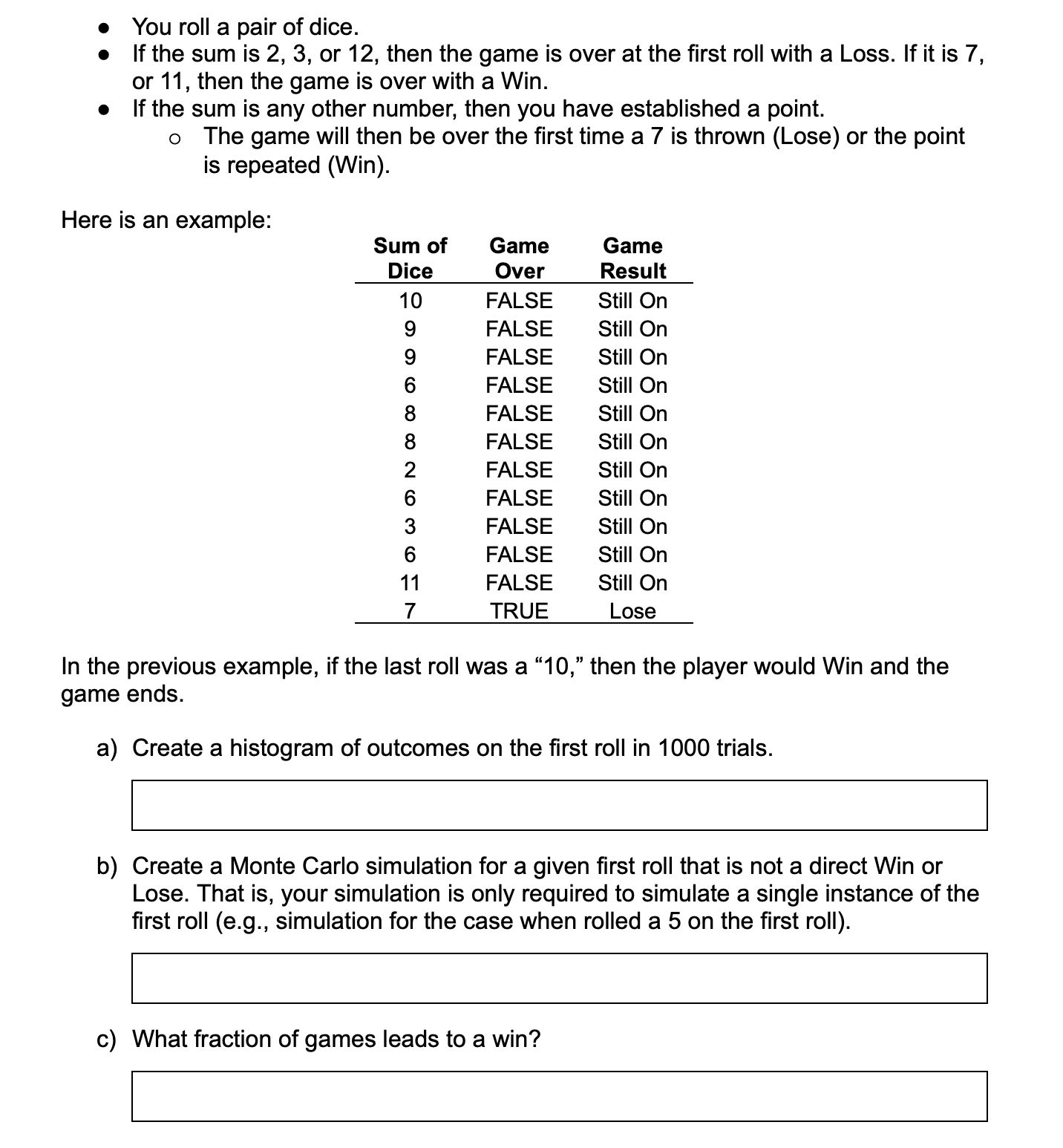
e You roll a pair of dice. e lf the sum is 2, 3, or 12, then the game is over at the first roll with a Loss. If it is 7, or 11, then the game is over with a Win. e lf the sum is any other number, then you have established a point. o The game will then be over the first time a 7 is thrown (Lose) or the point is repeated (Win). Here is an example: Sum of Game Game Dice Over Result 10 FALSE Still On 9 FALSE Still On 9 FALSE Still On 6 FALSE Still On 8 FALSE Still On 8 FALSE Still On 2 FALSE Still On 6 FALSE Still On 3 FALSE Still On 6 FALSE Still On 11 FALSE Still On 7 TRUE Lose In the previous example, if the last roll was a \"10,\" then the player would Win and the game ends. a) Create a histogram of outcomes on the first roll in 1000 trials. PO b) Create a Monte Carlo simulation for a given first roll that is not a direct Win or Lose. That is, your simulation is only required to simulate a single instance of the first roll (e.g., simulation for the case when rolled a 5 on the first roll). PO c) What fraction of games leads to a win? PT

Step by Step Solution

There are 3 Steps involved in it

1 Expert Approved Answer
Step: 1 Unlock blur-text-image

Question Has Been Solved by an Expert!

Get step-by-step solutions from verified subject matter experts

Step: 2 Unlock
Step: 3 Unlock

Students Have Also Explored These Related Accounting Questions!