



Question: solve question 8:07 0 410 B/S Edit 24 X The following question is based on the model of Diamond and Dybvig (1983). There are three
solve question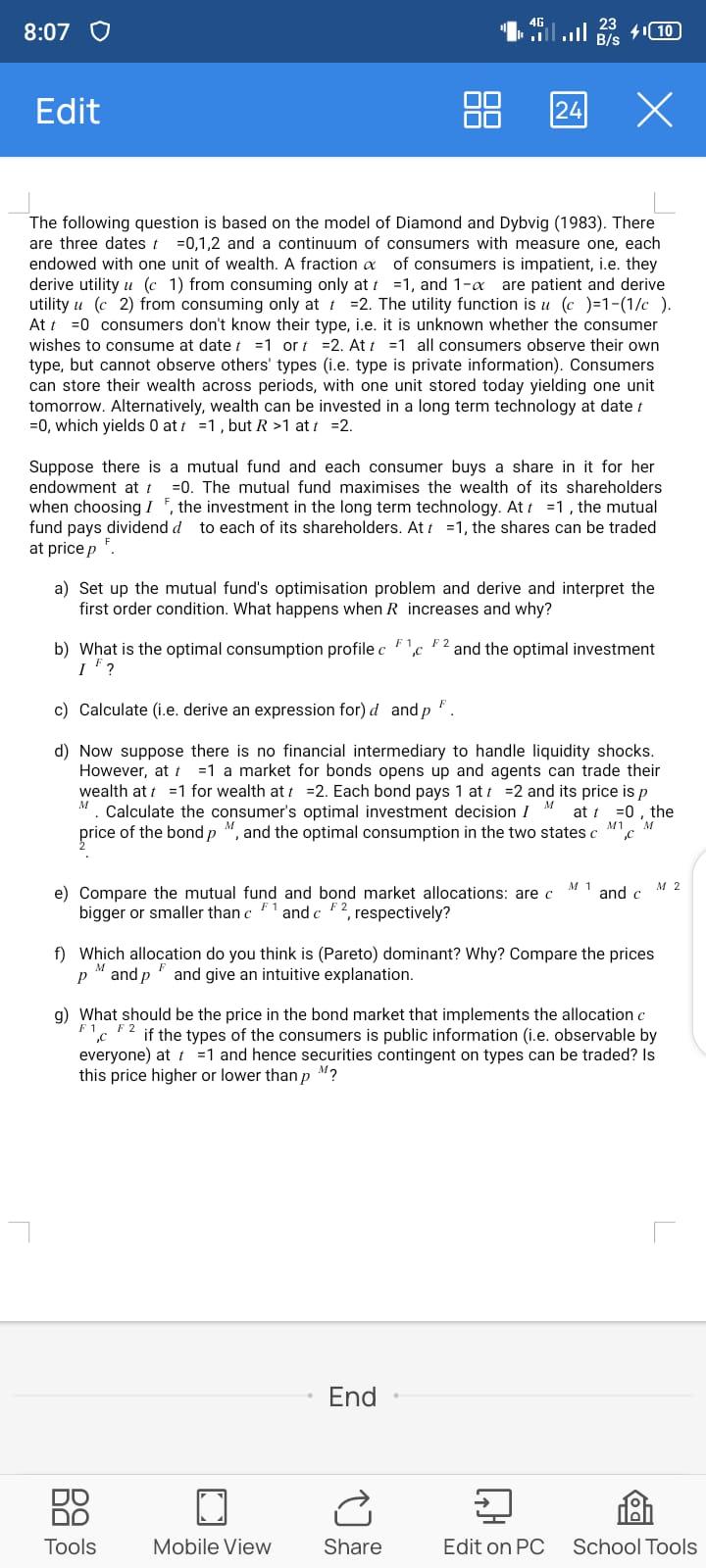
8:07 0 410 B/S Edit 24 X The following question is based on the model of Diamond and Dybvig (1983). There are three dates =0,1,2 and a continuum of consumers with measure one, each endowed with one unit of wealth. A fraction a of consumers is impatient, i.e. they derive utility u (c 1) from consuming only at t =1, and 1-0 are patient and derive utility u (c2) from consuming only at 1 =2. The utility function is u (c )=1-(1/c ). Att =0 consumers don't know their type, i.e. it is unknown whether the consumer wishes to consume at date t =1 or t =2. Att =1 all consumers observe their own type, but cannot observe others' types (i.e. type is private information). Consumers can store their wealth across periods, with one unit stored today yielding one unit tomorrow. Alternatively, wealth can be invested in a long term technology at date 1 =0, which yields 0 at t =1, but R >1 att =2. Suppose there is a mutual fund and each consumer buys a share in it for her endowment at t=0. The mutual fund maximises the wealth of its shareholders when choosing IF, the investment in the long term technology. Att =1, the mutual fund pays dividend d to each of its shareholders. Att =1, the shares can be traded at pricep a) Set up the mutual fund's optimisation problem and derive and interpret the first order condition. What happens when R increases and why? b) What is the optimal consumption profile c F1 I? F2 and the optimal investment c) Calculate (i.e. derive an expression for)d and p" d) Now suppose there is no financial intermediary to handle liquidity shocks. However, at t =1 a market for bonds opens up and agents can trade their wealth at t =1 for wealth at t =2. Each bond pays 1 att =2 and its price is p Calculate the consumer's optimal investment decision I at t=0, the M price of the bond p and the optimal consumption in the two statesc c M M M M1 M1 and c M2 e) Compare the mutual fund and bond market allocations: are c bigger or smaller than c Fland c F?, respectively? f) Which allocation do you think is (Pareto) dominant? Why? Compare the prices M P and p F and give an intuitive explanation. g) What should be the price in the bond market that implements the allocationc F1C F2 if the types of the consumers is public information (i.e. observable by everyone) at t = 1 and hence securities contingent on types can be traded? Is this price higher or lower than p M? End DD Tools Mobile View Share Edit on PC School Tools 8:07 0 410 B/S Edit 24 X The following question is based on the model of Diamond and Dybvig (1983). There are three dates =0,1,2 and a continuum of consumers with measure one, each endowed with one unit of wealth. A fraction a of consumers is impatient, i.e. they derive utility u (c 1) from consuming only at t =1, and 1-0 are patient and derive utility u (c2) from consuming only at 1 =2. The utility function is u (c )=1-(1/c ). Att =0 consumers don't know their type, i.e. it is unknown whether the consumer wishes to consume at date t =1 or t =2. Att =1 all consumers observe their own type, but cannot observe others' types (i.e. type is private information). Consumers can store their wealth across periods, with one unit stored today yielding one unit tomorrow. Alternatively, wealth can be invested in a long term technology at date 1 =0, which yields 0 at t =1, but R >1 att =2. Suppose there is a mutual fund and each consumer buys a share in it for her endowment at t=0. The mutual fund maximises the wealth of its shareholders when choosing IF, the investment in the long term technology. Att =1, the mutual fund pays dividend d to each of its shareholders. Att =1, the shares can be traded at pricep a) Set up the mutual fund's optimisation problem and derive and interpret the first order condition. What happens when R increases and why? b) What is the optimal consumption profile c F1 I? F2 and the optimal investment c) Calculate (i.e. derive an expression for)d and p" d) Now suppose there is no financial intermediary to handle liquidity shocks. However, at t =1 a market for bonds opens up and agents can trade their wealth at t =1 for wealth at t =2. Each bond pays 1 att =2 and its price is p Calculate the consumer's optimal investment decision I at t=0, the M price of the bond p and the optimal consumption in the two statesc c M M M M1 M1 and c M2 e) Compare the mutual fund and bond market allocations: are c bigger or smaller than c Fland c F?, respectively? f) Which allocation do you think is (Pareto) dominant? Why? Compare the prices M P and p F and give an intuitive explanation. g) What should be the price in the bond market that implements the allocationc F1C F2 if the types of the consumers is public information (i.e. observable by everyone) at t = 1 and hence securities contingent on types can be traded? Is this price higher or lower than p M? End DD Tools Mobile View Share Edit on PC School Tools
Step by Step Solution
There are 3 Steps involved in it

Get step-by-step solutions from verified subject matter experts