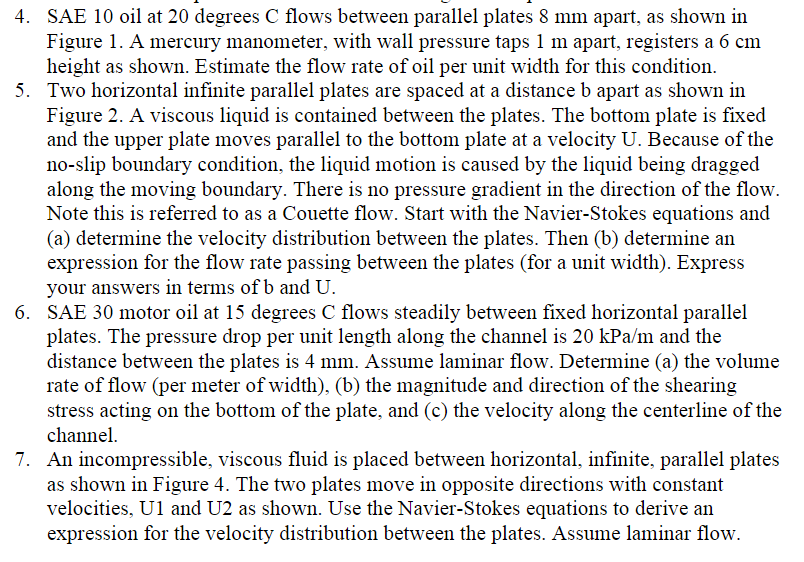
Question: solve, show all steps and solution. navier stokes equation problems... figures for problems 4,5, and 7. solve all 4 n SAE 10 oil at 20

solve, show all steps and solution. navier stokes equation problems... figures for problems 4,5, and 7. solve all 4
solve, show all steps and solution. navier stokessolve, show all steps and solution. navier stokessolve, show all steps and solution. navier stokes
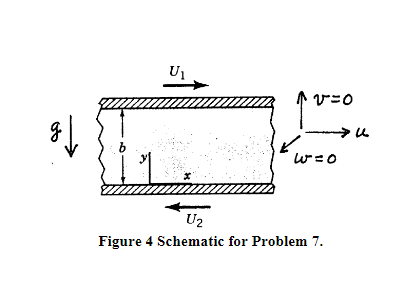
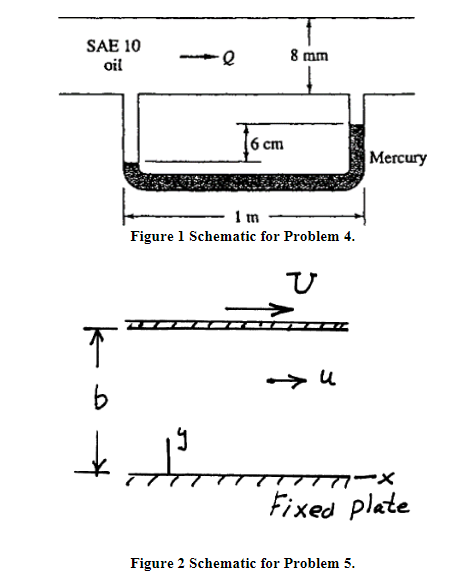
n SAE 10 oil at 20 degrees C flows between parallel plates 8 mm apart, as shown in Figure 1. A mercury manometer, with wall pressure taps 1 m apart, registers a 6 cm height as shown. Estimate the flow rate of oil per unit width for this condition. Two horizontal infinite parallel plates are spaced at a distance b apart as shown in Figure 2. A viscous liquid is contained between the plates. The bottom plate is fixed and the upper plate moves parallel to the bottom plate at a velocity U. Because of the no-slip boundary condition. the liquid motion is caused by the liquid being dragged along the moving boundary. There is no pressure gradient in the direction of the flow. Note this is referred to as a Couette flow. Start with the Navier-Stokes equations and (a) determine the velocity distribution between the plates. Then (b) determine an expression for the flow rate passing between the plates (for a unit width). Express your answers in terms of b and U. SAE 30 motor oil at 15 degrees C flows steadily between fixed horizontal parallel plates. The pressure drop per unit length along the channel is 20 kPa/m and the distance between the plates is 4 mm. Assume laminar flow. Determine (a) the volume rate of flow (per meter of width), (b) the magnitude and direction of the shearing stress acting on the bottom of the plate. and (c) the velocity along the centerline of the channel. An incompressible, viscous fluid is placed between horizontal, infinite, parallel plates as shown in Figure 4. The two plates move in opposite directions with constant velocities, Ul and U2 as shown. Use the Navier-Stokes equations to derive an expression for the velocity distribution between the plates. Assume laminar flow. SAE 10 8 mm oil - Q 6 cm Mercury 1 m Figure 1 Schematic for Problem 4. U -> u b 4 771-X Fixed plate Figure 2 Schematic for Problem 5.\f

Step by Step Solution

There are 3 Steps involved in it

1 Expert Approved Answer
Step: 1 Unlock blur-text-image

Question Has Been Solved by an Expert!

Get step-by-step solutions from verified subject matter experts

Step: 2 Unlock
Step: 3 Unlock

Students Have Also Explored These Related Law Questions!