





Question: solve Step 1: Make sure Amounts are in Moles How to Approach a Limiting Reactant Problem: Step 1- Make sure Amounts are in lobes Recognize

solve
solve Step 1: Make sure Amounts are in Moles How
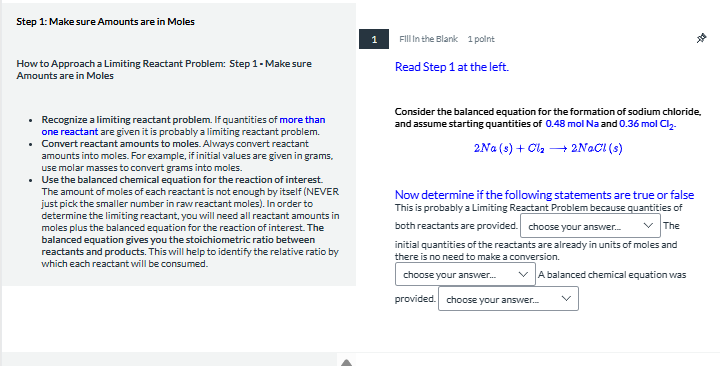
Step 1: Make sure Amounts are in Moles How to Approach a Limiting Reactant Problem: Step 1- Make sure Amounts are in lobes Recognize a limiting reactant problem. If quantities of more than one reactant are given itis probably a limiting reactant problem. Convert reactant amounts to moles. Always convert reactant amounts into moles. For example, if initial values are given in grams, use molar masses to convert grams into moles. Use the balanced chemical equation for the reaction of interest. The amount of moles of each reactant is not enough by itself (NEVER just pick the smaller number in raw reactant moles). Inorder to determine the limiting reactant, you will need all reactant amounts in moles plus the balanced equation for the reaction of interest. The balanced equation gives you the stoichiometric ratio between reactants and products. This will help to identify the relative ratio by which each reactant will be consumed. Fillinthe Blank = 1 point Read Step 1 at the left. Consider the balanced equation for the formation of sodium chloride. and assume starting quantities of 0.48 mol Na and 0.36 mol Cl). 2Na(s)+ Cl, + 2NeCl(s) Now determine if the following statements are true or false This is probably a Limiting Reactant Problem because quantities of both reactants are provided. \"cocseyeursnner [Th initial quantities of the reactants are already in units of moles and there is no need to make a conversion. choose your answer. \"eA balanced chemical equation was choose your answer._ ae provided

Step by Step Solution

There are 3 Steps involved in it

1 Expert Approved Answer
Step: 1 Unlock blur-text-image

Question Has Been Solved by an Expert!

Get step-by-step solutions from verified subject matter experts

Step: 2 Unlock
Step: 3 Unlock

Students Have Also Explored These Related Accounting Questions!