Question: solve Step 2: Finding the Limiting Reactant 2 Multiple Choice 1 point How to Approach a Limiting Reactant Problem: Step 2: Finding the Limiting Reactant
solve
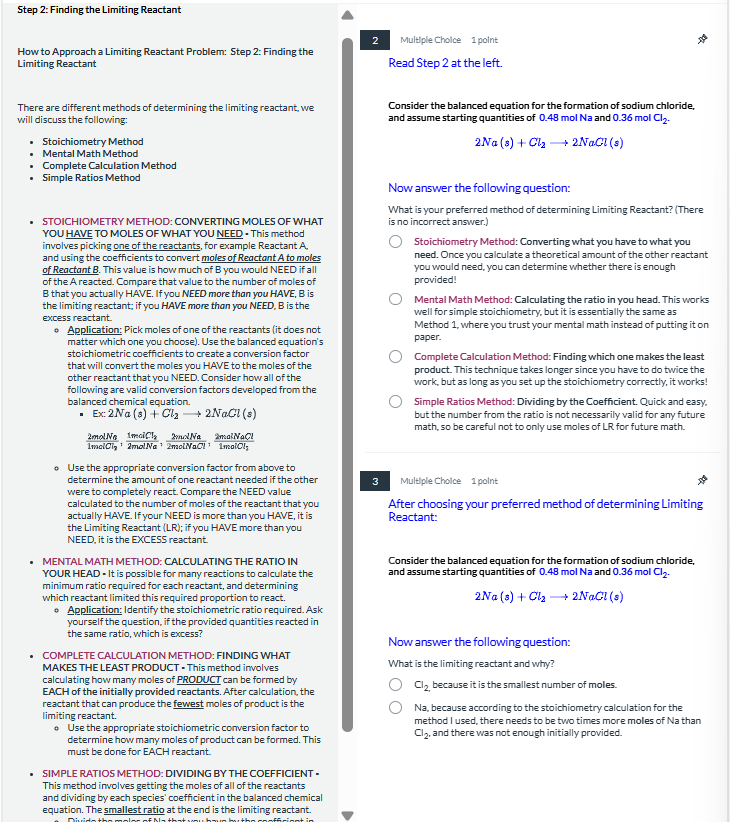
Step 2: Finding the Limiting Reactant 2 Multiple Choice 1 point How to Approach a Limiting Reactant Problem: Step 2: Finding the Limiting Reactant Read Step 2 at the left. There are different methods of determining the limiting reactant, we Consider the balanced equation for the formation of sodium chloride. will discuss the following: and assume starting quantities of 0.48 mol Na and 0.36 mol Clz- Stoichiometry Method 2Na (s) + Cha -+ 2NaCl(s) Mental Math Method Complete Calculation Method Simple Ratios Method Now answer the following question: What is your preferred method of determining Limiting Reactant? (There . STOICHIOMETRY METHOD: CONVERTING MOLES OF WHAT is no incorrect answer.) YOU HAVE TO MOLES OF WHAT YOU NEED - This method involves picking one of the reactants, for example Reactant A Stoichiometry Method: Converting what you have to what you and using the coefficients to convert moles of Reactant A to moles need. Once you calculate a theoretical amount of the other reactant of Reactant B. This value is how much of B you would NEED if all you would need, you can determine whether there is enough of the A reacted. Compare that value to the number of moles of provided! 3 that you actually HAVE. If you NEED more than you HAVE, B is the limiting reactant; if you HAVE more than you NEED, B is the O Mental Math Method: Calculating the ratio in you head. This works excess reactant. well for simple stoichiometry, but it is essentially the same as Application: Pick moles of one of the reactants (it does not Method 1, where you trust your mental math instead of putting it on matter which one you choose). Use the balanced equation's paper. stoichiometric coefficients to create a conversion factor Complete Calculation Method: Finding which one makes the least that will convert the moles you HAVE to the moles of the other reactant that you NEED. Consider how all of the product. This technique takes longer since you have to do twice the following are valid conversion factors developed from the work, but as long as you set up the stoichiometry correctly, it works! balanced chemical equation. O Simple Ratios Method: Dividing by the Coefficient. Quick and easy. . Ex: 2Na (s) + Cly -+2NaGl(s) but the number from the ratio is not necessarily valid for any future math, so be careful not to only use moles of LR for future math. 2molNe ImoiCle 1modDi, ' 1molNa * 2molNoOl' 1molCl; Use the appropriate conversion factor from above to determine the amount of one reactant needed if the other 3 Multiple Choice 1 point were to completely react. Compare the NEED value calculated to the number of moles of the reactant that you After choosing your preferred method of determining Limiting actually HAVE. If your NEED is more than you HAVE, it is Reactant: the Limiting Reactant (LR); if you HAVE more than you NEED, it is the EXCESS reactant MENTAL MATH METHOD: CALCULATING THE RATIO IN Consider the balanced equation for the formation of sodium chloride. YOUR HEAD - It is possible for many reactions to calculate the and assume starting quantities of 0.48 mol Na and 0.36 mol Clz- minimum ratio required for each reactant, and determining which reactant limited this required proportion to react. 2Na (s) + Cl -+2NaCl(s) Application: Identify the stoichiometric ratio required. Ask yourself the question, if the provided quantities reacted in the same ratio, which is excess? Now answer the following question: COMPLETE CALCULATION METHOD: FINDING WHAT MAKES THE LEAST PRODUCT - This method involves What is the limiting reactant and why? calculating how many moles of PRODUCT can be formed by EACH of the initially provided reactants. After calculation, the O Ciz, because it is the smallest number of moles. reactant that can produce the fewest moles of product is the Na, because according to the stoichiometry calculation for the limiting reactant. Use the appropriate stoichiometric conversion factor to method I used, there needs to be two times more moles of Na than determine how many moles of product can be formed. This Ely, and there was not enough initially provided. must be done for EACH reactant. . SIMPLE RATIOS METHOD: DIVIDING BY THE COEFFICIENT - This method involves getting the moles of all of the reactants and dividing by each species' coefficient in the balanced chemical equation. The smallest ratio at the end is the limiting reactant









 Study Help