







Question: Solve Supplementary Problems COMPLETE METRIC SPACES 22. Let (X, d) be a metric space and let e be the metric on X defined by e(a,
Solve
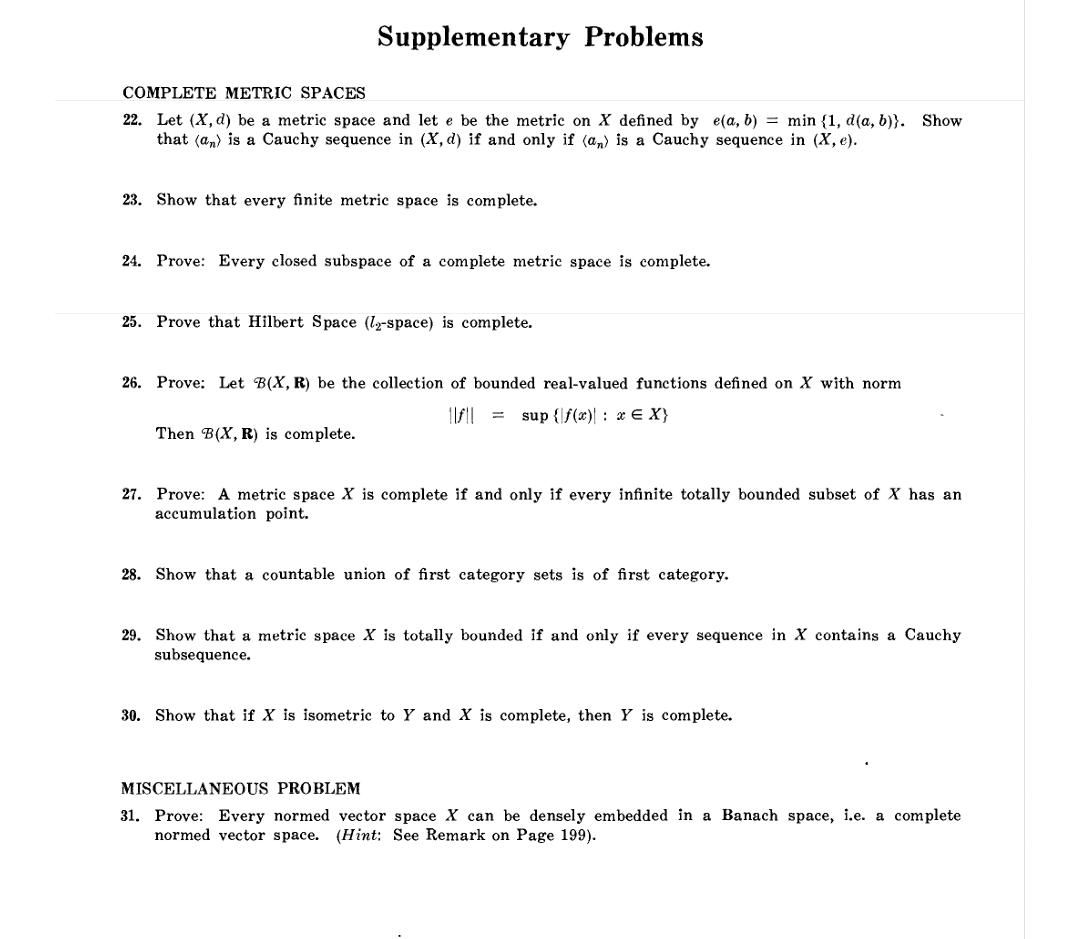
Supplementary Problems COMPLETE METRIC SPACES 22. Let (X, d) be a metric space and let e be the metric on X defined by e(a, b) = min {1, d(a, b)). Show that (a,) is a Cauchy sequence in (X, d) if and only if (a,) is a Cauchy sequence in (X, e). 23. Show that every finite metric space is complete. 24. Prove: Every closed subspace of a complete metric space is complete. 25. Prove that Hilbert Space (ly-space) is complete. 26. Prove: Let B(X, R) be the collection of bounded real-valued functions defined on X with norm 1Ifll = sup ( f(x)| : & E X} Then B(X, R) is complete. 27. Prove: A metric space X is complete if and only if every infinite totally bounded subset of X has an accumulation point. 28. Show that a countable union of first category sets is of first category. 29. Show that a metric space X is totally bounded if and only if every sequence in X contains a Cauchy subsequence. 30. Show that if X is isometric to Y and X is complete, then Y is complete. MISCELLANEOUS PROBLEM 31. Prove: Every normed vector space X can be densely embedded in a Banach space, i.e. a complete normed vector space. (Hint: See Remark on Page 199)
Step by Step Solution
There are 3 Steps involved in it

Get step-by-step solutions from verified subject matter experts
 Study Help