







Question: solve the differential equation regarding the relative risk aversion equation and use the solutions to solve each part of the question. Since we are looking
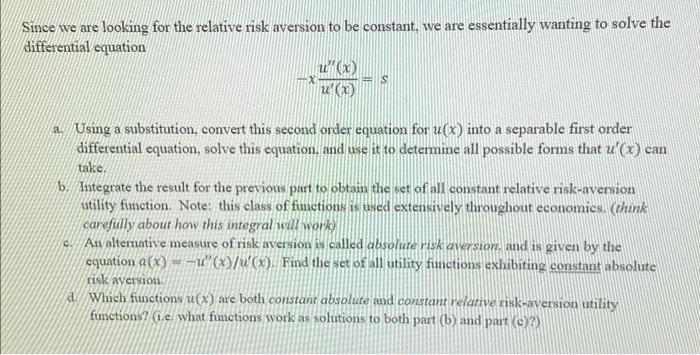
Since we are looking for the relative risk aversion to be constant, we are essentially wanting to solve the differential equation ua u'( X S a. Using a substitution, convert this second order equation for u(x) into a separable first order differential equation, solve this equation, and use it to determine all possible forms that u'(x) can take b. Integrate the result for the previous part to obtain the set of all constant relative risk-aversion atility function. Note: this class of functions is used extensively throughout economies (think carefully about how this integral will work) An alternative measure of risk aversion is called absolute risk aversion, and is given by the equation a(x) = -u"(x)/'(X). Find the set of all utility functions exhibiting constant absolute risk aversion a. Which functions u(x) are both constant absolute and constant relative risk-aversion utility functions? (ie what functions work as solutions to both part (b) and part (e)?) Since we are looking for the relative risk aversion to be constant, we are essentially wanting to solve the differential equation ua u'( X S a. Using a substitution, convert this second order equation for u(x) into a separable first order differential equation, solve this equation, and use it to determine all possible forms that u'(x) can take b. Integrate the result for the previous part to obtain the set of all constant relative risk-aversion atility function. Note: this class of functions is used extensively throughout economies (think carefully about how this integral will work) An alternative measure of risk aversion is called absolute risk aversion, and is given by the equation a(x) = -u"(x)/'(X). Find the set of all utility functions exhibiting constant absolute risk aversion a. Which functions u(x) are both constant absolute and constant relative risk-aversion utility functions? (ie what functions work as solutions to both part (b) and part (e)?)
Step by Step Solution
There are 3 Steps involved in it

Get step-by-step solutions from verified subject matter experts
 Study Help