







Question: Solve the following problems. For each problem, cite all references used and students consulted. 1. [2 pts) Write a short segment of ARM assembly code
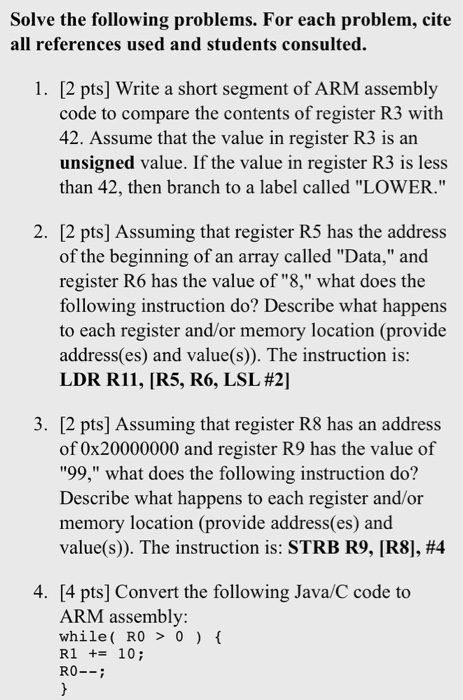
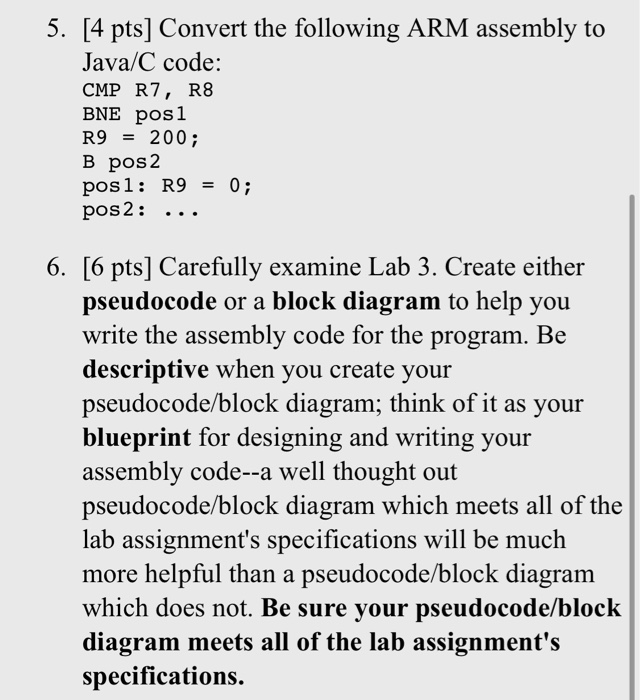
Solve the following problems. For each problem, cite all references used and students consulted. 1. [2 pts) Write a short segment of ARM assembly code to compare the contents of register R3 with 42. Assume that the value in register R3 is an unsigned value. If the value in register R3 is less than 42, then branch to a label called "LOWER." 2. [2 pts) Assuming that register R5 has the address of the beginning of an array called "Data," and register R6 has the value of "8," what does the following instruction do? Describe what happens to each register and/or memory location (provide address(es) and value(s). The instruction is: LDR R11, R5, R6, LSL #2] 3. [2 pts] Assuming that register R8 has an address of 0x20000000 and register R9 has the value of "99," what does the following instruction do? Describe what happens to each register and/or memory location (provide address(es) and value(s)). The instruction is: STRB R9, (R8), #4 4. [4 pts] Convert the following Java/C code to ARM assembly: while( RO > 0) { R1 += 10; RO-; 5. [4 pts] Convert the following ARM assembly to Java/C code: CMP R7, R8 BNE pos1 R9 = 200; B pos2 posl: R9 = 0; pos2: ... 6. [6 pts] Carefully examine Lab 3. Create either pseudocode or a block diagram to help you write the assembly code for the program. Be descriptive when you create your pseudocode/block diagram; think of it as your blueprint for designing and writing your assembly code--a well thought out pseudocode/block diagram which meets all of the lab assignment's specifications will be much more helpful than a pseudocode/block diagram which does not. Be sure your pseudocode/block diagram meets all of the lab assignment's specifications
Step by Step Solution
There are 3 Steps involved in it

Get step-by-step solutions from verified subject matter experts
 Study Help