







Question: Solve the following question: (6 points) (Please give your answer to four (4) decimal places where needed.) Let X1, ,X,I be iid with finite mean
Solve the following question:
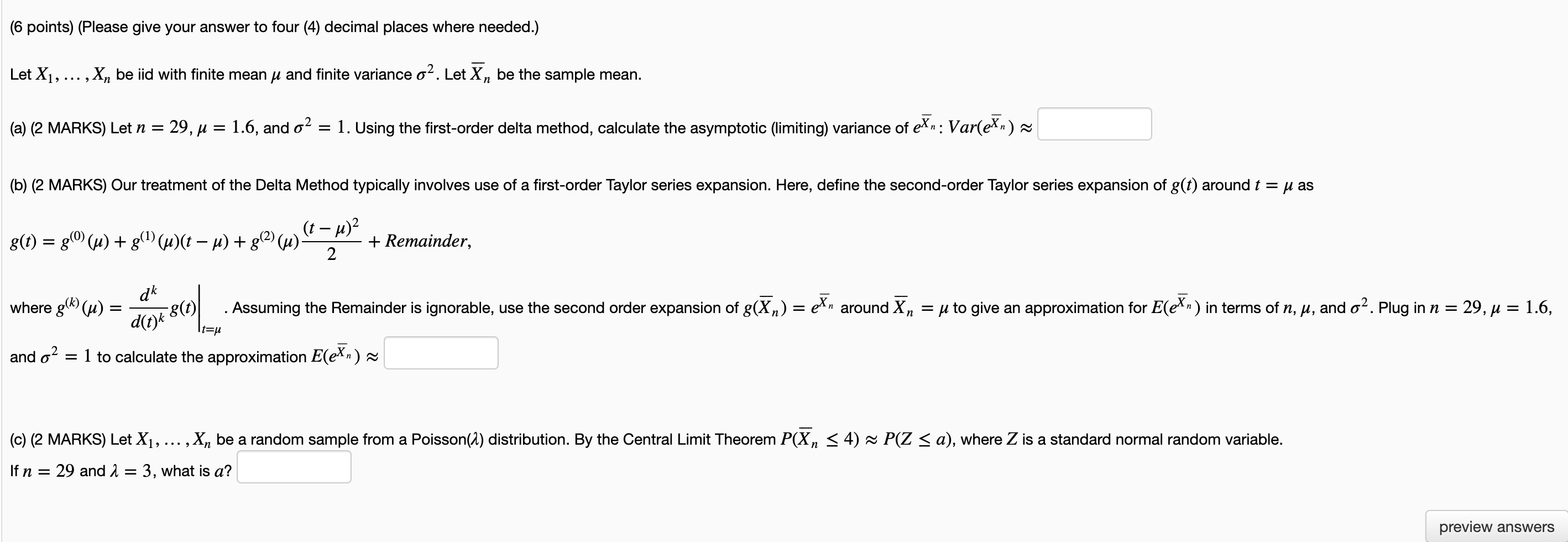
(6 points) (Please give your answer to four (4) decimal places where needed.) Let X1, ,X,I be iid with finite mean [4 and finite variance 0'2. Let in be the sample mean. (a) (2 MARKS) Let n = 29, [l = 1.6, and 0'2 = 1. Using the first-order delta method, calculate the asymptotic (limiting) variance of elf": Var(e'7~) z (b) (2 MARKS) Our treatment of the Delta Method typically involves use of a first-order Taylor series expansion. Here, define the second-order Taylor series expansion of g(t) around t = [4 as (t - 102 80) = gm) (1!) + g\") (/00 - M) + 3'\" (/4) 2 + Reminder, dk d(t)\" where g(k)([4) = g(t) . Assuming the Remainder is ignorable, use the second order expansion of g0?\" = 2"?\" around in = [4 to give an approximation for E(e'?~) in terms of n, [4, and (72. Plug in n = 29, [4 = 1.6, r=u and 02 = 1 to calculate the approximation E(er-) z (c) (2 MARKS) Let X1, . . . ,Xn be a random sample from a Poisson\") distribution. By the Central Limit Theorem PO?\" S 4) z P(Z S a), where Z is a standard normal random variable. lfn = 29 and}v = 3, what is a? preview answers
Step by Step Solution
There are 3 Steps involved in it

Get step-by-step solutions from verified subject matter experts
 Study Help