



Question: Solve the following question. A derivatives trader is modelling the volatility of an equity index using the following discrete-time model: Model 1: 6, - 0.12
Solve the following question.
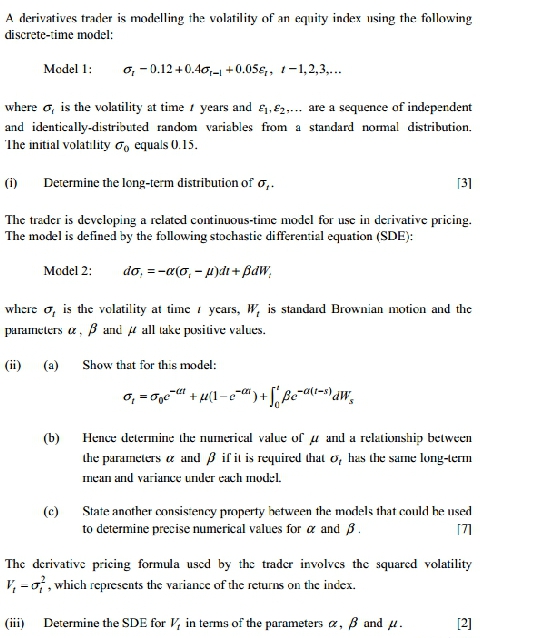
A derivatives trader is modelling the volatility of an equity index using the following discrete-time model: Model 1: 6, - 0.12 +0.40,-1 +0.056, 1-1,2,3,... where o, is the volatility at time / years and 51, 62,... are a sequence of independent and identically-distributed random variables from a standard normal distribution. The initial volatility Go equals 0.15. (i) Determine the long-term distribution of of. The trader is developing a related continuous-time model for use in derivative pricing. The model is defined by the following stochastic differential equation (SDE): Model 2: do, = -a(0, - ")di + paw where of is the volatility at time / years, #, is standard Brownian motion and the parameters a, / and / all take positive values. (ii) (a) Show that for this model: (b) Hence determine the numerical value of & and a relationship between the parameters a and / if it is required that o, has the same long-term mean and variance under each model. (C) State another consistency property between the models that could he used to determine precise numerical values for o and 3 . 171 The derivative pricing formula used by the trader involves the squared volatility I, - 7 , which represents the variance of the returns on the index. (iii) Determine the SDE for , in terms of the parameters , / and /. [2]
Step by Step Solution
There are 3 Steps involved in it

Get step-by-step solutions from verified subject matter experts