







Question: solve the given problems Let f(x) = ln(1 + x). i. Calculate the first, second, third, and fourth derivatives of f. ii. Using these derivatives,
solve the given problems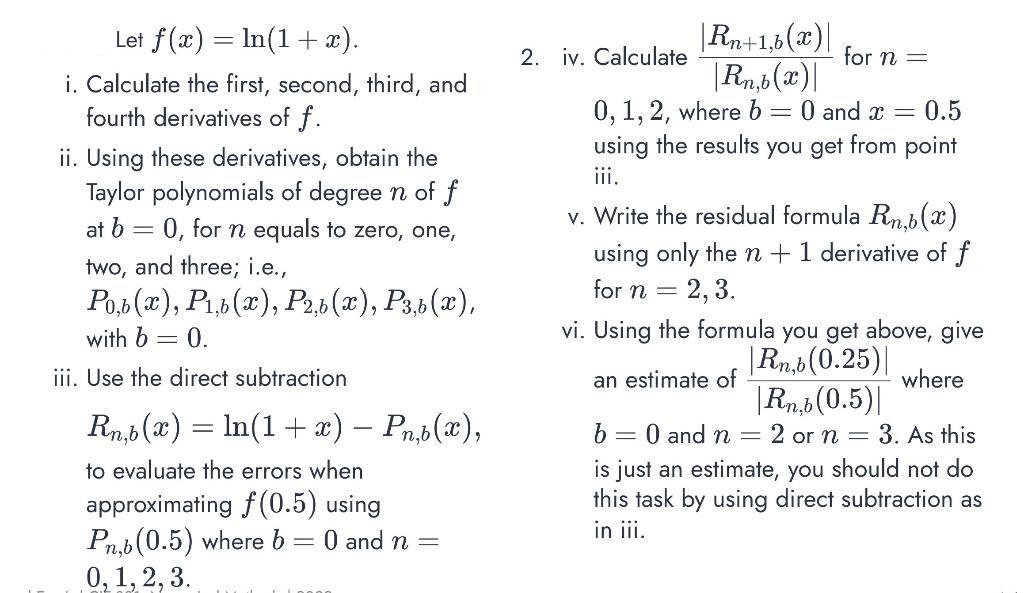
Let f(x) = ln(1 + x). i. Calculate the first, second, third, and fourth derivatives of f. ii. Using these derivatives, obtain the Taylor polynomials of degree n of f at b = 0, for n equals to zero, one, two, and three; i.e., Po,b(x), P,b(x), P2,6(x), P3,6(x), with b 0. = iii. Use the direct subtraction Rnb (x) = ln(1 + x) Pn,b(x), to evaluate the errors when approximating f(0.5) using Pn,b (0.5) where b 0, 1, 2, 3. = 0 and n = |Rn+1,b(x)| Rn,b(x)| for n = - = 0, 1, 2, where b 0 and x 0.5 using the results you get from point iii. 2. iv. Calculate v. Write the residual formula Rn,b(x) using only the n + 1 derivative of f for n 2, 3. - vi. Using the formula you get above, give an estimate of |Rn,b(0.25)| Rnb (0.5)| where 0 and n is just an estimate, you should not do this task by using direct subtraction as in iii. = 2 or n = 3. As this
Step by Step Solution
3.45 Rating (145 Votes )
There are 3 Steps involved in it
i To calculate the derivatives of fx ln1x we will use the chain rule and the derivative of the natural logarithm function First derivative fx ddx ln1x ... View full answer

Get step-by-step solutions from verified subject matter experts
 Study Help