







Question: Solve the problem below: Problem 2. Prove or disprove this statement: A system with more un- knowns than equations has at least one solution.
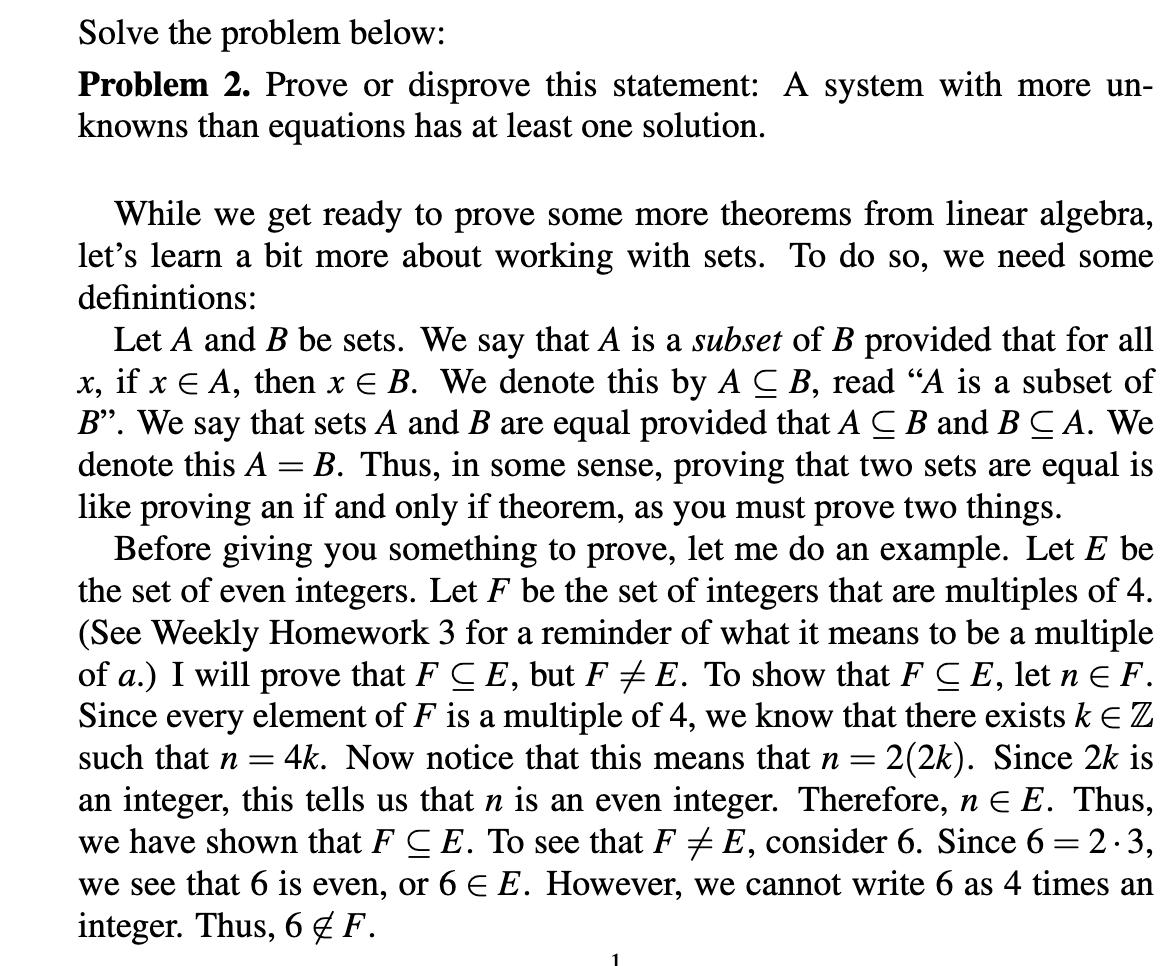
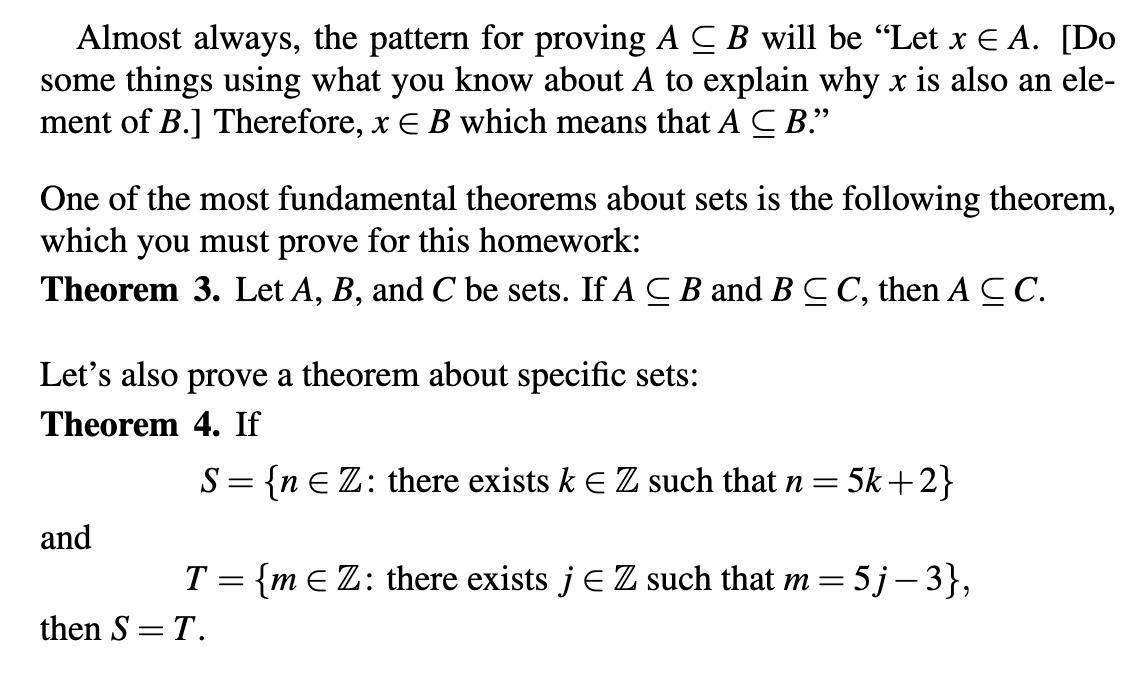
Solve the problem below: Problem 2. Prove or disprove this statement: A system with more un- knowns than equations has at least one solution. While we get ready to prove some more theorems from linear algebra, let's learn a bit more about working with sets. To do so, we need some definintions: Let A and B be sets. We say that A is a subset of B provided that for all x, if x A, then x B. We denote this by ACB, read A is a subset of B". We say that sets A and B are equal provided that A C B and BCA. We denote this A B. Thus, in some sense, proving that two sets are equal is like proving an if and only if theorem, as you must prove two things. Before giving you something to prove, let me do an example. Let E be the set of even integers. Let F be the set of integers that are multiples of 4. (See Weekly Homework 3 for a reminder of what it means to be a multiple of a.) I will prove that F C E, but F E. To show that F C E, let n F. Since every element of F is a multiple of 4, we know that there exists k = Z such that n = 4k. Now notice that this means that n = 2(2k). Since 2k is an integer, this tells us that n is an even integer. Therefore, n E. Thus, we have shown that FCE. To see that F# E, consider 6. Since 6 = 2.3, we see that 6 is even, or 6 E. However, we cannot write 6 as 4 times an integer. Thus, 6 & F. - Almost always, the pattern for proving ACB will be "Let x EA. [Do some things using what you know about A to explain why x is also an ele- ment of B.] Therefore, x E B which means that A C B." One of the most fundamental theorems about sets is the following theorem, which you must prove for this homework: Theorem 3. Let A, B, and C be sets. If ACB and BCC, then A C C. Let's also prove a theorem about specific sets: Theorem 4. If and S = {ne Z: there exists k Z such that n = 5k+2} T = {m Z: there exists j Z such that m = 5j-3}, then S = T.
Step by Step Solution
3.43 Rating (150 Votes )
There are 3 Steps involved in it
Problem 2 linear equations each zero For example of of n variables with in equ... View full answer

Get step-by-step solutions from verified subject matter experts
 Study Help