Question: solve the problem This question: 2 point(s) possible Submit quiz (Related to Checkpoint 5.2) (Future value) Leslie Mosallam, who recently sold her Porsche, placed $8,200
solve the problem
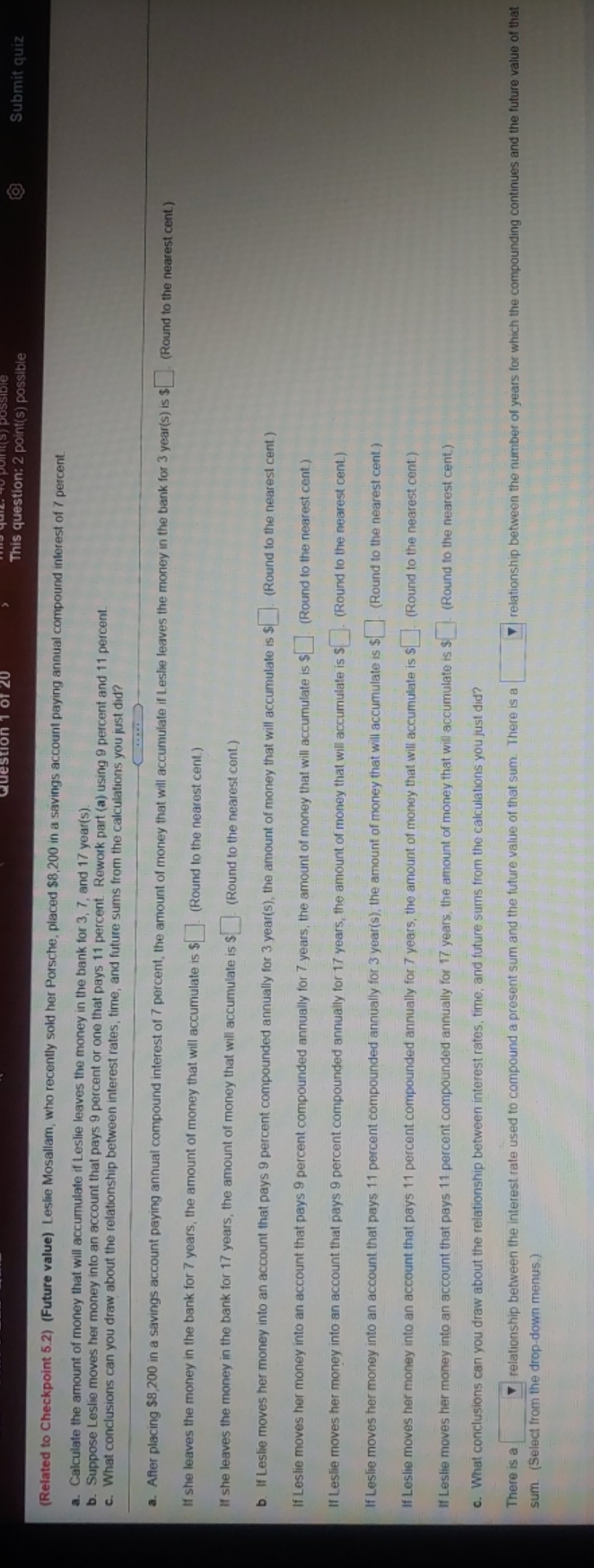
This question: 2 point(s) possible Submit quiz (Related to Checkpoint 5.2) (Future value) Leslie Mosallam, who recently sold her Porsche, placed $8,200 in a savings account paying annual compound interest of 7 percent. a. Calculate the amount of money that will accumulate if Leslie leaves the money in the bank for 3, 7, and 17 year(s). b. Suppose Leslie moves her money into an account that pays 9 percent or one that pays 11 percent. Rework part (a) using 9 percent and 11 percent. c. What conclusions can you draw about the relationship between interest rates, time, and future sums from the calculations you just did? a. After placing $8,200 in a savings account paying annual compound interest of 7 percent, the amount of money that will accumulate if Leslie leaves the money in the bank for 3 year(s) is $ (Round to the nearest cent.) If she leaves the money in the bank for 7 years, the amount of money that will accumulate is $ (Round to the nearest cent.) If she leaves the money in the bank for 17 years, the amount of money that will accumulate is $| (Round to the nearest cent ) b. If Leslie moves her money into an account that pays 9 percent compounded annually for 3 year(s), the amount of money that will accumulate is $ . (Round to the nearest cent ) If Leslie moves her money into an account that pays 9 percent compounded annually for 7 years, the amount of money that will accumulate is $ . (Round to the nearest cent.) If Leslie moves her money into an account that pays 9 percent compounded annually for 17 years, the amount of money that will accumulate is $ . (Round to the nearest cent.) If Leslie moves her money into an account that pays 11 percent compounded annually for 3 year(s), the amount of money that will accumulate is $| (Round to the nearest cent.) If Leslie moves her money into an account that pays 11 percent compounded annually for 7 years, the amount of money that will accumulate is $|. (Round to the nearest cent.) If Leslie moves her money into an account that pays 11 percent compounded annually for 17 years, the amount of money that will accumulate is $ . (Round to the nearest cent.) c. What conclusions can you draw about the relationship between interest rates, time, and future sums from the calculations you just did? relationship between the interest rate used to compound a present sum and the future value of that sum. There is a relationship between the number of years for which the compounding continues and the future value of that There is a sum. (Select from the drop-down menus.)









 Study Help