



Question: solve the question The difference between the number of customers in line at the express checkout and the number in line at the superexpress checkout
solve the question
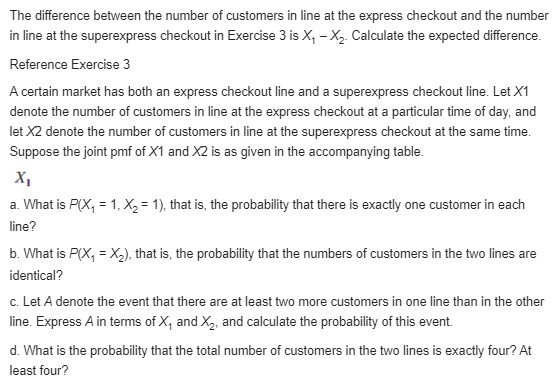
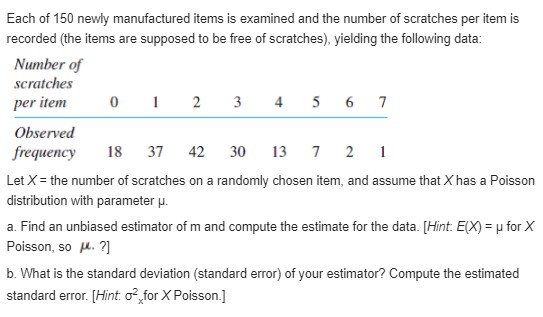
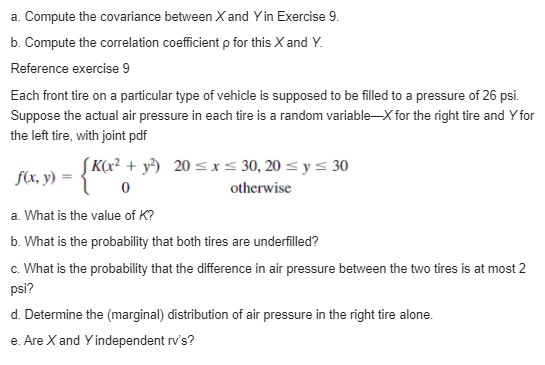
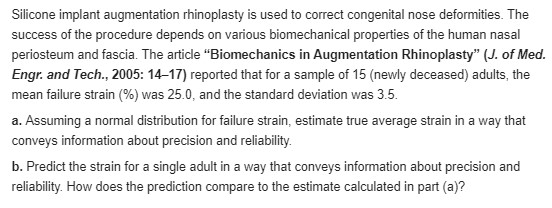
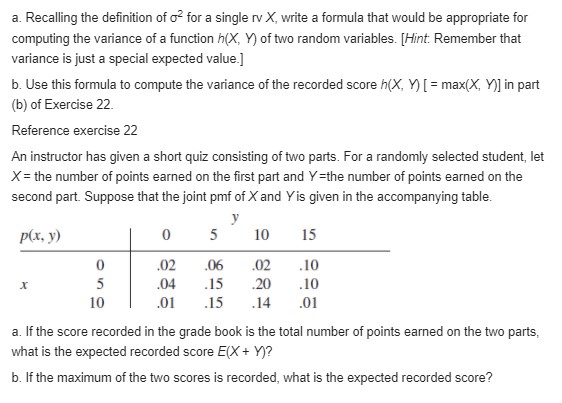
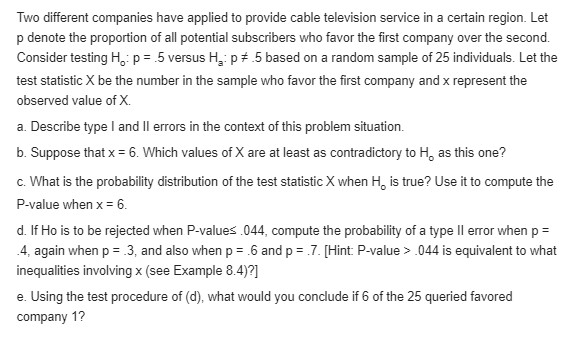
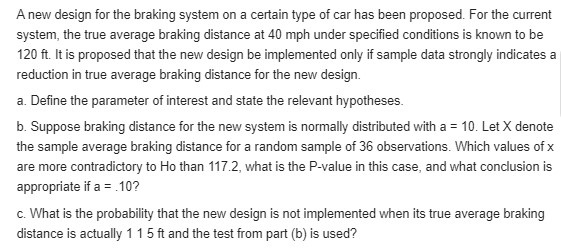
The difference between the number of customers in line at the express checkout and the number in line at the superexpress checkout in Exercise 3 is X, - X2 Calculate the expected difference. Reference Exercise 3 A certain market has both an express checkout line and a superexpress checkout line. Let X1 denote the number of customers in line at the express checkout at a particular time of day, and let X2 denote the number of customers in line at the superexpress checkout at the same time. Suppose the joint pmf of X1 and X2 is as given in the accompanying table. X a. What is P(X, = 1, X, = 1), that is, the probability that there is exactly one customer in each line? b. What is P(X, = X,), that is, the probability that the numbers of customers in the two lines are identical? c. Let A denote the event that there are at least two more customers in one line than in the other line. Express A in terms of X, and X2, and calculate the probability of this event. d. What is the probability that the total number of customers in the two lines is exactly four? At least four?Each of 150 newly manufactured items is examined and the number of scratches per item is recorded (the items are supposed to be free of scratches), yielding the following data: Number of scratches per item 2 3 4 5 6 7 Observed frequency 18 37 42 30 13 7 2 1 Let X = the number of scratches on a randomly chosen item, and assume that X has a Poisson distribution with parameter J. a. Find an unbiased estimator of m and compute the estimate for the data. [Hint. E(X) = p for X Poisson, so M. ?] b. What is the standard deviation (standard error) of your estimator? Compute the estimated standard error. [Hint: of for X Poisson.]a. Compute the covariance between X and Yin Exercise 9. b. Compute the correlation coefficient p for this X and Y. Reference exercise 9 Each front tire on a particular type of vehicle is supposed to be filled to a pressure of 26 psi. Suppose the actual air pressure in each tire is a random variable-X for the right tire and Y for the left tire, with joint pdf f(x, y) [K(x2 + y-) 20 s x = 30, 20 = y = 30 0 otherwise a. What is the value of K? b. What is the probability that both tires are underfilled? c. What is the probability that the difference in air pressure between the two tires is at most 2 psi? d. Determine the (marginal) distribution of air pressure in the right tire alone. e. Are X and Y independent rv's?Silicone implant augmentation rhinoplasty is used to correct congenital nose deformities. The success of the procedure depends on various biomechanical properties of the human nasal periosteum and fascia. The article "Biomechanics in Augmentation Rhinoplasty" (J. of Med. Engr. and Tech., 2005: 14-17) reported that for a sample of 15 (newly deceased) adults, the mean failure strain (%) was 25.0, and the standard deviation was 3.5. a. Assuming a normal distribution for failure strain, estimate true average strain in a way that conveys information about precision and reliability. b. Predict the strain for a single adult in a way that conveys information about precision and reliability. How does the prediction compare to the estimate calculated in part (a)?a. Recalling the definition of of for a single rv X, write a formula that would be appropriate for computing the variance of a function h(X, Y) of two random variables. [Hint. Remember that variance is just a special expected value.] b. Use this formula to compute the variance of the recorded score h(X, Y) [ = max(X, Y)] in part (b) of Exercise 22. Reference exercise 22 An instructor has given a short quiz consisting of two parts. For a randomly selected student, let X = the number of points earned on the first part and Y=the number of points earned on the second part. Suppose that the joint pmf of X and Y is given in the accompanying table. y p(x. y) 5 10 15 02 .06 .02 .10 X 5 .04 .15 .20 10 .01 .15 .14 .01 a. If the score recorded in the grade book is the total number of points earned on the two parts, what is the expected recorded score E(X + Y)? b. If the maximum of the two scores is recorded, what is the expected recorded score?Two different companies have applied to provide cable television service in a certain region. Let p denote the proportion of all potential subscribers who favor the first company over the second. Consider testing H.: p = .5 versus H,: p # .5 based on a random sample of 25 individuals. Let the test statistic X be the number in the sample who favor the first company and x represent the observed value of X. a. Describe type I and II errors in the context of this problem situation. b. Suppose that x = 6. Which values of X are at least as contradictory to H. as this one? c. What is the probability distribution of the test statistic X when H, is true? Use it to compute the P-value when x = 6. d. If Ho is to be rejected when P-values .044, compute the probability of a type II error when p = 4, again when p = .3, and also when p = .6 and p = .7. [Hint: P-value > .044 is equivalent to what inequalities involving x (see Example 8.4)?] e. Using the test procedure of (d), what would you conclude if 6 of the 25 queried favored company 1?A new design for the braking system on a certain type of car has been proposed. For the current system, the true average braking distance at 40 mph under specified conditions is known to be 120 ft. It is proposed that the new design be implemented only if sample data strongly indicates a reduction in true average braking distance for the new design. a. Define the parameter of interest and state the relevant hypotheses. b. Suppose braking distance for the new system is normally distributed with a = 10. Let X denote the sample average braking distance for a random sample of 36 observations. Which values of x are more contradictory to Ho than 117.2, what is the P-value in this case, and what conclusion is appropriate if a = .10? c. What is the probability that the new design is not implemented when its true average braking distance is actually 1 1 5 ft and the test from part (b) is used
Step by Step Solution
There are 3 Steps involved in it

Get step-by-step solutions from verified subject matter experts