Question: Solve the questions through the attached text. Note: The solution is by computer or phone, without handwriting. 1 2 3 questions RENAULT SPEEDS UP DELIVERY
Solve the questions through the attached text. Note: The solution is by computer or phone, without handwriting.
1
2
3
questions
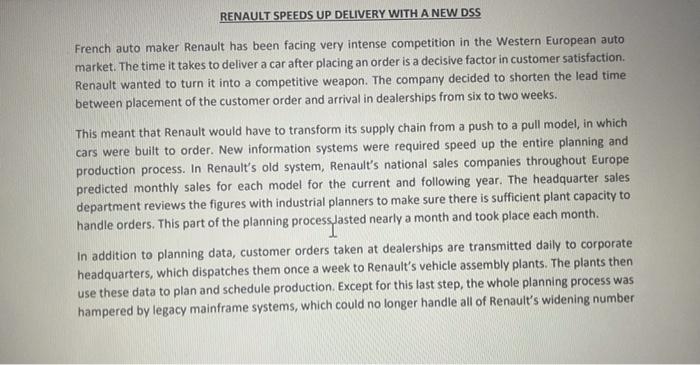
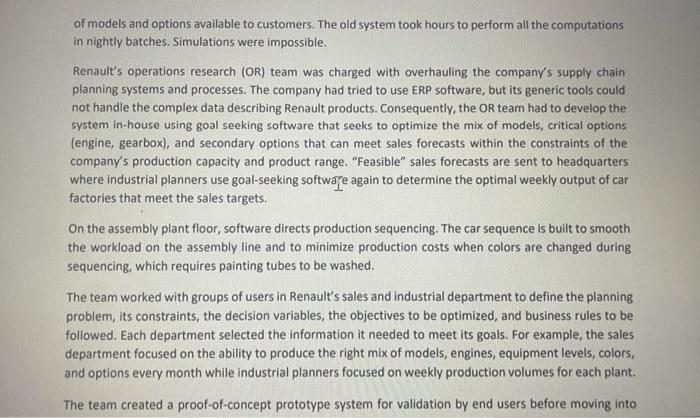
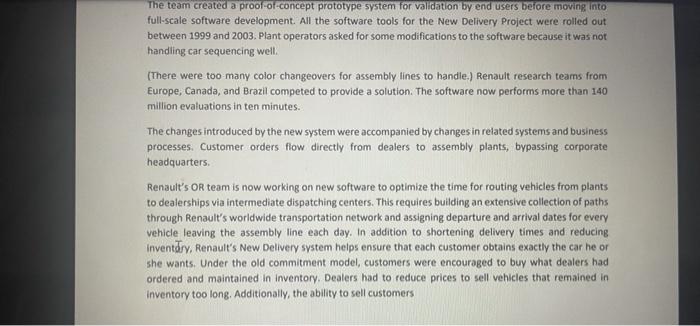
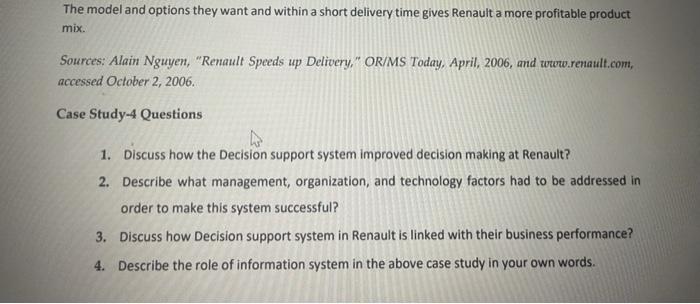
RENAULT SPEEDS UP DELIVERY WITH A NEW DSS French auto maker Renault has been facing very intense competition in the Western European auto market. The time it takes to deliver a car after placing an order is a decisive factor in customer satisfaction. Renault wanted to turn it into a competitive weapon. The company decided to shorten the lead time between placement of the customer order and arrival in dealerships from six to two weeks. This meant that Renault would have to transform its supply chain from a push to a pull model, in which cars were built to order. New information systems were required speed up the entire planning and production process. In Renault's old system, Renault's national sales companies throughout Europe predicted monthly sales for each model for the current and following year. The headquarter sales department reviews the figures with industrial planners to make sure there is sufficient plant capacity to handle orders. This part of the planning process lasted nearly a month and took place each month. In addition to planning data, customer orders taken at dealerships are transmitted daily to corporate headquarters, which dispatches them once a week to Renault's vehicle assembly plants. The plants then use these data to plan and schedule production. Except for this last step, the whole planning process was hampered by legacy mainframe systems, which could no longer handle all of Renault's widening number of models and options available to customers. The old system took hours to perform all the computations in nightly batches. Simulations were impossible. Renault's operations research (OR) team was charged with overhauling the company's supply chain planning systems and processes. The company had tried to use ERP software, but its generic tools could not handle the complex data describing Renault products. Consequently, the OR team had to develop the system in-house using goal seeking software that seeks to optimize the mix of models, critical options (engine, gearbox), and secondary options that can meet sales forecasts within the constraints of the company's production capacity and product range. "Feasible" sales forecasts are sent to headquarters where industrial planners use goal-seeking software again to determine the optimal weekly output of car factories that meet the sales targets. On the assembly plant floor, software directs production sequencing. The car sequence is built to smooth the workload on the assembly line and to minimize production costs when colors are changed during sequencing, which requires painting tubes to be washed. The team worked with groups of users in Renault's sales and industrial department to define the planning problem, its constraints, the decision variables, the objectives to be optimized, and business rules to be followed. Each department selected the information it needed to meet its goals. For example, the sales department focused on the ability to produce the right mix of models, engines, equipment levels, colors, and options every month while industrial planners focused on weekly production volumes for each plant. The team created a proof-of-concept prototype system for validation by end users before moving into The team created a proof-of-concept prototype system for validation by end users before moving into full-scale software development. All the software tools for the New Delivery Project were rolled out between 1999 and 2003. Plant operators asked for some modifications to the software because it was not handling car sequencing well (There were too many color changeovers for assembly lines to handle.) Renault research teams from Europe, Canada, and Brazil competed to provide a solution. The software now performs more than 140 million evaluations in ten minutes. The changes introduced by the new system were accompanied by changes in related systems and business processes. Customer orders flow directly from dealers to assembly plants, bypassing corporate headquarters Renault's OR team is now working on new software to optimize the time for routing vehicles from plants to dealerships via intermediate dispatching centers. This requires building an extensive collection of paths through Renault's worldwide transportation network and assigning departure and arrival dates for every vehicle leaving the assembly line each day. In addition to shortening delivery times and reducing Inventory, Renault's New Delivery system helps ensure that each customer obtains exactly the car he or she wants. Under the old commitment model, customers were encouraged to buy what dealers had ordered and maintained in inventory. Dealers had to reduce prices to sell vehicles that remained in Inventory too long, Additionally, the ability to sell customers The model and options they want and within a short delivery time gives Renault a more profitable product mix. Sources: Alain Nguyen, "Renault Speeds up Delivery," OR/MS Today, April, 2006, and www.renault.com, accessed October 2, 2006. Case Study-4 Questions w 1. Discuss how the Decision support system improved decision making at Renault? 2. Describe what management, organization, and technology factors had to be addressed in order to make this system successful? 3. Discuss how Decision support system in Renault is linked with their business performance? 4. Describe the role of information system in the above case study in your own words









 Study Help