







Question: Solve the two case studies. For each, develop a memo explaining your recommendation A financier has a staff of three people whose job it is
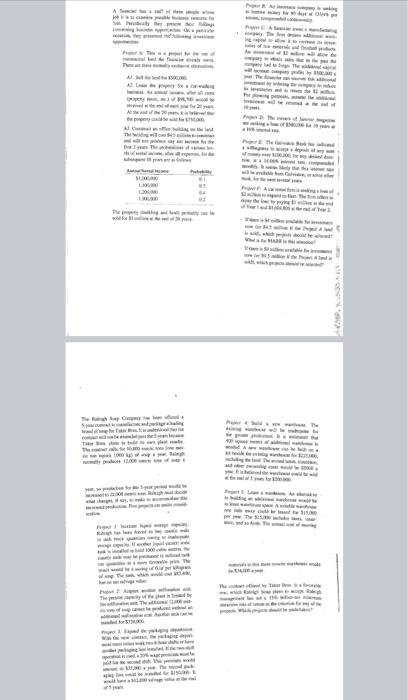
A financier has a staff of three people whose job it is to examine possible business ventures for him.
Periodically they present their findings concerning business opportunities. On a particular occasion, they
Presented the following investment opportunities:
Alternatives
Project A: This is a project for the use of commercial land the financier already owns. There are three mutually exclusive alternatives.
A1. Sell the land for $500,000
A2. Lease the property for a car-washing business. An annual income, after all costs (property taxes, etc.) of $98,700 would be received at the end of each year for 20 years. At the end of the 20 years, it is believed that the property could be sold for $750,000.
A3. Construct an office building on the land. The building will cost $4.5 million to construct and will not produce any net income for the first 2 years. The probabilities of various levels of rental income, after all expenses, for the subsequent 18 years are as follows:
Annual Rental Income Probability
$1,000,000 0.1
1,100,000 0.3
1,200,000 0.4
1,900,000 0.2
The property (building and land) probably can be sold for $3 million at the end of 20 years.
Project B: An insurance company is seeking to borrow money for 90 days at 12 34% per annum, compounded continuously.
Project C: A financier owns a manufacturing company. The firm desires additional working capital to allow it to increase its inventories of raw materials and finished products. An investment of $2 million will allow the company to obtain sales that in the past the company had to forgo. The additional capital will increase company profits by $500,000 a year. The financier can recover this additional investment by ordering the company to reduce its inventories and to return the $2 million. For planning purposes, assume the additional investment will be returned at the end of 10 years.
Project D: The owners of Sunrise magazine are seeking a loan of $500,000 for 10 years at a 16% interest rate.
Project E: The Galveston Bank has indicated a willingness to accept a deposit of any sum of money over $100,000, for any desired duration, at a 14.06% interest rate, compounded monthly. It seems likely that this interest rate will be available from Galveston, or some other bank, for the next several years.
Project F: A car rental firm is seeking a loan of $2 million to expand its fleet. The firm offers to repay the loan by paying $1 million at the end of Year 1 and $1,604,800 at the end of Year 2.
If there is $4 million available for investment now (or $4.5 million if the Project A land is sold),
Which projects should be selected?
What is the MARR in this situation?
If there is $9 million available for investment now (or $9.5 million if the Project A land is sold), Which projects should be selected?
The Raleigh Soup Company has been offered a 5-year contract to manufacture and package a leading brand of soap for Taker Bros. It is understood that the contract will not be extended past the 5 years because Taker Bros. plans to build its own plant nearby. The contract calls for 10,000 metric tons (one metric ton equals 1000 kg ) of soap a year. Raleigh normally produces 12,000 metric tons of soap a year, so production for the 5-year period would be increased to 22,000 metric tons. Raleigh must decide what changes, if any, to make to accommodate this increased production. Five projects are under consideration.
Project 1: Increased liquid storage capacity. Raleigh has been forced to buy caustic soda in tank truck quantities owing to inadequate storage capacity. If another liquid caustic soda tank is installed to hold 1000 cubic meters, the caustic soda may be purchased in railroad tank car quantities at a more favorable price. The result would be a saving of 0.1 cents per kilogram of soap. The tank, which would cost $83,400, has no net salvage value.
Project 2: Acquire another sulfonation unit. The present capacity of the plant is limited by the sulfonation unit. The additional 12,000 metric tons of soap cannot be produced without an additional sulfonation unit. Another unit can be installed for $320,000.
Project 3: Expand the packaging department. With the new contract, the packaging department must either work two 8-hour shifts or have another packaging line installed. If the two-shift operation is used, a 20% wage premium must be paid for the second shift. This premium would amount to $35,000 a year. The second packaging line could be installed for $150,000. It would have a $42,000 salvage value at the end of 5 years.
Project 4: Build a new warehouse. The existing warehouse will be adequate for the greater production. It is estimated that 400 square meters of additional warehouse is needed. A new warehouse for $225,000 including the land. The annual taxes, insurance, and other ownership costs would be $5,000 a year. It is believed the warehouse could be at the end of 5 years for $200,000
Project 5: Lease a warehouse. An alternative to building an additional warehouse would be to lease warehouse space. A suitable warehouse one mile away could be leased for $15,000 per year. The $15,000 included taxes, insurance, and so forth. The annual cost of moving materials to this more remote warehouse would be $34,000 a year.
The contract offered by Taker Bros. is a favorable one, which Raleigh Soup plans to accept. Raleigh management has set a 15% before-tax minimum attractive rate of return as the criterion for any of the projects.
Which projects should be undertaken?
Step by Step Solution
There are 3 Steps involved in it

Get step-by-step solutions from verified subject matter experts
 Study Help