







Question: Solve them correctly A Gaussian surface B Gaussian surface C +Q +Q A charge of +Q is distributed in different ways within a Gaussian surface.
Solve them correctly
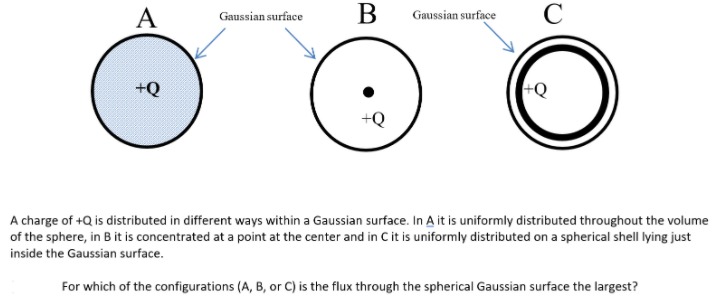
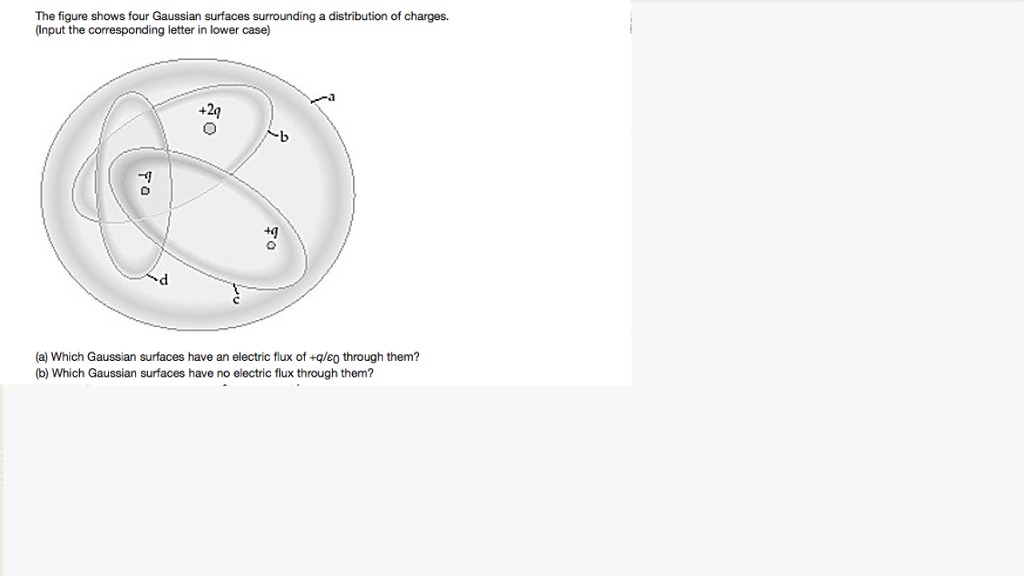
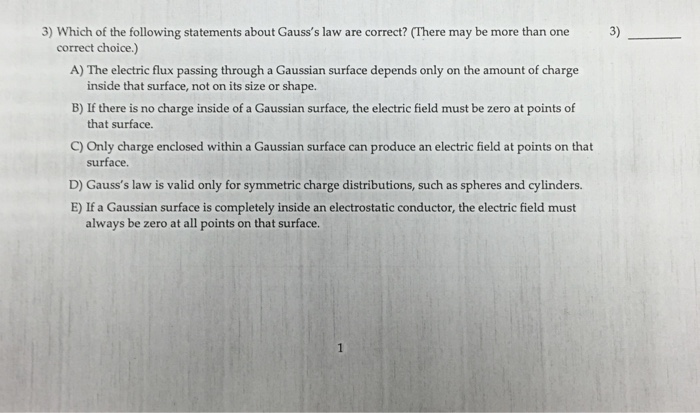
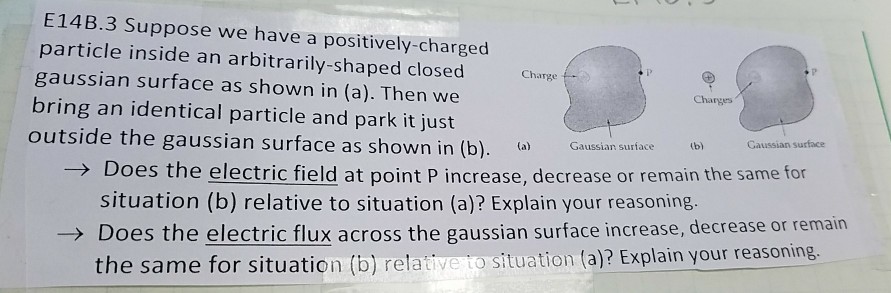
A Gaussian surface B Gaussian surface C +Q +Q A charge of +Q is distributed in different ways within a Gaussian surface. In A it is uniformly distributed throughout the volume of the sphere, in B it is concentrated at a point at the center and in C it is uniformly distributed on a spherical shell lying just inside the Gaussian surface. For which of the configurations (A, B, or C) is the flux through the spherical Gaussian surface the largest?The figure shows four Gaussian surfaces surrounding a distribution of charges. Input the corresponding letter in lower case) +29 (a) Which Gaussian surfaces have an electric flux of +q/co through them? (b) Which Gaussian surfaces have no electric flux through them?3) Which of the following statements about Gauss's law are correct? (There may be more than one 3) correct choice.) A) The electric flux passing through a Gaussian surface depends only on the amount of charge inside that surface, not on its size or shape. B) If there is no charge inside of a Gaussian surface, the electric field must be zero at points of that surface. C) Only charge enclosed within a Gaussian surface can produce an electric field at points on that surface. D) Gauss's law is valid only for symmetric charge distributions, such as spheres and cylinders. E) If a Gaussian surface is completely inside an electrostatic conductor, the electric field must always be zero at all points on that surface.E14B.3 Suppose we have a positively-charged particle inside an arbitrarily-shaped closed Charge gaussian surface as shown in (a). Then we Charges bring an identical particle and park it just outside the gaussian surface as shown in (b). (a) Gaussian surface Gaussian surface > Does the electric field at point P increase, decrease or remain the same for situation (b) relative to situation (a)? Explain your reasoning. > Does the electric flux across the gaussian surface increase, decrease or remain the same for situation (b) relative to situation (a)? Explain your reasoning
Step by Step Solution
There are 3 Steps involved in it

Get step-by-step solutions from verified subject matter experts
 Study Help