







Question: Solve these problems: 1. A rock moves only in the vertical direction. Its acceleration is constant and is downward with a magnitude of -0.00160 km/
Solve these problems:
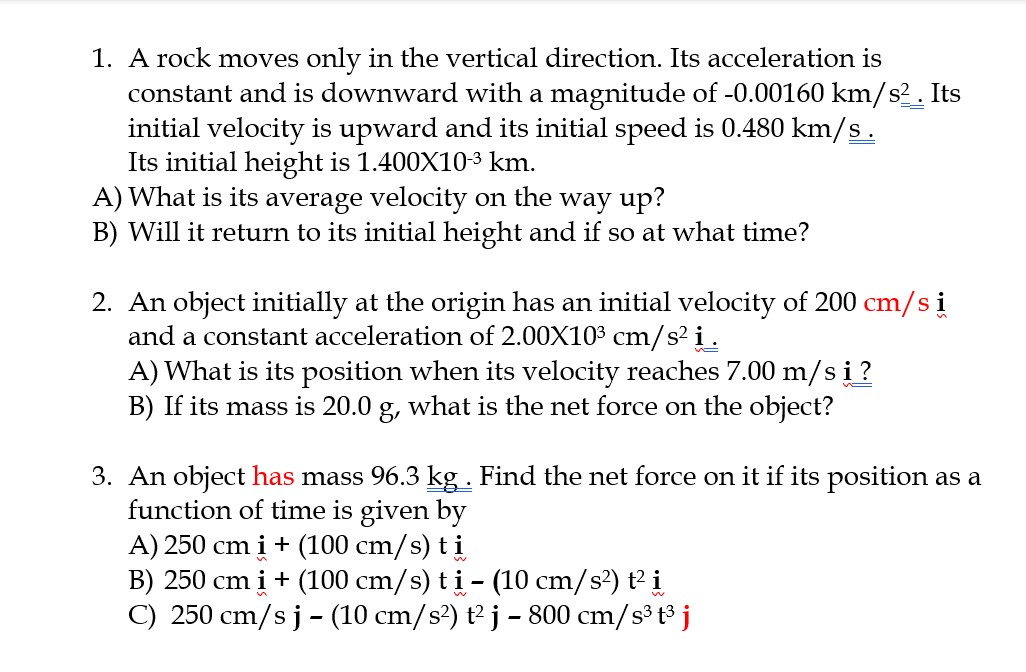
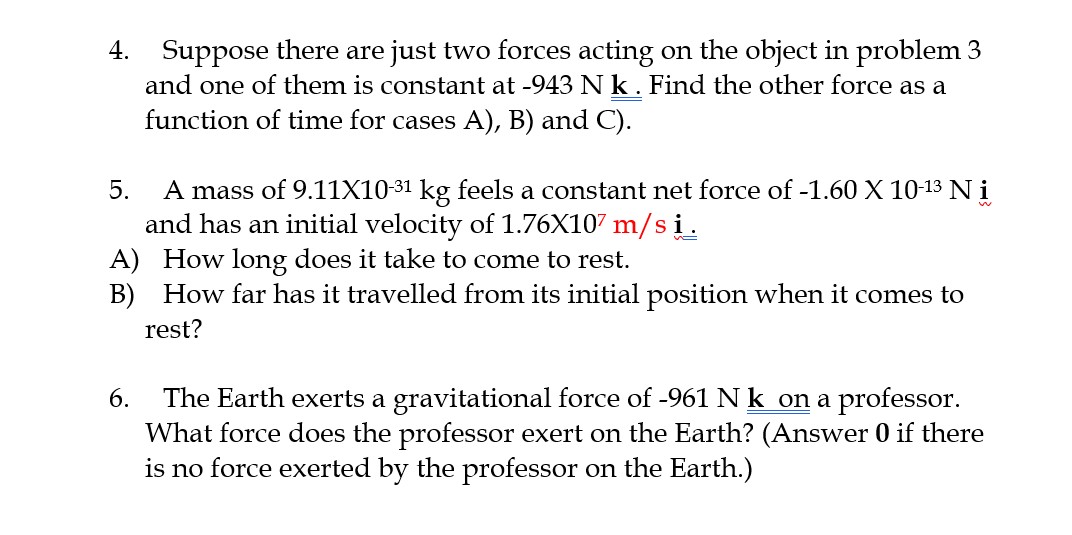
1. A rock moves only in the vertical direction. Its acceleration is constant and is downward with a magnitude of -0.00160 km/ 93:. Its initial velocity is upward and its initial speed is 0.480 km/L Its initial height is 1.400X10⁻³ km. A) What is its average velocity on the way up? B) Will it return to its initial height and if so at what time? 2. An object initially at the origin has an initial velocity of 200 cm/ s i and a constant acceleration of 2.00X103 cm/ s2 1:. A) What is its position when its velocity reaches 7.00 m / 5 i=1? B) If its mass is 20.0 g, what is the net force on the object? 3. An object has mass 96.3 5g: Find the net force on it if its position as a function of time is given by A) 250 cmi + (100 cm/s) ti B) 250 cmi + (100 cm/s) ti- (10 cm/s2) t2; C) 250 C111/S]-(10 cm/sz) th - 800 cm/s3 t3j 4. Suppose there are just two forces acting on the object in problem 3 and one of them is constant at -943 N k: Find the other force as a function of time for cases A), B) and C). 5. A mass of 9.11X10'31 kg feels a constant net force of -1.60 X 10'13 N i and has an initial velocity of 1.76X10⁷ m / s 1:. A) How long does it take to come to rest. B) How far has it travelled from its initial position when it comes to rest? 6. The Earth exerts a gravitational force of -961 N k on a professor. What force does the professor exert on the Earth? (Answer 0 if there is no force exerted by the professor on the Earth.)
Step by Step Solution
There are 3 Steps involved in it

Get step-by-step solutions from verified subject matter experts
 Study Help