







Question: Solve these problems: . A plane flies from A to B and immediately back again from B to A, a distance of 5000 km each
Solve these problems:
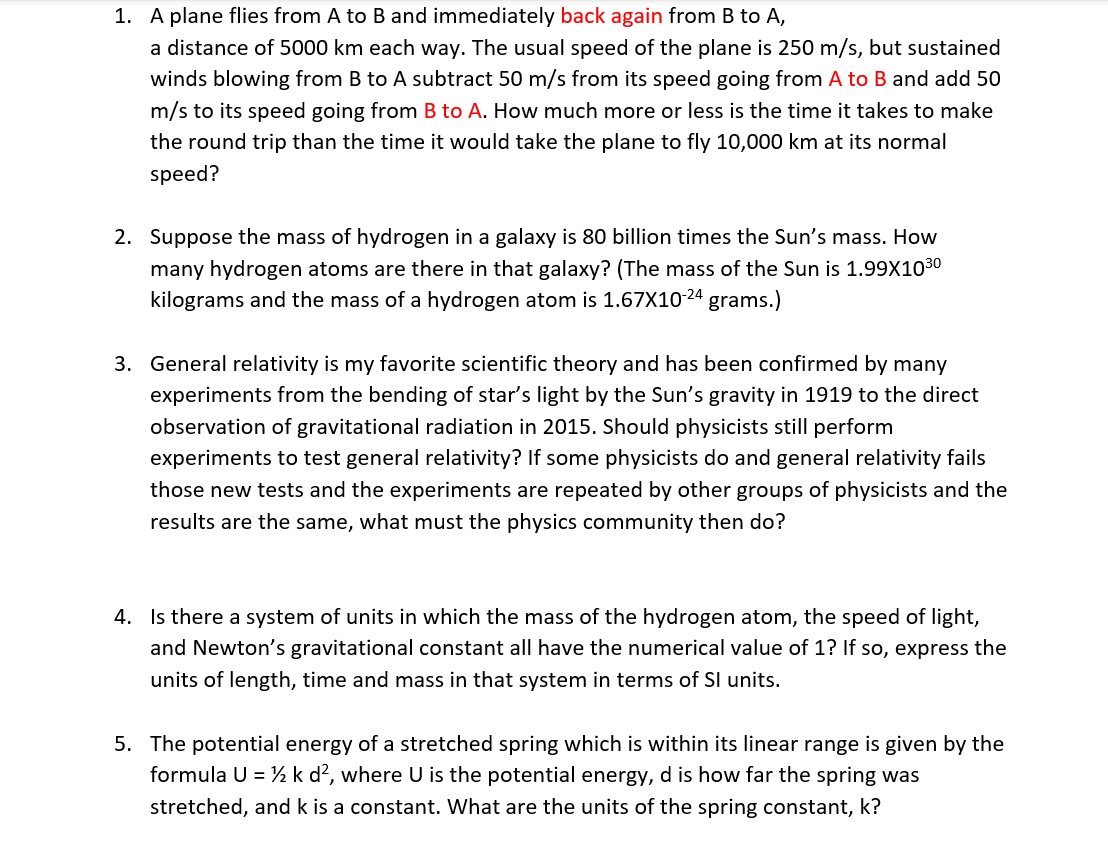
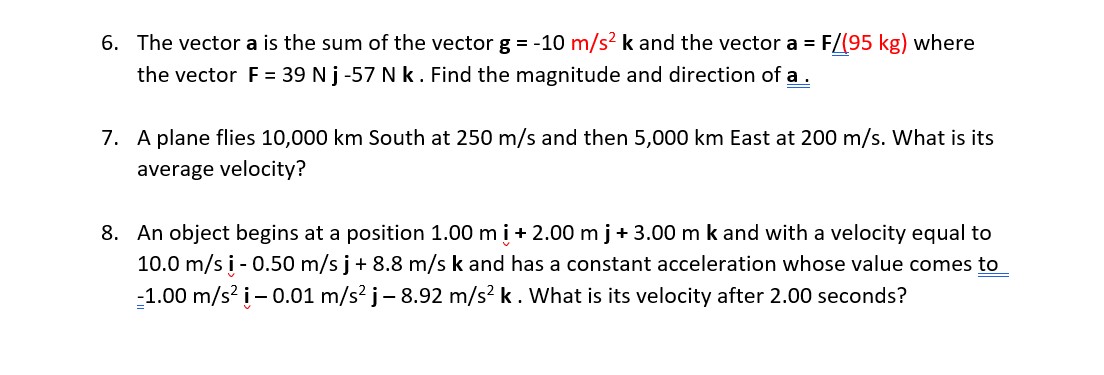
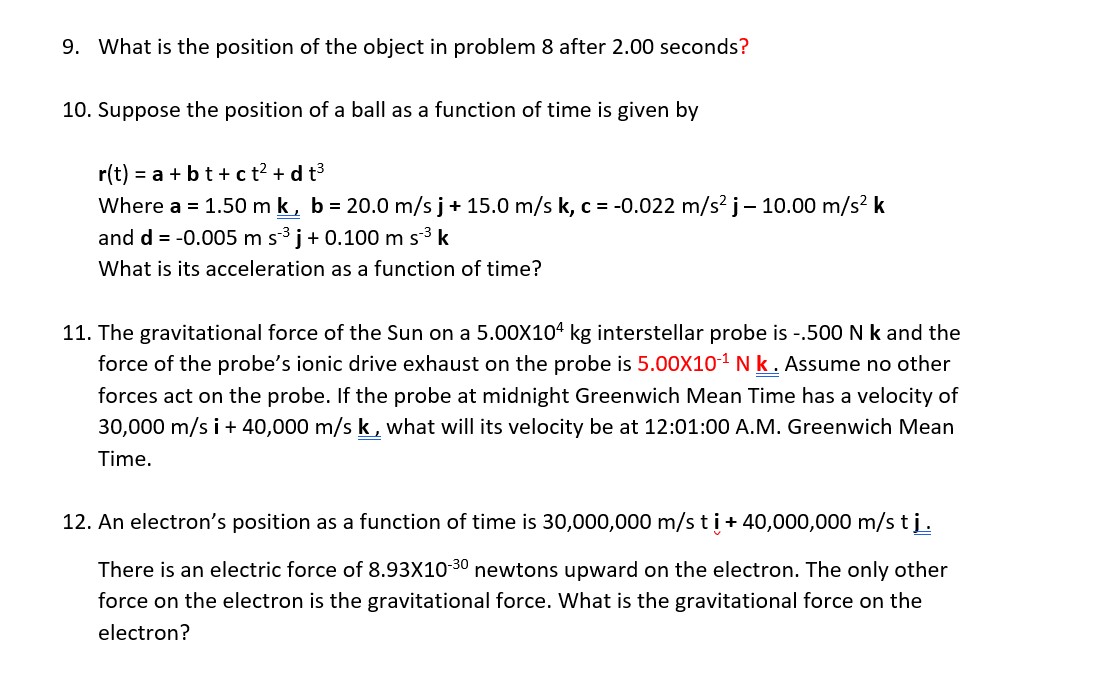
. A plane flies from A to B and immediately back again from B to A, a distance of 5000 km each way. The usual speed of the plane is 250 m/s, but sustained winds blowing from B to A subtract 50 m/s from its speed going from A to B and add 50 mfs to its speed going from B to A. How much more or less is the time it takes to make the round trip than the time it would take the plane to fly 10,000 km at its normal speed? Suppose the mass of hydrogen in a galaxy is 80 billion times the Sun's mass. How many hydrogen atoms are there in that galaxy? (The mass of the Sun is 1.99X1030 kilograms and the mass of a hydrogen atom is 1.67)(10'2\"L grams.) General relativity is my favorite scientific theory and has been confirmed by many experiments from the bending of star's light by the Sun's gravity in 1919 to the direct observation of gravitational radiation in 2015. Should physicists still perform experiments to test general relativity? If some physicists do and general relativity fails those new tests and the experiments are repeated by other groups of physicists and the results are the same, what must the physics community then do? Is there a system of units in which the mass of the hydrogen atom, the speed of light, and Newton's gravitational constant all have the numerical value of 1? If so, express the units of length, time and mass in that system in terms of SI units. . The potential energy of a stretched spring which is within its linear range is given by the formula U = 1/z k d2, where U is the potential energy, d is how far the spring was stretched, and k is a constant. What are the units of the spring constant, k? 6. The vector a is the sum of the vector g = -10 m/s2 k and the vector a = F/(95 kg) where the vector F = 39 N j -57 N k . Find the magnitude and direction of a . 7. A plane flies 10,000 km South at 250 m/s and then 5,000 km East at 200 m/s. What is its average velocity? 8. An object begins at a position 1.00 m j + 2.00 m j + 3.00 m k and with a velocity equal to 10.0 m/s i - 0.50 m/s j + 8.8 m/s k and has a constant acceleration whose value comes to -1.00 m/s2 i- 0.01 m/s2 j- 8.92 m/s2 k . What is its velocity after 2.00 seconds?10. 11. 12. What is the position ofthe object in problem 8 after 2.00 seconds? Suppose the position of a ball as a function oftime is given by r(t}=a+bt+ct2+dt3 Where a = 1.50 m k:, b = 20.0 m/s j + 15.0 m/s k, c = -0.022 mis2 j 10.00 m/s2 k and d = -0.005 m 5'3 j + 0.100 m s'3 k What is its acceleration as a function of time? The gravitational force of the Sun on a 5.00X10\"L kg interstellar probe is -.500 N k and the force of the probe's ionic drive exhaust on the probe is 5.00>(10'1 N L Assume no other forces act on the probe. If the probe at midnight Greenwich Mean Time has a velocity of 30,000 m/s i + 40,000 m/s k1, what will its velocity be at 12:01:00 A.M. Greenwich Mean Time. An electron's position as a function of time is 30,000,000 m/s t i + 40,000,000 m/s tj:. There is an electric force of 8.93X10'3D newtons upward on the electron. The onlyr other force on the electron is the gravitational force. What is the gravitational force on the electron
Step by Step Solution
There are 3 Steps involved in it

Get step-by-step solutions from verified subject matter experts
 Study Help