





Question: solve this 10795 . Onsome Ch 18.1 & 18.2: Reaction Rates and Equilibrium Directions: You will be reading the textbook, taking notes, and doing a

solve this
solve this 10795 . Onsome Ch 18.1 & 18.2:
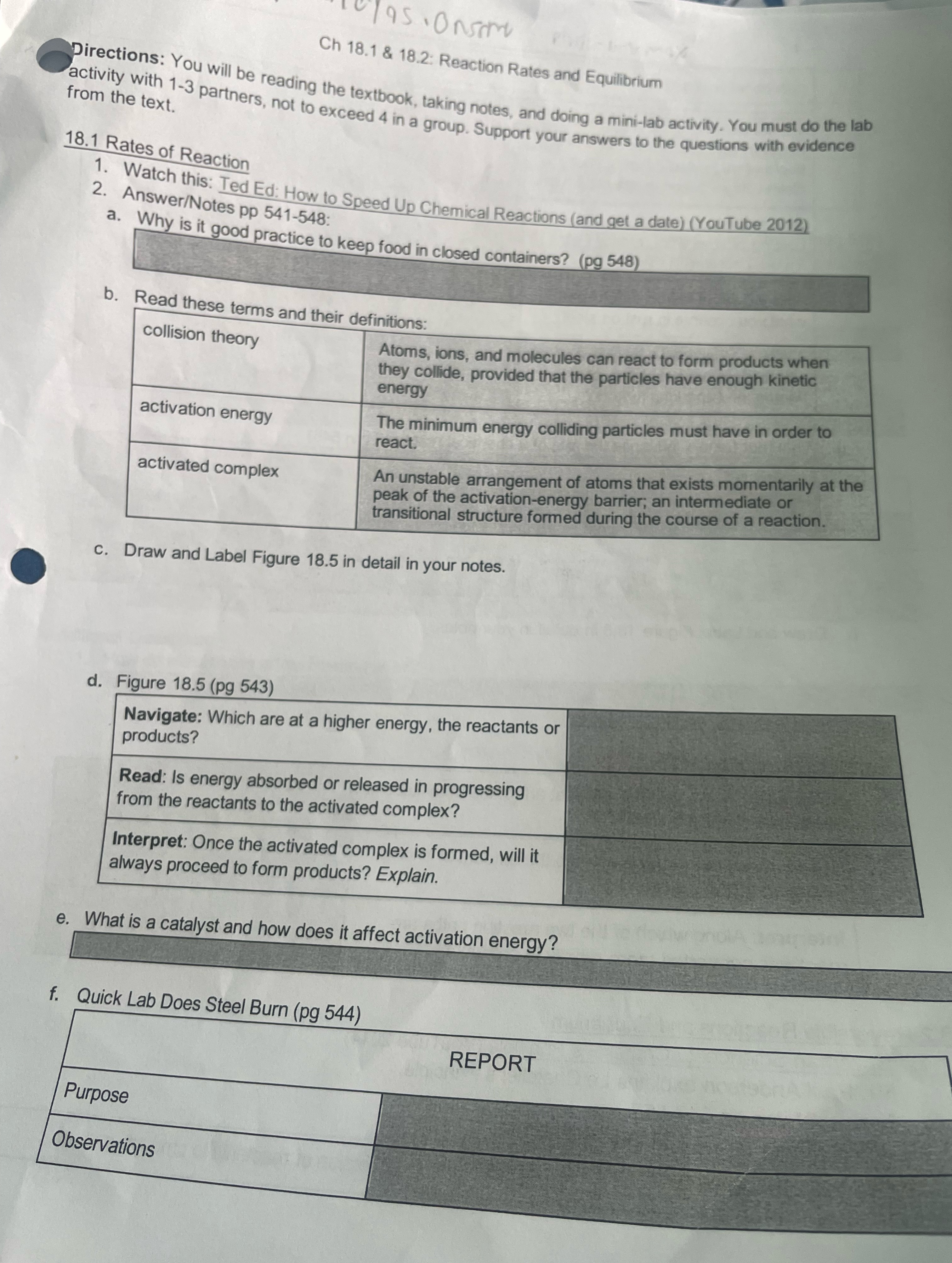
10795 . Onsome Ch 18.1 & 18.2: Reaction Rates and Equilibrium Directions: You will be reading the textbook, taking notes, and doing a mini-lab activity. You must do the lab from the text. activity with 1-3 partners, not to exceed 4 in a group. Support your answers to the questions with evidence 18.1 Rates of Reaction 1. Watch this: Ted Ed: How to Speed Up Chemical Reactions (and get a date) (YouTube 2012) 2. Answer/Notes pp 541-548: a. Why is it good practice to keep food in closed containers? (pg 548) b. Read these terms and their definitions: collision theory Atoms, ions, and molecules can react to form products when they collide, provided that the particles have enough kinetic energy activation energy The minimum energy colliding particles must have in order to react. activated complex An unstable arrangement of atoms that exists momentarily at the peak of the activation-energy barrier; an intermediate or transitional structure formed during the course of a reaction. c. Draw and Label Figure 18.5 in detail in your notes. d. Figure 18.5 (pg 543) Navigate: Which are at a higher energy, the reactants or products? Read: Is energy absorbed or released in progressing from the reactants to the activated complex? Interpret: Once the activated complex is formed, will it always proceed to form products? Explain. e. What is a catalyst and how does it affect activation energy? f. Quick Lab Does Steel Burn (pg 544) REPORT Purpose Observations

Step by Step Solution

There are 3 Steps involved in it

1 Expert Approved Answer
Step: 1 Unlock blur-text-image

Question Has Been Solved by an Expert!

Get step-by-step solutions from verified subject matter experts

Step: 2 Unlock
Step: 3 Unlock

Students Have Also Explored These Related Accounting Questions!