







Question: solve this case study.. CLOSING CASE The Trans Pacific Partnership (TPP) On February 4, 2016, ministers from 12 governments signed off on the Trans Pacific
solve this case study..
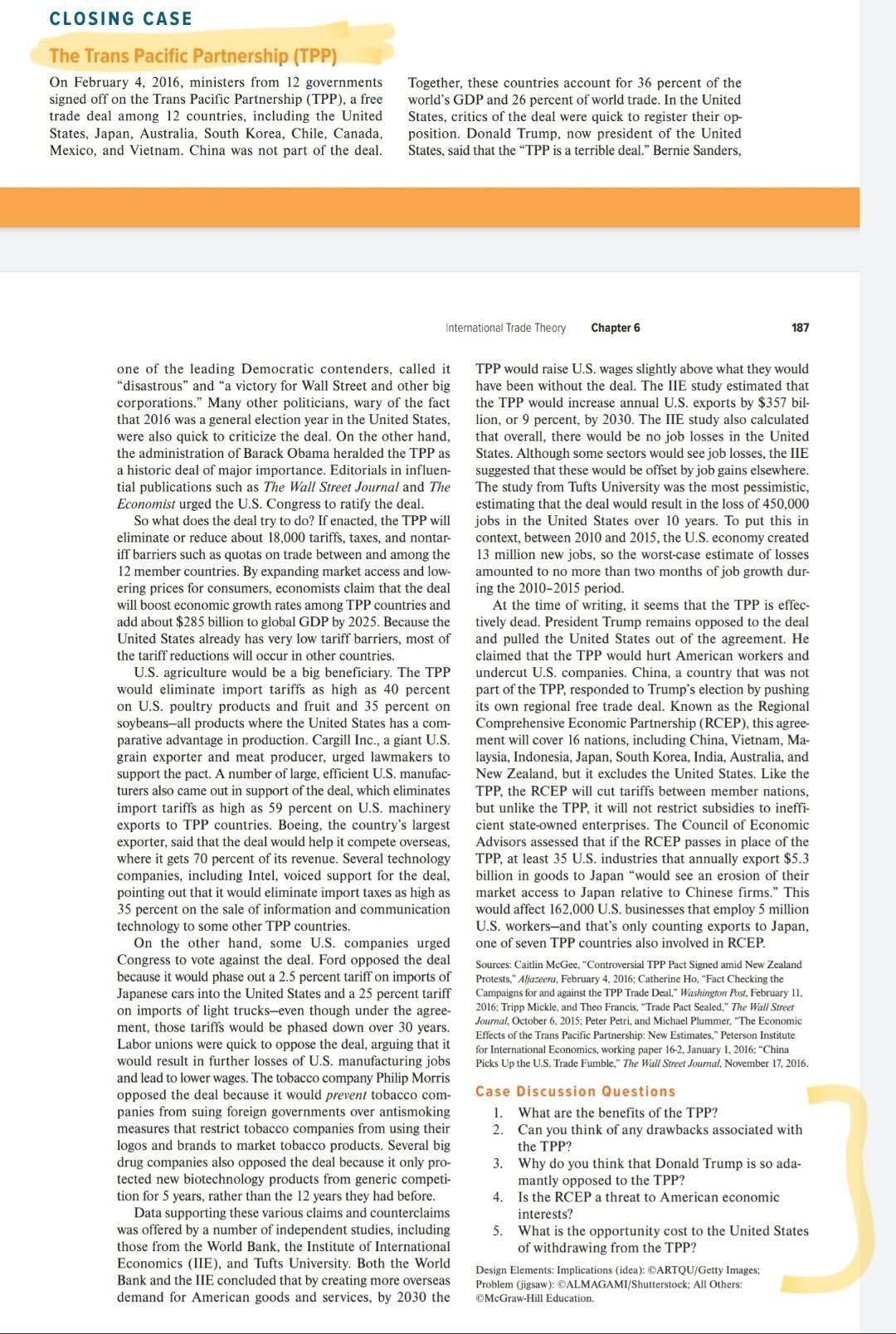
CLOSING CASE The Trans Pacific Partnership (TPP) On February 4, 2016, ministers from 12 governments signed off on the Trans Pacific Partnership (TPP), a free trade deal among 12 countries, including the United States, Japan, Australia, South Korea, Chile, Canada, Mexico, and Vietnam. China was not part of the deal. Together, these countries account for 36 percent of the world's GDP and 26 percent of world trade. In the United States, critics of the deal were quick to register their op- position. Donald Trump, now president of the United States, said that the "TPP is a terrible deal." Bernie Sanders, International Trade Theory Chapter 6 187 one of the leading Democratic contenders, called it "disastrous" and "a victory for Wall Street and other big corporations." Many other politicians, wary of the fact that 2016 was a general election year in the United States, were also quick to criticize the deal. On the other hand, the administration of Barack Obama heralded the TPP as a historic deal of major importance. Editorials in influen- tial publications such as The Wall Street Journal and The Economist urged the U.S. Congress to ratify the deal. So what does the deal try to do? If enacted, the TPP will eliminate or reduce about 18,000 tariffs, taxes, and nontar- iff barriers such as quotas on trade between and among the 12 member countries. By expanding market access and low- ering prices for consumers, economists claim that the deal will boost economic growth rates among TPP countries and add about $285 billion to global GDP by 2025. Because the United States already has very low tariff barriers, most of the tariff reductions will occur in other countries. U.S. agriculture would be a big beneficiary. The TPP would eliminate import tariffs as high as 40 percent on U.S. poultry products and fruit and 35 percent on soybeans-all products where the United States has a com- parative advantage in production. Cargill Inc., a giant U.S. grain exporter and meat producer, urged lawmakers to support the pact. A number of large, efficient U.S. manufac- turers also came out in support of the deal, which eliminates import tariffs as high as 59 percent on U.S. machinery exports to TPP countries. Boeing, the country's largest exporter, said that the deal would help it compete overseas, where it gets 70 percent of its revenue. Several technology companies, including Intel, voiced support for the deal, pointing out that it would eliminate import taxes as high as 35 percent on the sale of information and communication technology to some other TPP countries. On the other hand, some U.S. companies urged Congress to vote against the deal. Ford opposed the deal because it would phase out a 2.5 percent tariff on imports of Japanese cars into the United States and a 25 percent tariff on imports of light trucks-even though under the agree- ment, those tariffs would be phased down over 30 years. Labor unions were quick to oppose the deal, arguing that it would result in further losses of U.S. manufacturing jobs and lead to lower wages. The tobacco company Philip Morris opposed the deal because it would prevent tobacco com- panies from suing foreign governments over antismoking measures that restrict tobacco companies from using their logos and brands to market tobacco products. Several big drug companies also opposed the deal because it only pro- tected new biotechnology products from generic competi- tion for 5 years, rather than the 12 years they had before. Data supporting these various claims and counterclaims was offered by a number of independent studies, including those from the World Bank, the Institute of International Economics (IIE), and Tufts University. Both the World Bank and the IE concluded that by creating more overseas demand for American goods and services, by 2030 the TPP would raise U.S. wages slightly above what they would have been without the deal. The IE study estimated that the TPP would increase annual U.S. exports by $357 bil- lion, or 9 percent, by 2030. The IIE study also calculated that overall, there would be no job losses in the United States. Although some sectors would see job losses, the IIE suggested that these would be offset by job gains elsewhere. The study from Tufts University was the most pessimistic, estimating that the deal would result in the loss of 450,000 jobs in the United States over 10 years. To put this in context, between 2010 and 2015, the U.S. economy created 13 million new jobs, so the worst-case estimate of losses amounted to no more than two months of job growth dur- ing the 2010-2015 period. At the time of writing, it seems that the TPP is effec- tively dead. President Trump remains opposed to the deal and pulled the United States out of the agreement. He claimed that the TPP would hurt American workers and undercut U.S. companies. China, a country that was not part of the TPP, responded to Trump's election by pushing its own regional free trade deal. Known as the Regional Comprehensive Economic Partnership (RCEP), this agree- ment will cover 16 nations, including China, Vietnam, Ma- laysia, Indonesia, Japan, South Korea, India, Australia, and New Zealand, but it excludes the United States. Like the TPP, the RCEP will cut tariffs between member nations, but unlike the TPP, it will not restrict subsidies to ineffi- cient state-owned enterprises. The Council of Economic Advisors assessed that if the RCEP passes in place of the TPP, at least 35 U.S. industries that annually export $5.3 billion in goods to Japan "would see an erosion of their market access to Japan relative to Chinese firms." This would affect 162,000 U.S. businesses that employ 5 million U.S. workers-and that's only counting exports to Japan, one of seven TPP countries also involved in RCEP. Sources: Caitlin McGee, "Controversial TPP Pact Signed amid New Zealand Protests." Aljazeera, February 4, 2016; Catherine Ho, "Fact Checking the Campaigns for and against the TPP Trade Deal." Washington Post, February 11, 2016; Tripp Mickle, and Theo Francis, "Trade Pact Sealed," The Wall Street Journal, October 6, 2015: Peter Petri, and Michael Plummer, "The Economic Effects of the Trans Pacific Partnership: New Estimates," Peterson Institute for International Economics, working paper 16-2, January 1, 2016; "China Picks Up the U.S. Trade Fumble," The Wall Street Journal, November 17, 2016. Case Discussion Questions 1. What are the benefits of the TPP? 2. Can you think of any drawbacks associated with the TPP? 3. Why do you think that Donald Trump is so ada- mantly opposed to the TPP? 4. Is the RCEP a threat to American economic interests? 5. What is the opportunity cost to the United States of withdrawing from the TPP? Design Elements: Implications (idea): CARTQU/Getty Images: Problem (jigsaw): CALMAGAMI/Shutterstock: All Others: McGraw-Hill EducationStep by Step Solution
There are 3 Steps involved in it
1 Expert Approved Answer
Step: 1 Unlock

Question Has Been Solved by an Expert!
Get step-by-step solutions from verified subject matter experts
Step: 2 Unlock
Step: 3 Unlock
 Study Help