







Question: solve this one FAST thanku The Big Question is: Using the command G=digraphs.RandomDirectedGNPcls, .25) , generate a random directed graph on 15 vertices, with the
solve this one FAST thanku
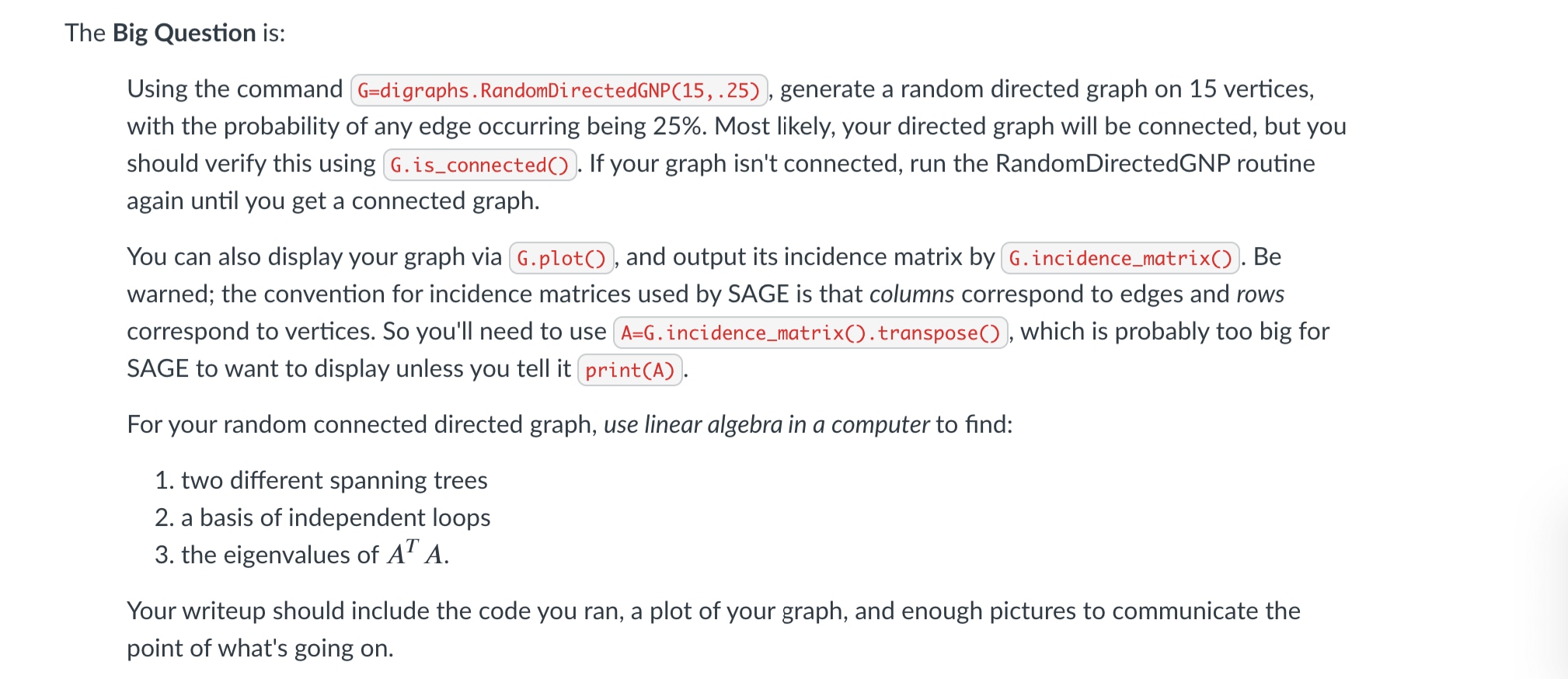
The Big Question is: Using the command G=digraphs.RandomDirectedGNPcls, .25) , generate a random directed graph on 15 vertices, with the probability of any edge occurring being 25%. Most likely. your directed graph will be connected, but you should verify this using G.is_connected() . If your graph isn't connected, run the RandomDirectedGNP routine again until you get a connected graph. You can also display your graph via G.plot() , and output its incidence matrix by G.incidence_matr'ix() . Be warned; the convention for incidence matrices used by SAGE is that columns correspond to edges and rows correspond to vertices. So you'll need to use A=G.incidence_matr'ix()Vtranspose() ,which is probably too big for SAGE to want to display unless you tell it print(A) . For your random connected directed graph, use linear algebra in a computer to nd: 1. two different spanning trees 2. a basis of independent loops 3. the eigenvalues of AT A. Your writeup should include the code you ran, a plot of your graph, and enough pictures to communicate the point of what's going on
Step by Step Solution
There are 3 Steps involved in it

Get step-by-step solutions from verified subject matter experts
 Study Help