







Question: Solve this question by: a) least cost method b) northwest method c) vogel's approximation method PROBLEM 20 A company has two branches that produce a
Solve this question by:
a) least cost method
b) northwest method
c) vogel's approximation method
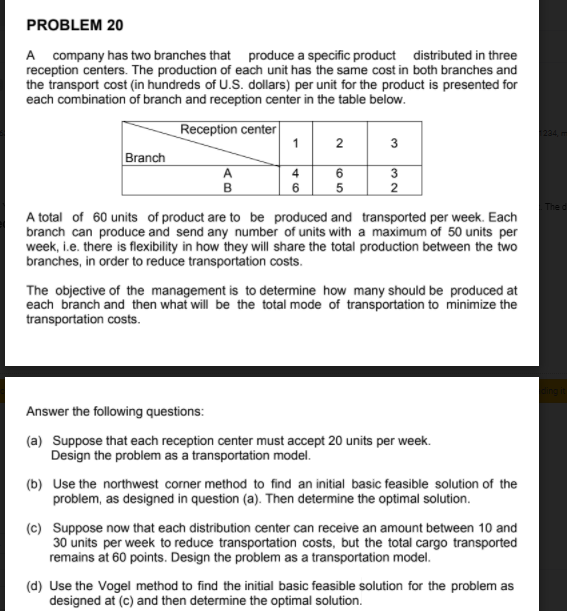
PROBLEM 20 A company has two branches that produce a specific product distributed in three reception centers. The production of each unit has the same cost in both branches and the transport cost (in hundreds of U.S. dollars) per unit for the product is presented for each combination of branch and reception center in the table below. Reception center 1 3 Branch A 4 6 3 B 6 5 N A total of 60 units of product are to be produced and transported per week. Each branch can produce and send any number of units with a maximum of 50 units per week, i.e. there is flexibility in how they will share the total production between the two branches, in order to reduce transportation costs. The objective of the management is to determine how many should be produced at each branch and then what will be the total mode of transportation to minimize the transportation costs. Answer the following questions: (a) Suppose that each reception center must accept 20 units per week. Design the problem as a transportation model. (b) Use the northwest corner method to find an initial basic feasible solution of the problem, as designed in question (a). Then determine the optimal solution. (c) Suppose now that each distribution center can receive an amount between 10 and 30 units per week to reduce transportation costs, but the total cargo transported remains at 60 points. Design the problem as a transportation model. (d) Use the Vogel method to find the initial basic feasible solution for the problem as designed at (c) and then determine the optimal solution. PROBLEM 20 A company has two branches that produce a specific product distributed in three reception centers. The production of each unit has the same cost in both branches and the transport cost (in hundreds of U.S. dollars) per unit for the product is presented for each combination of branch and reception center in the table below. Reception center 1 3 Branch A 4 6 3 B 6 5 N A total of 60 units of product are to be produced and transported per week. Each branch can produce and send any number of units with a maximum of 50 units per week, i.e. there is flexibility in how they will share the total production between the two branches, in order to reduce transportation costs. The objective of the management is to determine how many should be produced at each branch and then what will be the total mode of transportation to minimize the transportation costs. Answer the following questions: (a) Suppose that each reception center must accept 20 units per week. Design the problem as a transportation model. (b) Use the northwest corner method to find an initial basic feasible solution of the problem, as designed in question (a). Then determine the optimal solution. (c) Suppose now that each distribution center can receive an amount between 10 and 30 units per week to reduce transportation costs, but the total cargo transported remains at 60 points. Design the problem as a transportation model. (d) Use the Vogel method to find the initial basic feasible solution for the problem as designed at (c) and then determine the optimal solution
Step by Step Solution
There are 3 Steps involved in it

Get step-by-step solutions from verified subject matter experts
 Study Help