







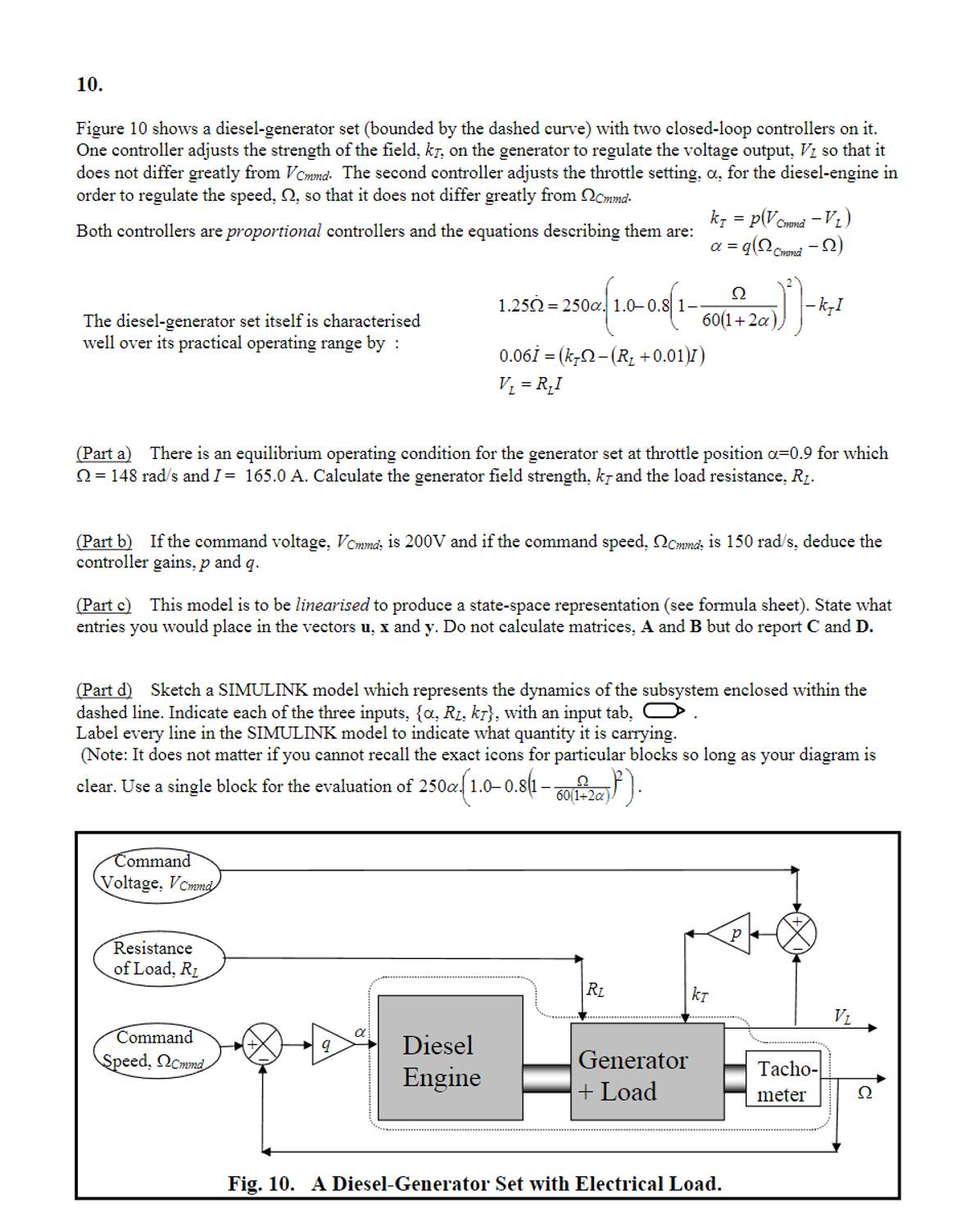
Question: Solve this question from a Systems Analysis worksheet Figure 1 0 shows a diesel - generator set ( bounded by the dashed curve ) with
Solve this question from a Systems Analysis worksheet
Figure shows a dieselgenerator set bounded by the dashed curve with two closedloop controllers on it One controller adjusts the strength of the field, on the generator to regulate the voltage output, so that it does not differ greatly from The second controller adjusts the throttle setting, for the dieselengine in order to regulate the speed, so that it does not differ greatly from
Both controllers are proportional controllers and the equations describing them are:
The dieselgenerator set itself is characterised
Part a There is an equilibrium operating condition for the generator set at throttle position for which and Calculate the generator field strength, and the load resistance,
Part b If the command voltage, is and if the command speed, is deduce the controller gains, and
Part c This model is to be linearised to produce a statespace representation see formula sheet State what entries you would place in the vectors and Do not calculate matrices, A and but do report and
Part d Sketch a SIMULINK model which represents the dynamics of the subsystem enclosed within the dashed line. Indicate each of the three inputs, with an input tab, Label every line in the SIMULINK model to indicate what quantity it is carrying.
Note: It does not matter if you cannot recall the exact icons for particular blocks so long as your diagram is clear. Use a single block for the evaluation of
Step by Step Solution
There are 3 Steps involved in it
1 Expert Approved Answer
Step: 1 Unlock

Question Has Been Solved by an Expert!
Get step-by-step solutions from verified subject matter experts
Step: 2 Unlock
Step: 3 Unlock
 Study Help