







Question: Solve this question Question 1 Rose Chemical, Inc., processes pine rosin into three products: turpentine, paint thinner, and spot remover. During May, the joint costs
Solve this question
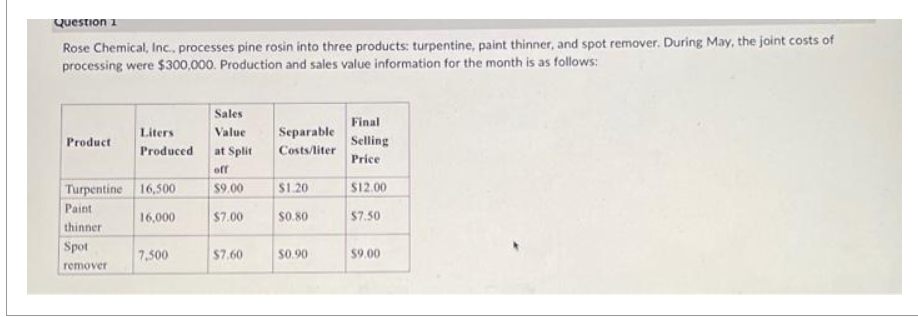
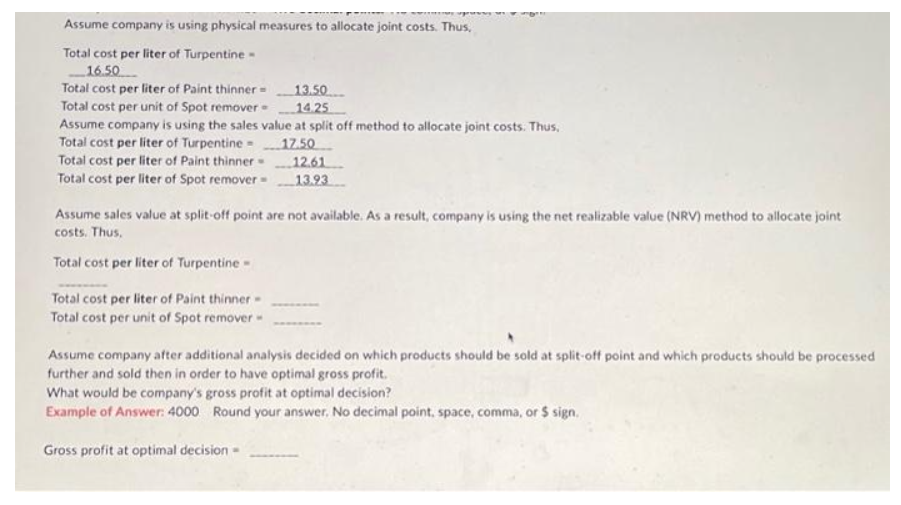
Question 1 Rose Chemical, Inc., processes pine rosin into three products: turpentine, paint thinner, and spot remover. During May, the joint costs of processing were $300,000. Production and sales value information for the month is as follows: Sales Final Liters Value Product Separable Produced Selling at Split Costs/liter Price off Turpentine 16.500 $9.00 $1.20 $12.00 Paint 16,000 $7.00 $0.80 $7.50 thinner Spot 7,500 $7.60 $0.90 $9.00 removerAssume company is using physical measures to allocate joint costs. Thus, Total cost per liter of Turpentine = 16.50 Total cost per liter of Paint thinner = _ _13.50 Total cost per unit of Spot remover = 14.25 Assume company is using the sales value at split off method to allocate joint costs. Thus, Total cost per liter of Turpentine = _17.50 Total cost per liter of Paint thinner . _12.61 Total cost per liter of Spot remover = 13.93 Assume sales value at split-off point are not available. As a result, company is using the net realizable value (NRV) method to allocate joint costs. Thus. Total cost per liter of Turpentine = Total cost per liter of Paint thinner = Total cost per unit of Spot remover - Assume company after additional analysis decided on which products should be sold at split-off point and which products should be processed further and sold then in order to have optimal gross profit. What would be company's gross profit at optimal decision? Example of Answer: 4000 Round your answer, No decimal point. space, comma, or $ sign. Gross profit at optimal decision =
Step by Step Solution
There are 3 Steps involved in it

Get step-by-step solutions from verified subject matter experts
 Study Help