







Question: Solve using Matlab Just write out the code that would be needed to copy onto MATLAB Consider the following set of equilibrium reactions: CH_4(fg) +
Solve using Matlab
Just write out the code that would be needed to copy onto MATLAB
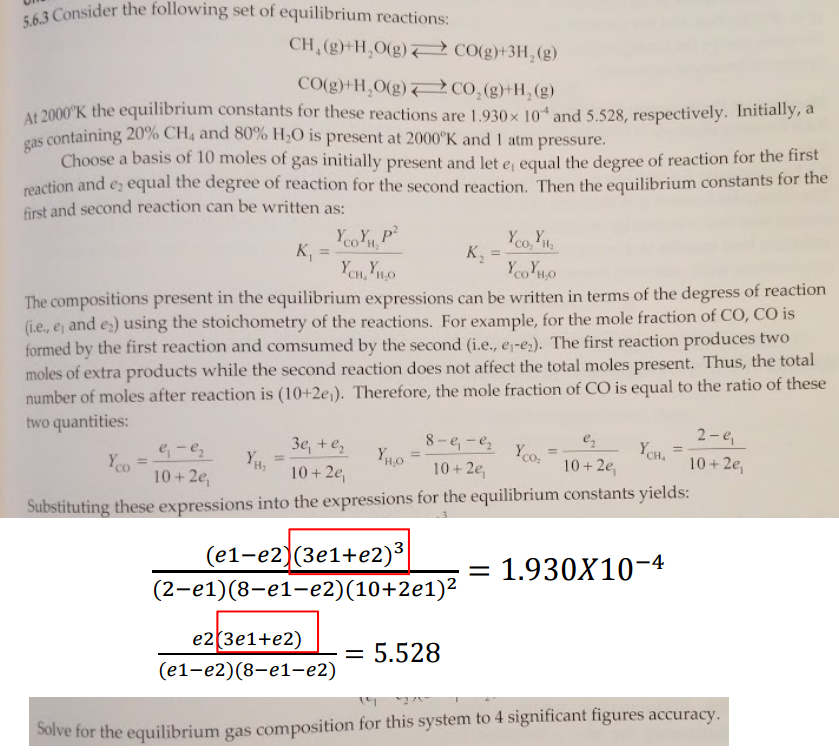
Consider the following set of equilibrium reactions: CH_4(fg) + H_2O(g) CO(g) + 3H_2(g) CO(g) + H_2O(g) CO_2(g) + H_2(g) at 2000 degree K the equilibrium constants for these reactions are 1.930 times 10^-4 and 5.528, respectively. Initially, a gas containing 20 percentage CH_4 and 80 percentage H_2O is present at 2000 degree K and 1 atm pressure. Choose a basis of 10 moles of gas initially present and let e_1 equal the degree of reaction for the first reaction and e_2 equal the decree of reaction for the second reaction. Then the equilibrium constants for the first and second reaction can be written as: K_1 = Y_CO Y_H_2p^2/Y-CH_4 Y_H_2O K_2 = Y_CO_2 Y_H_2/Y_CO Y_H_2O The compositions present in the equilibrium expressions can be written in terms of the degree of reaction (i.e., e_1 and e_2) using the of the reactions. For example, for the mole fraction of CO, CO is formed by the first reaction and consumed by the second (i.e., e_1-e_2). The first reaction produces two moles of extra products while the second reaction does not affect the total moles present. Thus, the total number of moles after reaction is (10+2e_1). Therefore, the mole fraction of CO is equal to the ratio of these two quantities: Y_CO = e_1-e_2/10+2e_1 Y_H_2 = 3e_1+ e_2/10+2e_1 Y_H_2O = 8-e_1-e_2/10+2e_1 Y_CO_2 = e_2/10+2e_1 Y_CH_4 = 2-e_1/10+2e_1 Substituting these expressions into the expressions for the equilibrium constants yields: (e1-e2)(3e1+e2)^3/(2-e1)(8-e1-e2)(10+2e1)^2 = 1.930 times 10^-4 e2(3e1+e2)/(e1-e2)(8-e1-e2) = 5.528 Solve for the equilibrium gas composition for this system to 4 significant figures accuracy
Step by Step Solution
There are 3 Steps involved in it

Get step-by-step solutions from verified subject matter experts
 Study Help