







Question: Solve using Molecular diffusion continuity equation and Flux equation 1. You set up an experimental setup to study the crystallization of NaCl. The setup is
Solve using Molecular diffusion continuity equation and Flux equation 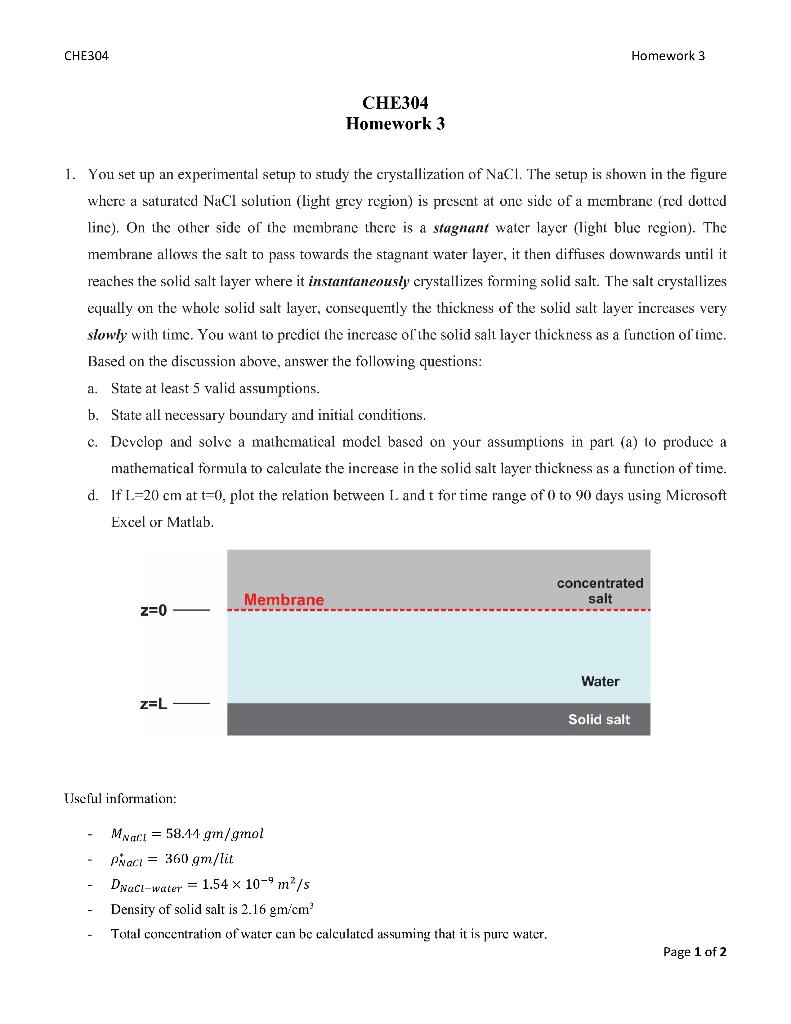
1. You set up an experimental setup to study the crystallization of NaCl. The setup is shown in the figure where a saturated NaCl solution (light grey region) is present at one side of a membrane (red dotted line). On the other side of the membrane there is a stagnant water layer (light blue region). The membrane allows the salt to pass towards the stagnant water layer, it then diffuses downwards until it reaches the solid salt layer where it instantaneously crystallizes forming solid salt. The salt crystallizes equally on the whole solid salt layer, consequently the thickness of the solid salt layer increases very slowly with time. You want to predict the increase of the solid salt layer thickness as a function of time. Based on the discussion above, answer the following questions: a. State at least 5 valid assumptions. b. State all necessary boundary and initial conditions. c. Develop and solve a mathematical model based on your assumptions in part (a) to produce a mathematical formula to calculate the increase in the solid salt layer thickness as a function of time. d. If L=20cm at t=0, plot the relation between L and t for time range of 0 to 90 days using Microsoft Excel or Matlab. Useful information: - MNarl=58.41gm/gmol - NaCl=360gm/lit - DNaCl-water=1.54109m2/s - Density of solid salt is 2.16gmcm3 - Total concentration of water can be calculated assuming that it is pure water. Page 1 of 2 1. You set up an experimental setup to study the crystallization of NaCl. The setup is shown in the figure where a saturated NaCl solution (light grey region) is present at one side of a membrane (red dotted line). On the other side of the membrane there is a stagnant water layer (light blue region). The membrane allows the salt to pass towards the stagnant water layer, it then diffuses downwards until it reaches the solid salt layer where it instantaneously crystallizes forming solid salt. The salt crystallizes equally on the whole solid salt layer, consequently the thickness of the solid salt layer increases very slowly with time. You want to predict the increase of the solid salt layer thickness as a function of time. Based on the discussion above, answer the following questions: a. State at least 5 valid assumptions. b. State all necessary boundary and initial conditions. c. Develop and solve a mathematical model based on your assumptions in part (a) to produce a mathematical formula to calculate the increase in the solid salt layer thickness as a function of time. d. If L=20cm at t=0, plot the relation between L and t for time range of 0 to 90 days using Microsoft Excel or Matlab. Useful information: - MNarl=58.41gm/gmol - NaCl=360gm/lit - DNaCl-water=1.54109m2/s - Density of solid salt is 2.16gmcm3 - Total concentration of water can be calculated assuming that it is pure water. Page 1 of 2
Step by Step Solution
There are 3 Steps involved in it

Get step-by-step solutions from verified subject matter experts
 Study Help