







Question: solving problem task Answer: Inventory Management and Demand Forecasting: Collect historical data on food item demand at various locations and analyse it. Develop a demand
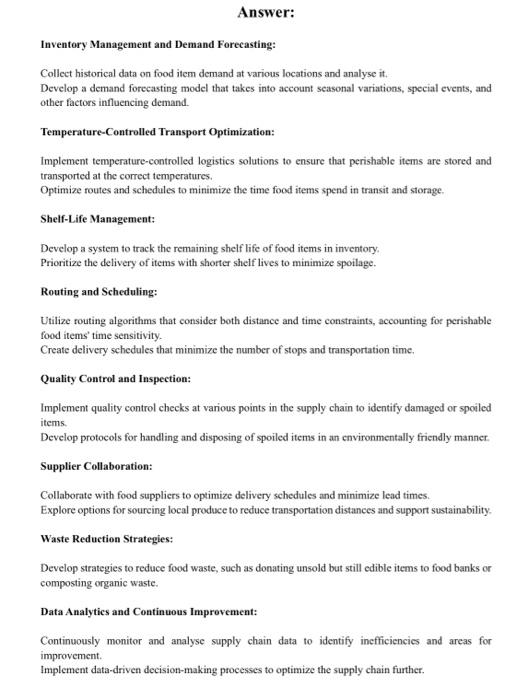
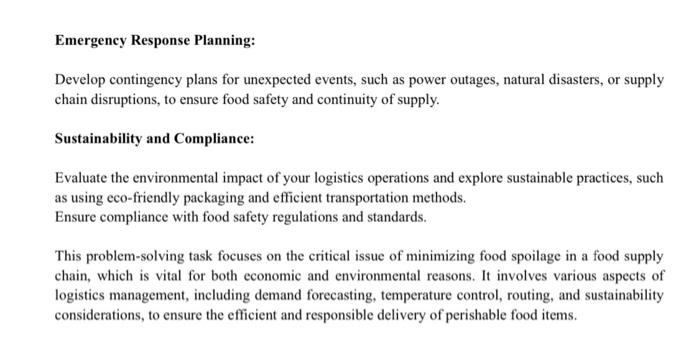
Answer: Inventory Management and Demand Forecasting: Collect historical data on food item demand at various locations and analyse it. Develop a demand forecasting model that takes into account seasonal variations, special events, and other factors influencing demand. Temperature-Controlled Transport Optimization: Implement temperature-controlled logistics solutions to ensure that perishable items are stored and transported at the correct temperatures. Optimize routes and schedules to minimize the time food items spend in transit and slorage. Shelf-Life Management: Develop a system to track the remaining shelf life of food items in inventory. Prioritize the delivery of items with shorter shelf lives to minimize spoilage. Routing and Scheduling: Utilize fouting algorithms that consider both distance and time constraints, accounting fot perishable food items' time sensitivity. Create delivery schedules that minimize the number of stops and transportation time. Quality Control and Inspection: Implement quality control checks at various points in the supply chain to identify damaged or spoiled items. Develop protocols for handling and disposing of spoiled items in an environmentally friendly manner. Supplier Collaboration: Collaborate with food suppliers to optimize delivery schedules and minimize lead times. Explore options for sourcing local produce to reduce transportation distances and support sustainability. Waste Reduction Strategies: Develop strategies to reduce food waste, such as donating unsold but still edible items to food banks or composting organic waste. Data Analytics and Continuous Improvement: Continuously monitor and analyse supply chain data to identify inefficiencies and areas for improvement. Implement data-driven decision-making ptocesses to optimize the supply chain further. Emergency Response Planning: Develop contingency plans for unexpected events, such as power outages, natural disasters, or supply chain disruptions, to ensure food safety and continuity of supply. Sustainability and Compliance: Evaluate the environmental impact of your logistics operations and explore sustainable practices, such as using eco-friendly packaging and efficient transportation methods. Ensure compliance with food safety regulations and standards. This problem-solving task focuses on the critical issue of minimizing food spoilage in a food supply chain, which is vital for both economic and environmental reasons. It involves various aspects of logistics management, including demand forecasting, temperature control, routing, and sustainability considerations, to ensure the efficient and responsible delivery of perishable food items
Step by Step Solution
There are 3 Steps involved in it

Get step-by-step solutions from verified subject matter experts
 Study Help