







Question: Some problems can be solved using either the energy principles or the kinematic equations and Newton's second law. Solve a problem using both methods and
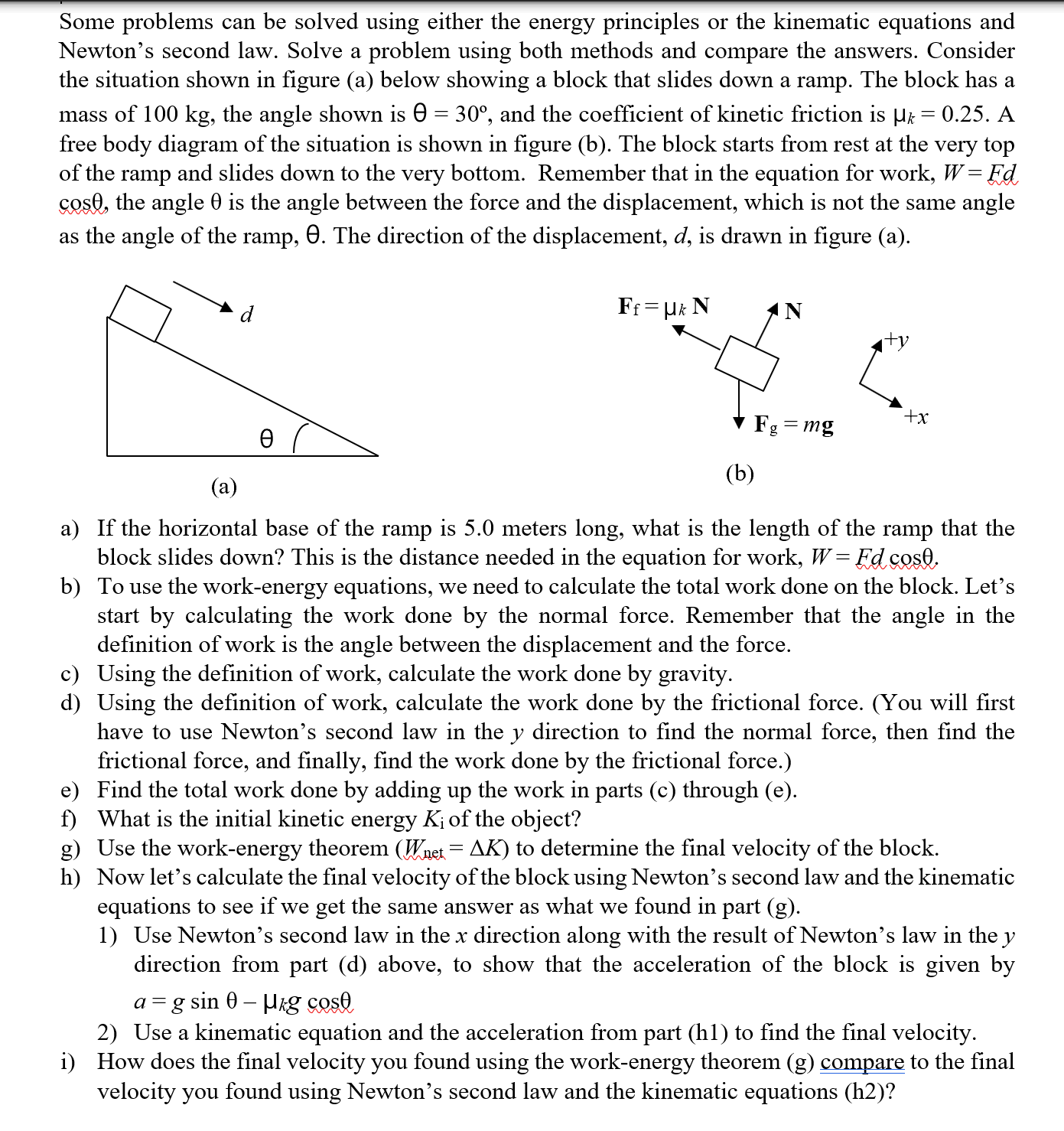

Some problems can be solved using either the energy principles or the kinematic equations and Newton's second law. Solve a problem using both methods and compare the answers. Consider the situation shown in figure (a) below showing a block that slides down a ramp. The block has a mass of 100 kg, the angle shown is 0 = 30, and the coefficient of kinetic friction is Mk = 0.25. A free body diagram of the situation is shown in figure (b). The block starts from rest at the very top of the ramp and slides down to the very bottom. Remember that in the equation for work, W = Ed cose, the angle 0 is the angle between the force and the displacement, which is not the same angle as the angle of the ramp, 0. The direction of the displacement, d, is drawn in figure (a). d Ff = Uk N F. = mg X+ ( b ) (a) a) If the horizontal base of the ramp is 5.0 meters long, what is the length of the ramp that the block slides down? This is the distance needed in the equation for work, W= Ed cosh b) To use the work-energy equations, we need to calculate the total work done on the block. Let's start by calculating the work done by the normal force. Remember that the angle in the definition of work is the angle between the displacement and the force. c) Using the definition of work, calculate the work done by gravity. d) Using the definition of work, calculate the work done by the frictional force. (You will first have to use Newton's second law in the y direction to find the normal force, then find the frictional force, and finally, find the work done by the frictional force.) Find the total work done by adding up the work in parts (c) through (e). f) What is the initial kinetic energy Ki of the object? g) Use the work-energy theorem (Wnet = AK) to determine the final velocity of the block. h) Now let's calculate the final velocity of the block using Newton's second law and the kinematic equations to see if we get the same answer as what we found in part (g). 1) Use Newton's second law in the x direction along with the result of Newton's law in the y direction from part (d) above, to show that the acceleration of the block is given by a = g sin 0 - Mag cosh 2) Use a kinematic equation and the acceleration from part (h1) to find the final velocity. i) How does the final velocity you found using the work-energy theorem (g) compare to the final velocity you found using Newton's second law and the kinematic equations (h2)?A ) 5 . 1 7 Cos(30 ) = 7 sedso ) ofasing 5 set ( 30 ) = 0 / 30 25 / 2 . 53 ) . 51 3 - 5 203 5 m -5213- 10 53 = 5, 17 35 02 5 5 3 Cost - Cos ( 30 ) 27 5.7735 m B) W = Ed cost -Ww = 0 W = F . 5 Fy = Mg cos 1 30 ) = 100 . 9.8 . (05 ( 30 ) # 848, 57 )9 1 7 Wtorn = 848. 57 - 5 7735 + 4 905 5 / ?? ? 30 D) frictional force f = MKN N= Macos : 100 - 9.81 - Cos ( 30 ) = 849.57 So frictional Force HKN F = 0 . 25 - 849 , 57 = 212. 4 N Work force done" Wf = fixed cost -> = - 212.4 . 57735 = - 1223. 9825 D + 4 9 05 - 12 23 . 98 2 = W tat = 3681018J F ) Initial Kinetic energy. Block at Rest Ki = 05 K : = 2 MV : ? = 2 m ( 0 ) 2 = 0 G ) Whet = DK 3681 . 018 = 2 mvp2 = 3601:0602 2 = VF2: 73.62 - 8.58m/ H ) Fret = fa-fx = =gsing - Mig cos. = 9.81 ( sin(30))- 0.25-cos( 30))= 2-78m/s V2 = 10 + 2: 2.78 - 5.7735 = 32. 10066 25.66.57 m/s I )
Step by Step Solution
There are 3 Steps involved in it

Get step-by-step solutions from verified subject matter experts
 Study Help