







Question: someone help with this matlab problem asap thank you .... Any periodic real signal g(t) with period To can be written as an infinite weighted
someone help with this matlab problem asap thank you ....
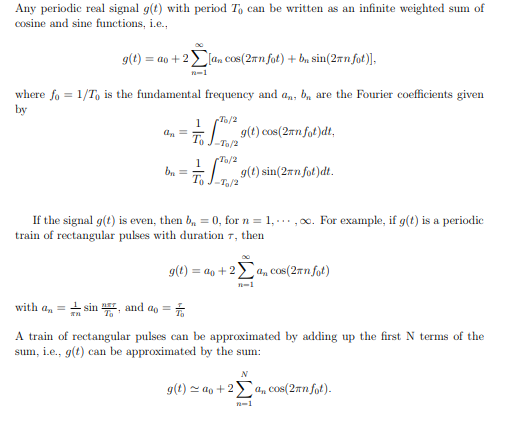
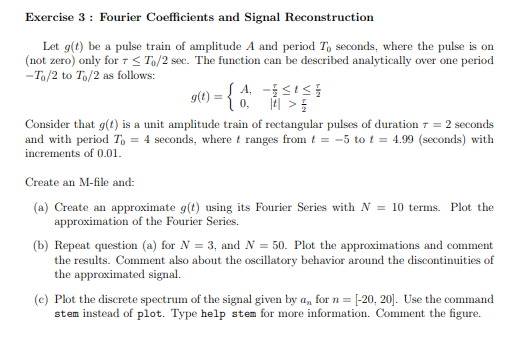
Any periodic real signal g(t) with period To can be written as an infinite weighted sum of oosine and sine functions, i.e. where fo = 1/To is the fundamental frequency and an, bn are the Fourier coefficients given by 0 J-To/2 (t) sin(2n fot)dt To J-To/2 If the signal g(t) is even, then b0, for n-1, .. .oo. For example, if g(t) is a periodic train of rectangular pulses with duration , then with a- sin and a A train of rectangular pulses can be approximated by adding up the first N terms of the sum, i.e., g(t) can be approximated by the sum: g(t)--ao + 2 an cos(2m/01) Exercise 3: Fourier Coefficients and Signal Reconstruction Let g(t) be a pulse train of amplitude A and period To seconds, where the pulse is on (not zero) only for T S To/2 sec. The function can be described analytically over one period -To/2 to To/2 as follows: go, 0. Consider that g(t) is a unit amplitude train of rectangular pulses of duration -2 seconds and with period To = 4 seconds, where t ranges fron t =-5 to t = 4.99 (seconds) with increments of 0.01 Create an M-file and: (a) Create an approximate g(t) using its Fourier Series with N = 10 terms. Plot the approximation of the Fourier Series. (b) Repeat question (a) for N = 3, and N = 50-Plot the approximations and comment the results. Comment also about the oscillatory behavior around the discontinuities of the approximated signal. (e) Plot the discrete spectrum of the signal given by an for n--20, 20. Use the command stem instead of plot. Type help stem for more information. Commen the figure. Any periodic real signal g(t) with period To can be written as an infinite weighted sum of oosine and sine functions, i.e. where fo = 1/To is the fundamental frequency and an, bn are the Fourier coefficients given by 0 J-To/2 (t) sin(2n fot)dt To J-To/2 If the signal g(t) is even, then b0, for n-1, .. .oo. For example, if g(t) is a periodic train of rectangular pulses with duration , then with a- sin and a A train of rectangular pulses can be approximated by adding up the first N terms of the sum, i.e., g(t) can be approximated by the sum: g(t)--ao + 2 an cos(2m/01) Exercise 3: Fourier Coefficients and Signal Reconstruction Let g(t) be a pulse train of amplitude A and period To seconds, where the pulse is on (not zero) only for T S To/2 sec. The function can be described analytically over one period -To/2 to To/2 as follows: go, 0. Consider that g(t) is a unit amplitude train of rectangular pulses of duration -2 seconds and with period To = 4 seconds, where t ranges fron t =-5 to t = 4.99 (seconds) with increments of 0.01 Create an M-file and: (a) Create an approximate g(t) using its Fourier Series with N = 10 terms. Plot the approximation of the Fourier Series. (b) Repeat question (a) for N = 3, and N = 50-Plot the approximations and comment the results. Comment also about the oscillatory behavior around the discontinuities of the approximated signal. (e) Plot the discrete spectrum of the signal given by an for n--20, 20. Use the command stem instead of plot. Type help stem for more information. Commen the figure
Step by Step Solution
There are 3 Steps involved in it

Get step-by-step solutions from verified subject matter experts
 Study Help