Question: Sound waves: In this assignment you will explore how to approximate a sound wave from a discrete set of data samples. You will notice that
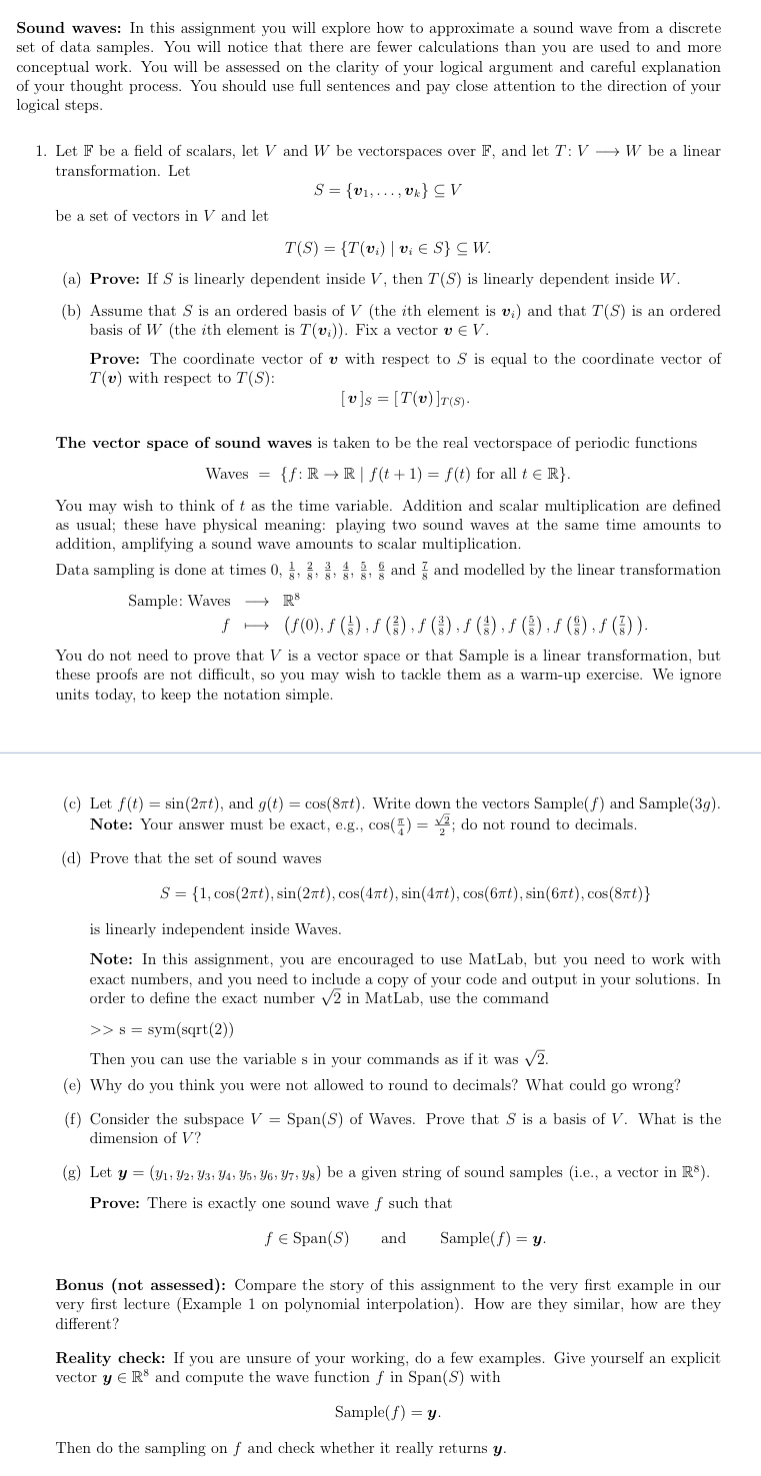
Sound waves: In this assignment you will explore how to approximate a sound wave from a discrete set of data samples. You will notice that there are fewer calculations than you are used to and more conceptual work. You will be assessed on the clarity of your logical argument and careful explanation of your thought process. You should use full sentences and pay close attention to the direction of your logical steps. 1. Let F be a field of scalars, let V and W be vectorspaces over F, and let T: V -> W be a linear transformation. Let S = {v1, .. . . Vx} CV be a set of vectors in V and let T(S) = {T(vi) | v; ES} CW. (a) Prove: If S is linearly dependent inside V, then T(S) is linearly dependent inside W. (b) Assume that S is an ordered basis of V (the ith element is v.) and that T(S) is an ordered basis of W (the ith element is T(v;)). Fix a vector v E V. Prove: The coordinate vector of v with respect to S is equal to the coordinate vector of T(v) with respect to T(S): [v]s = [T(v) ]r(s). The vector space of sound waves is taken to be the real vectorspace of periodic functions Waves = {f: R - R| f(t + 1) = f(t) for all te R}. You may wish to think of t as the time variable. Addition and scalar multiplication are defined as usual; these have physical meaning: playing two sound waves at the same time amounts to addition, amplifying a sound wave amounts to scalar multiplication. Data sampling is done at times 0, }, 3, 3, 4, 2, g and ; and modelled by the linear transformation Sample: Waves f H ( 1 0 ) , 1 ( 8 ) . 5 0 ) . 5 0 ) , s Q ) , 5 Q ) , 5 0) .5 ()) You do not need to prove that V is a vector space or that Sample is a linear transformation, but these proofs are not difficult, so you may wish to tackle them as a warm-up exercise. We ignore units today, to keep the notation simple. (c) Let f(t) = sin(2nt), and g(t) = cos(8xt). Write down the vectors Sample(f) and Sample(39). Note: Your answer must be exact, e.g., cos(1) = ; do not round to decimals. (d) Prove that the set of sound waves S = {1, cos(2xt), sin(2nt), cos(4at), sin(Ant), cos(6at), sin(6at), cos(8at) } is linearly independent inside Waves. Note: In this assignment, you are encouraged to use MatLab, but you need to work with exact numbers, and you need to include a copy of your code and output in your solutions. In order to define the exact number v2 in MatLab, use the command > > s = sym(sqrt(2)) Then you can use the variable s in your commands as if it was v2. (e) Why do you think you were not allowed to round to decimals? What could go wrong? (f) Consider the subspace V = Span(S) of Waves. Prove that S is a basis of V. What is the dimension of V? (g) Let y = (y1, y2, y3, ya, Us, 36, 97, ys) be a given string of sound samples (i.e., a vector in R$). Prove: There is exactly one sound wave f such that f E Span(S) and Sample( f) = y. Bonus (not assessed): Compare the story of this assignment to the very first example in our very first lecture (Example 1 on polynomial interpolation). How are they similar, how are they different? Reality check: If you are unsure of your working, do a few examples. Give yourself an explicit vector y E R* and compute the wave function f in Span(S) with Sample(f) = y. Then do the sampling on f and check whether it really returns y
Step by Step Solution
There are 3 Steps involved in it
1 Expert Approved Answer
Step: 1 Unlock
Question Has Been Solved by an Expert!
Get step-by-step solutions from verified subject matter experts
Step: 2 Unlock
Step: 3 Unlock
Students Have Also Explored These Related Mathematics Questions!









 Study Help