Question: Source: Templonuevo, G., Busch, P. (2020) Executive Information System development for Aklan, Philippines International Business Information Management Conference (35th IBIMA) 1-2 April, Seville - Spain
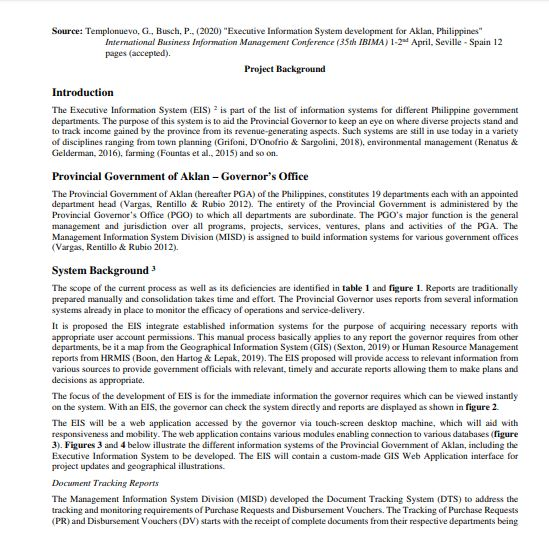
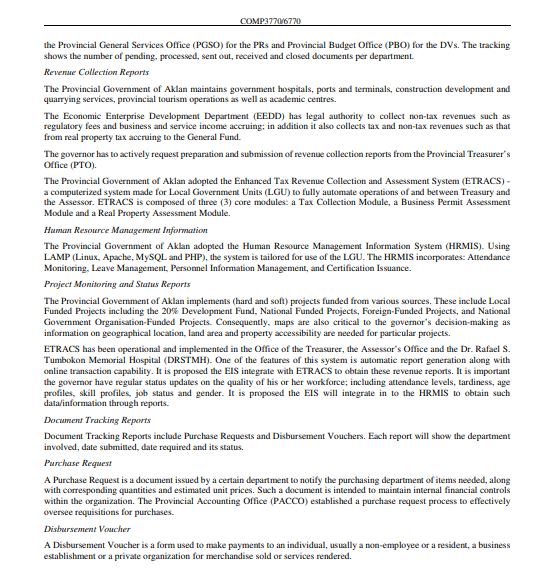
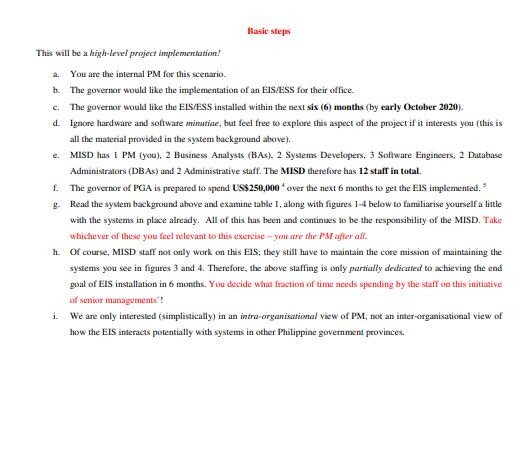
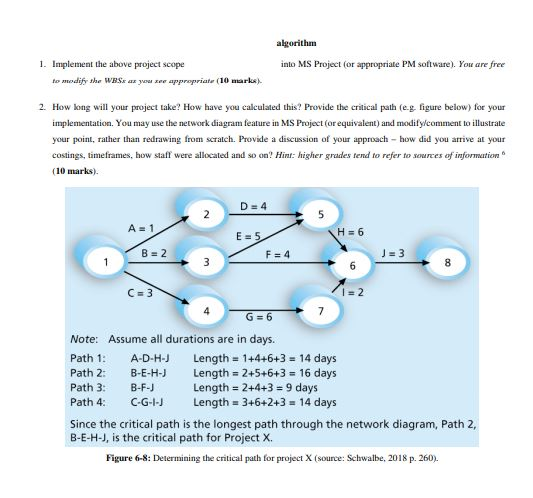
Source: Templonuevo, G., Busch, P. (2020) "Executive Information System development for Aklan, Philippines International Business Information Management Conference (35th IBIMA) 1-2 April, Seville - Spain 12 papes accepted) Project Background Introduction The Executive Information System (EIS) is part of the list of information systems for different Philippine government departments. The purpose of this system is to aid the Provincial Governor to keep an eye on where diverse projects stand and to track income gained by the province from its revenue generating aspects. Such systems are still in use today in a variety of disciplines ranging from town planning (Grifoni, D'Onofrio & Sargolini, 2018), environmental management (Renatus Gelderman, 2016), farming (Fountas et al., 2015) and so on. Provincial Government of Aklan - Governor's Office The Provincial Government of Aklan (hereafter PGA) of the Philippines, constitutes 19 departments each with an appointed department head (Vargas. Rentillo & Rubio 2012). The entirely of the Provincial Government is administered by the Provincial Governor's Office (PGO) to which all departments are subordinate. The PGO's major function is the general management and jurisdiction over all programs, projects, services, ventures, plans and activities of the PGA. The Management Information System Division (MISD) is assigned to build information systems for various government offices (Vargas, Rentillo & Rubio 2012). System Background The scope of the current process as well as its deficiencies are identified in table 1 and figure 1. Reports are traditionally prepared manually and consolidation takes time and effort. The Provincial Governor uses reports from several information systems already in place to monitor the efficacy of operations and service delivery. It is proposed the EIS integrale established information systems for the purpose of acquiring necessary reports with appropriate user account permissions. This manual process basically applies to any report the governor requires from other departments, be it a map from the Cieographical Information System (GIS) (Sexton, 2019) or Human Resource Management reports from HRMIS (Boon, den Hartog & Lepak, 2019). The EIS proposed will provide access to relevant information from various sources to provide government officials with relevant, timely and accurate reports allowing them to make plans and decisions as appropriate The focus of the development of EIS is for the immediate information the governor requires which can be viewed instantly on the system. With an EIS, the govemor can check the system directly and reports are displayed as shown in figure 2 The EIS will be a web application accessed by the governor via touch screen desktop machine, which will aid with responsiveness and mobility. The web application contains various modules enabling connection to various databases figure 3). Figures 3 and 4 below illustrate the different information systems of the Provincial Government of Atlan, including the Executive Information System to be developed. The EIS will contain a custom-made GIS Web Application interface for project updates and geographical illustrations Document Tracking Reports The Management Information System Division (MISD) developed the Document Tracking System (DTS) to address the tracking and monitoring requirements of Purchase Requests and Disbursement Vouchers. The Tracking of Purchase Requests (PR) and Disbursement Vouchers (DV) starts with the receipt of complete documents from their respective departments being COMP37706770 the Provincial General Services Office (PGSO) for the PRs and Provincial Budget Office (PBO) for the DVs. The tracking shows the number of pending processed, sent oul, received and closed documents per department Rew Collection Reports The Provincial Government of Allan maintains government hospitals, ports and terminals, construction development and quarrying services provincial tourism operations as well as academic centres The Economic Enterprise Development Department (FEDD) has legal authority to collect non-tax revenues such as regulatory fees and business and service income accruing: in addition it also collects tax and non-tax revenues such as that from real property tax accruing to the General Fund. The governor has to actively request preparation and submission of revenue collection reports from the Provincial Treasure's Office (PTO). The Provincial Government of Aklan adopted the Enhanced Tax Revenue Collection and Assessment System (ETRACS) - a computerized system made for Local Government Units (LGU) to fully automate operations of and between Treasury and the Assessor ETRACS is composed of three (3) core modules: a Tax Collection Module, a Business Permit Assessment Module and a Real Property Assessment Module. Human Resource Management Information The Provincial Government of Aklan adopted the Human Resource Management Information System (HRMIS). Using LAMP (Linux, Apache, MySQL and PHP), the system is tailored for use of the LGU. The HRMIS incorporates: Attendance Monitoring, Leave Management, Personnel Information Management, and Certification Issuance. Project Monitoring and Status Reports The Provincial Government of Aklan implements (hand and soft) projects funded from various sources. These include Local Funded Projects including the 20% Development Fund, National Funded Projects, Foreign-Funded Projects, and National Government Organisation Funded Projects. Consequently, maps are also critical to the governor's decision- making as information on geographical location, land area and property accessibility are needed for particular projects ETRACS has been operational and implemented in the Office of the Treasurer, the Assessor's Office and the Dr. Rafael S. Tumbokon Memorial Hospital (DRSTMH). One of the features of this system is automatic report generation along with online transaction capability. It is proposed the EIS integrale with ETRACS to obtain these revenue reports. It is important the governor have regular status updates on the quality of his or her workforce, including attendance levels, tardiness, ane profiles, skill profiles, job status and gender. It is proposed the EIS will integrate in to the HRMIS to obtain such data/information through reports Document Trucking Reports Document Tracking Reports include Purchase Requests and Disbursement Vouchers. Each report will show the department involved, date submitted, date required and its status. Purchase Request A Purchase Request is a document issued by a certain department to notify the purchasing department of items needed, along with corresponding quantities and estimated unit prices. Such a document is intended to maintain internal financial controls within the organization. The Provincial Accounting Office (PACCO) established a purchase request process to effectively overee requisitions for purchases. Disbursement Voucher A Disbursement Voucher is a form used to make payments to an individual, usually a non-employee or a resident, a business establishment or a private organization for merchandise sold or services rendered Basie steps This will be a high-level project implementation! a. You are the internal PM for this scenario. b. The governor would like the implementation of an EIS/ESS for their office. c. The governor would like the EIS/ESS installed within the next six (6) months (by early October 2020). d. Ignore hardware and software miratia, but feel free to explore this aspect of the project if it interests you this is all the material provided in the system background above). e. MISD has 1 PM (you). 2 Business Analysts (BA), 2 Systems Developers, 3 Software Engineers, 2 Database Administrators (DBAs) and 2 Administrative staff. The MISD therefore has 12 staff in total. 1. The governor of PGA is prepared to spend US$250,000 * over the next 6 months to get the EIS implemented. 2. Read the system background above and examine table 1, along with figures 1-4 below to familiarise yourself a little with the systems in place already. All of this has been and continues to be the responsibility of the MISD. Take whichever of these you feel relevant to this exercise you are the PM after all. h. Of course, MISD stall not only work on this EIS; they still have to maintain the core mission of maintaining the systems you see in figures 3 and 4. Therefore, the above stalling is only partially dedicated to achieving the end goal of EIS installation in 6 months. You decide what fraction of time needs spending by the staff on this initiative of senior managements! We are only interested (simplistically) in an intra-organisational view of PM, not an inter-organisational view of how the EIS interacts potentially with systems in other Philippine government provinces. algorithm into MS Project (or appropriate PM software). You are free 1. Implement the above project scope temdify he WRSE we appropriate (10 mars 2. How long will your project take? How have you calculated this? Provide the critical path (eg figure below) for your implementation. You may use the network diagram feature in MS Project (or equivalent and modify comment to illustrate your point, rather than redrawing from scratch. Provide a discussion of your approach - how did you arrive at your costings, timeframes, how staff were allocated and so on? Hint: higher grades tend to refer to sources of information (10 marks). HE 1 = 2 G= 6 7 Note: Assume all durations are in days. Path 1: A-D-H-) Length = 1+4+6+3 = 14 days Path 2: B-E-H-) Length = 2+5+6+3 = 16 days Path 3: B-F-) Length = 2+4+3 = 9 days Path 4: C-G-I-) Length = 3+6+2+3 = 14 days Since the critical path is the longest path through the network diagram, Path 2, B-E-H-), is the critical path for Project X. Figure 6-8: Determining the critical path for project X (source: Schwalbe 2018 p. 260). Source: Templonuevo, G., Busch, P. (2020) "Executive Information System development for Aklan, Philippines International Business Information Management Conference (35th IBIMA) 1-2 April, Seville - Spain 12 papes accepted) Project Background Introduction The Executive Information System (EIS) is part of the list of information systems for different Philippine government departments. The purpose of this system is to aid the Provincial Governor to keep an eye on where diverse projects stand and to track income gained by the province from its revenue generating aspects. Such systems are still in use today in a variety of disciplines ranging from town planning (Grifoni, D'Onofrio & Sargolini, 2018), environmental management (Renatus Gelderman, 2016), farming (Fountas et al., 2015) and so on. Provincial Government of Aklan - Governor's Office The Provincial Government of Aklan (hereafter PGA) of the Philippines, constitutes 19 departments each with an appointed department head (Vargas. Rentillo & Rubio 2012). The entirely of the Provincial Government is administered by the Provincial Governor's Office (PGO) to which all departments are subordinate. The PGO's major function is the general management and jurisdiction over all programs, projects, services, ventures, plans and activities of the PGA. The Management Information System Division (MISD) is assigned to build information systems for various government offices (Vargas, Rentillo & Rubio 2012). System Background The scope of the current process as well as its deficiencies are identified in table 1 and figure 1. Reports are traditionally prepared manually and consolidation takes time and effort. The Provincial Governor uses reports from several information systems already in place to monitor the efficacy of operations and service delivery. It is proposed the EIS integrale established information systems for the purpose of acquiring necessary reports with appropriate user account permissions. This manual process basically applies to any report the governor requires from other departments, be it a map from the Cieographical Information System (GIS) (Sexton, 2019) or Human Resource Management reports from HRMIS (Boon, den Hartog & Lepak, 2019). The EIS proposed will provide access to relevant information from various sources to provide government officials with relevant, timely and accurate reports allowing them to make plans and decisions as appropriate The focus of the development of EIS is for the immediate information the governor requires which can be viewed instantly on the system. With an EIS, the govemor can check the system directly and reports are displayed as shown in figure 2 The EIS will be a web application accessed by the governor via touch screen desktop machine, which will aid with responsiveness and mobility. The web application contains various modules enabling connection to various databases figure 3). Figures 3 and 4 below illustrate the different information systems of the Provincial Government of Atlan, including the Executive Information System to be developed. The EIS will contain a custom-made GIS Web Application interface for project updates and geographical illustrations Document Tracking Reports The Management Information System Division (MISD) developed the Document Tracking System (DTS) to address the tracking and monitoring requirements of Purchase Requests and Disbursement Vouchers. The Tracking of Purchase Requests (PR) and Disbursement Vouchers (DV) starts with the receipt of complete documents from their respective departments being COMP37706770 the Provincial General Services Office (PGSO) for the PRs and Provincial Budget Office (PBO) for the DVs. The tracking shows the number of pending processed, sent oul, received and closed documents per department Rew Collection Reports The Provincial Government of Allan maintains government hospitals, ports and terminals, construction development and quarrying services provincial tourism operations as well as academic centres The Economic Enterprise Development Department (FEDD) has legal authority to collect non-tax revenues such as regulatory fees and business and service income accruing: in addition it also collects tax and non-tax revenues such as that from real property tax accruing to the General Fund. The governor has to actively request preparation and submission of revenue collection reports from the Provincial Treasure's Office (PTO). The Provincial Government of Aklan adopted the Enhanced Tax Revenue Collection and Assessment System (ETRACS) - a computerized system made for Local Government Units (LGU) to fully automate operations of and between Treasury and the Assessor ETRACS is composed of three (3) core modules: a Tax Collection Module, a Business Permit Assessment Module and a Real Property Assessment Module. Human Resource Management Information The Provincial Government of Aklan adopted the Human Resource Management Information System (HRMIS). Using LAMP (Linux, Apache, MySQL and PHP), the system is tailored for use of the LGU. The HRMIS incorporates: Attendance Monitoring, Leave Management, Personnel Information Management, and Certification Issuance. Project Monitoring and Status Reports The Provincial Government of Aklan implements (hand and soft) projects funded from various sources. These include Local Funded Projects including the 20% Development Fund, National Funded Projects, Foreign-Funded Projects, and National Government Organisation Funded Projects. Consequently, maps are also critical to the governor's decision- making as information on geographical location, land area and property accessibility are needed for particular projects ETRACS has been operational and implemented in the Office of the Treasurer, the Assessor's Office and the Dr. Rafael S. Tumbokon Memorial Hospital (DRSTMH). One of the features of this system is automatic report generation along with online transaction capability. It is proposed the EIS integrale with ETRACS to obtain these revenue reports. It is important the governor have regular status updates on the quality of his or her workforce, including attendance levels, tardiness, ane profiles, skill profiles, job status and gender. It is proposed the EIS will integrate in to the HRMIS to obtain such data/information through reports Document Trucking Reports Document Tracking Reports include Purchase Requests and Disbursement Vouchers. Each report will show the department involved, date submitted, date required and its status. Purchase Request A Purchase Request is a document issued by a certain department to notify the purchasing department of items needed, along with corresponding quantities and estimated unit prices. Such a document is intended to maintain internal financial controls within the organization. The Provincial Accounting Office (PACCO) established a purchase request process to effectively overee requisitions for purchases. Disbursement Voucher A Disbursement Voucher is a form used to make payments to an individual, usually a non-employee or a resident, a business establishment or a private organization for merchandise sold or services rendered Basie steps This will be a high-level project implementation! a. You are the internal PM for this scenario. b. The governor would like the implementation of an EIS/ESS for their office. c. The governor would like the EIS/ESS installed within the next six (6) months (by early October 2020). d. Ignore hardware and software miratia, but feel free to explore this aspect of the project if it interests you this is all the material provided in the system background above). e. MISD has 1 PM (you). 2 Business Analysts (BA), 2 Systems Developers, 3 Software Engineers, 2 Database Administrators (DBAs) and 2 Administrative staff. The MISD therefore has 12 staff in total. 1. The governor of PGA is prepared to spend US$250,000 * over the next 6 months to get the EIS implemented. 2. Read the system background above and examine table 1, along with figures 1-4 below to familiarise yourself a little with the systems in place already. All of this has been and continues to be the responsibility of the MISD. Take whichever of these you feel relevant to this exercise you are the PM after all. h. Of course, MISD stall not only work on this EIS; they still have to maintain the core mission of maintaining the systems you see in figures 3 and 4. Therefore, the above stalling is only partially dedicated to achieving the end goal of EIS installation in 6 months. You decide what fraction of time needs spending by the staff on this initiative of senior managements! We are only interested (simplistically) in an intra-organisational view of PM, not an inter-organisational view of how the EIS interacts potentially with systems in other Philippine government provinces. algorithm into MS Project (or appropriate PM software). You are free 1. Implement the above project scope temdify he WRSE we appropriate (10 mars 2. How long will your project take? How have you calculated this? Provide the critical path (eg figure below) for your implementation. You may use the network diagram feature in MS Project (or equivalent and modify comment to illustrate your point, rather than redrawing from scratch. Provide a discussion of your approach - how did you arrive at your costings, timeframes, how staff were allocated and so on? Hint: higher grades tend to refer to sources of information (10 marks). HE 1 = 2 G= 6 7 Note: Assume all durations are in days. Path 1: A-D-H-) Length = 1+4+6+3 = 14 days Path 2: B-E-H-) Length = 2+5+6+3 = 16 days Path 3: B-F-) Length = 2+4+3 = 9 days Path 4: C-G-I-) Length = 3+6+2+3 = 14 days Since the critical path is the longest path through the network diagram, Path 2, B-E-H-), is the critical path for Project X. Figure 6-8: Determining the critical path for project X (source: Schwalbe 2018 p. 260)









 Study Help