



Question: Source: World Financial Review (Dec, 2018) This article attempts to provide a deeper explanation for the United States' trade imbalances, which U.S. President Donald Trump
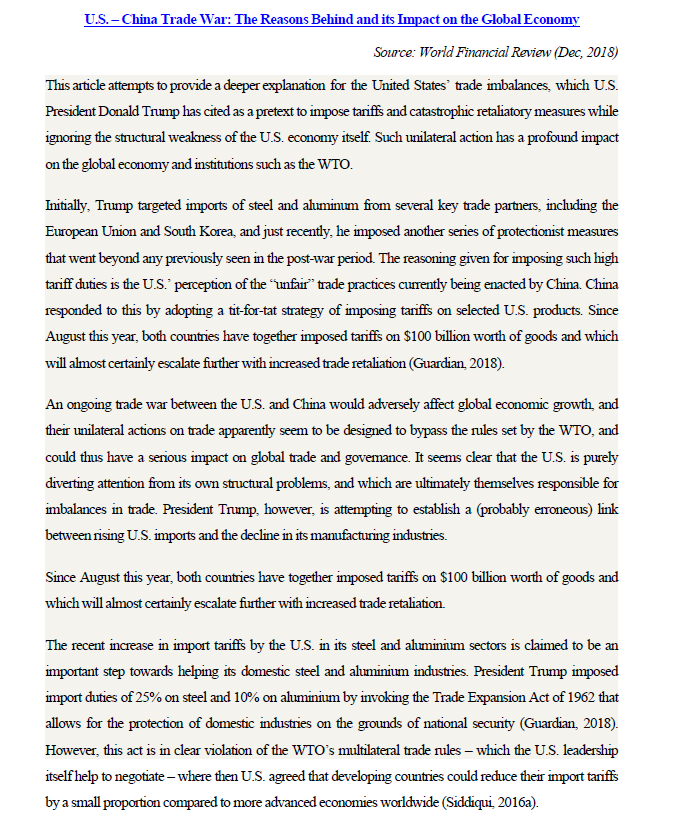
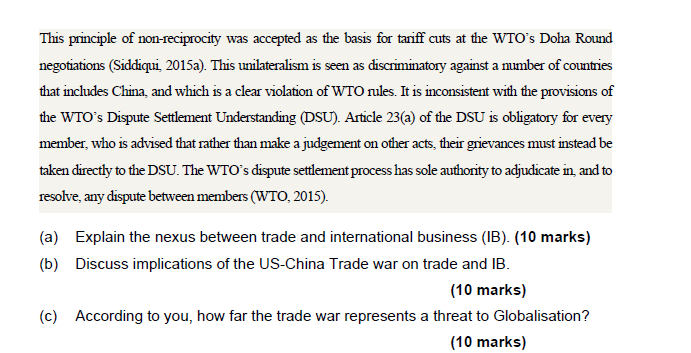
Source: World Financial Review (Dec, 2018) This article attempts to provide a deeper explanation for the United States' trade imbalances, which U.S. President Donald Trump has cited as a pretext to impose tariffs and catastrophic retaliatory measures while ignoring the structural weakness of the U.S. economy itself. Such unilateral action has a profound impact on the global economy and institutions such as the WTO. Initially, Trump targeted imports of steel and aluminum from several key trade partners, including the European Union and South Korea, and just recently, he imposed another series of protectionist measures that went beyond any previously seen in the post-war period. The reasoning given for imposing such high tariff duties is the U.S.' perception of the "unfair" trade practices currently being enacted by China. China responded to this by adopting a tit-for-tat strategy of imposing tariffs on selected U.S. products. Since August this year, both countries have together imposed tariffs on $100 billion worth of goods and which will almost certainly escalate further with increased trade retaliation (Guardian, 2018). An ongoing trade war between the U.S. and China would adversely affect global economic growth, and their unilateral actions on trade apparently seem to be designed to bypass the rules set by the WTO, and could thus have a serious impact on global trade and governance. It seems clear that the U.S. is purely diverting attention from its own structural problems, and which are ultimately themselves responsible for imbalances in trade. President Trump, however, is attempting to establish a (probably erroneous) link between rising U.S. imports and the decline in its manufacturing industries. Since August this year, both countries have together imposed tariffs on $100 billion worth of goods and which will almost certainly escalate further with increased trade retaliation. The recent increase in import tariffs by the U.S. in its steel and aluminium sectors is claimed to be an important step towards helping its domestic steel and aluminium industries. President Trump imposed import duties of 25% on steel and 10% on aluminium by invoking the Trade Expansion Act of 1962 that allows for the protection of domestic industries on the grounds of national security (Guardian, 2018). However, this act is in clear violation of the WTO's multilateral trade rules - which the U.S. leadership itself help to negotiate - where then U.S. agreed that developing countries could reduce their import tariffs by a small proportion compared to more advanced economies worldwide (Siddiqui, 2016a). This principle of non-reciprocity was accepted as the basis for tariff cuts at the WTO's Doha Round negotiations (Siddiqui, 2015a). This unilateralism is seen as discriminatory against a number of countries that includes China, and which is a clear violation of WTO rules. It is inconsistent with the provisions of the WTO's Dispute Settlement Understanding (DSU). Article 23(a) of the DSU is obligatory for every member, who is advised that rather than make a judgement on other acts, their grievances must instead be taken directly to the DSU. The WTO's dispute settlement process has sole authority to adjudicate in, and to resolve, any dispute between members (WTO, 2015). (a) Explain the nexus between trade and international business (IB). (10 marks) (b) Discuss implications of the US-China Trade war on trade and IB. (10 marks) (c) According to you, how far the trade war represents a threat to Globalisation? (10 marks)
Step by Step Solution
There are 3 Steps involved in it

Get step-by-step solutions from verified subject matter experts