







Question: Sparse Representation of Binary Numbers We can represent binary numbers as a list of increasing integers where each element is a power of two: type

![two: type nat-int list For example: 5 1 4] or 15-[1 2;](https://dsd5zvtm8ll6.cloudfront.net/si.experts.images/questions/2024/09/66f3d585f16d3_94166f3d58592f4e.jpg)
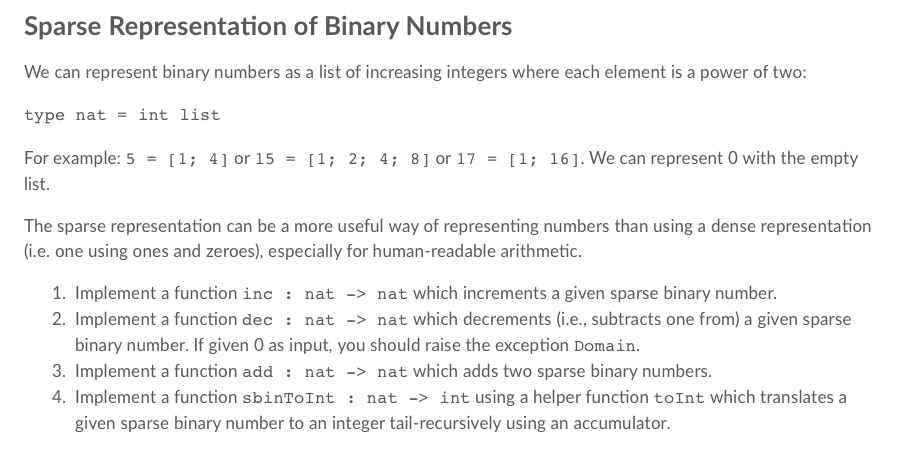
Sparse Representation of Binary Numbers We can represent binary numbers as a list of increasing integers where each element is a power of two: type nat-int list For example: 5 1 4] or 15-[1 2; 4; 8 or 17 16]. We can represent O with the empty ist. The sparse representation can be a more useful way of representing numbers than using a dense representation i.e. one using ones and zeroes), especially for human-readable arithmetic 1. Implement a functioninc nat -> nat which increments a given sparse binary number. 2. Implement a function dec : nat-> nat which decrements (i.e., subtracts one from) a given sparse binary number. If given 0 as input, you should raise the exception Domain 3. Implement a function add nat -> nat which adds two sparse binary numbers Implement a function sbinToInt nat -> int using a helper function toInt which translates a given sparse binary number to an integer tail-recursively using an accumulator Sparse Representation of Binary Numbers We can represent binary numbers as a list of increasing integers where each element is a power of two: type nat-int list For example: 5 1 4] or 15-[1 2; 4; 8 or 17 16]. We can represent O with the empty ist. The sparse representation can be a more useful way of representing numbers than using a dense representation i.e. one using ones and zeroes), especially for human-readable arithmetic 1. Implement a functioninc nat -> nat which increments a given sparse binary number. 2. Implement a function dec : nat-> nat which decrements (i.e., subtracts one from) a given sparse binary number. If given 0 as input, you should raise the exception Domain 3. Implement a function add nat -> nat which adds two sparse binary numbers Implement a function sbinToInt nat -> int using a helper function toInt which translates a given sparse binary number to an integer tail-recursively using an accumulator
Step by Step Solution
There are 3 Steps involved in it

Get step-by-step solutions from verified subject matter experts
 Study Help