







Question: SPECIAL RELATIVITY Answer the following problems. Show your solutions. 1. Find the value of y for the following situation. An Earth-bound observer measures 23.9 I119.
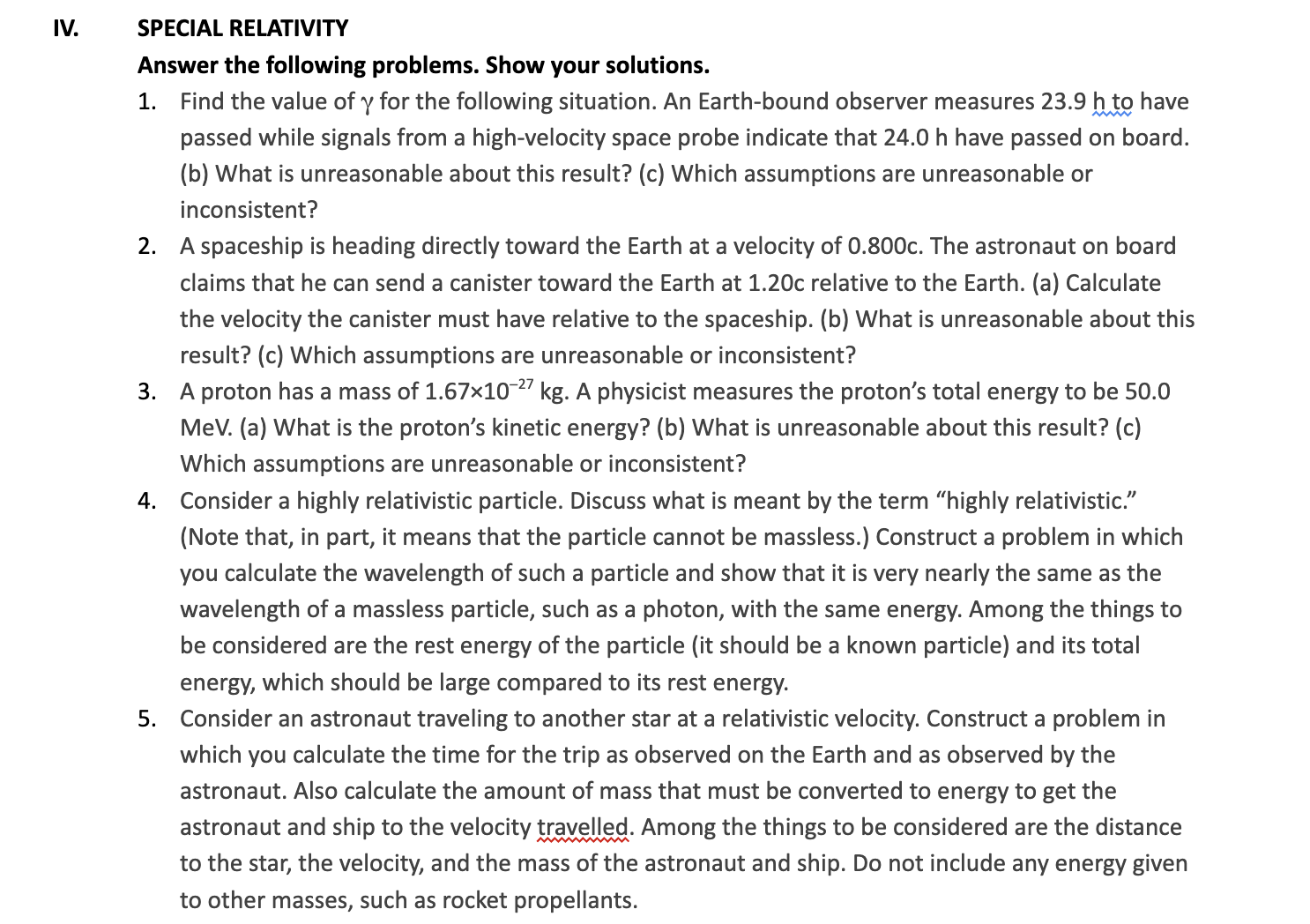
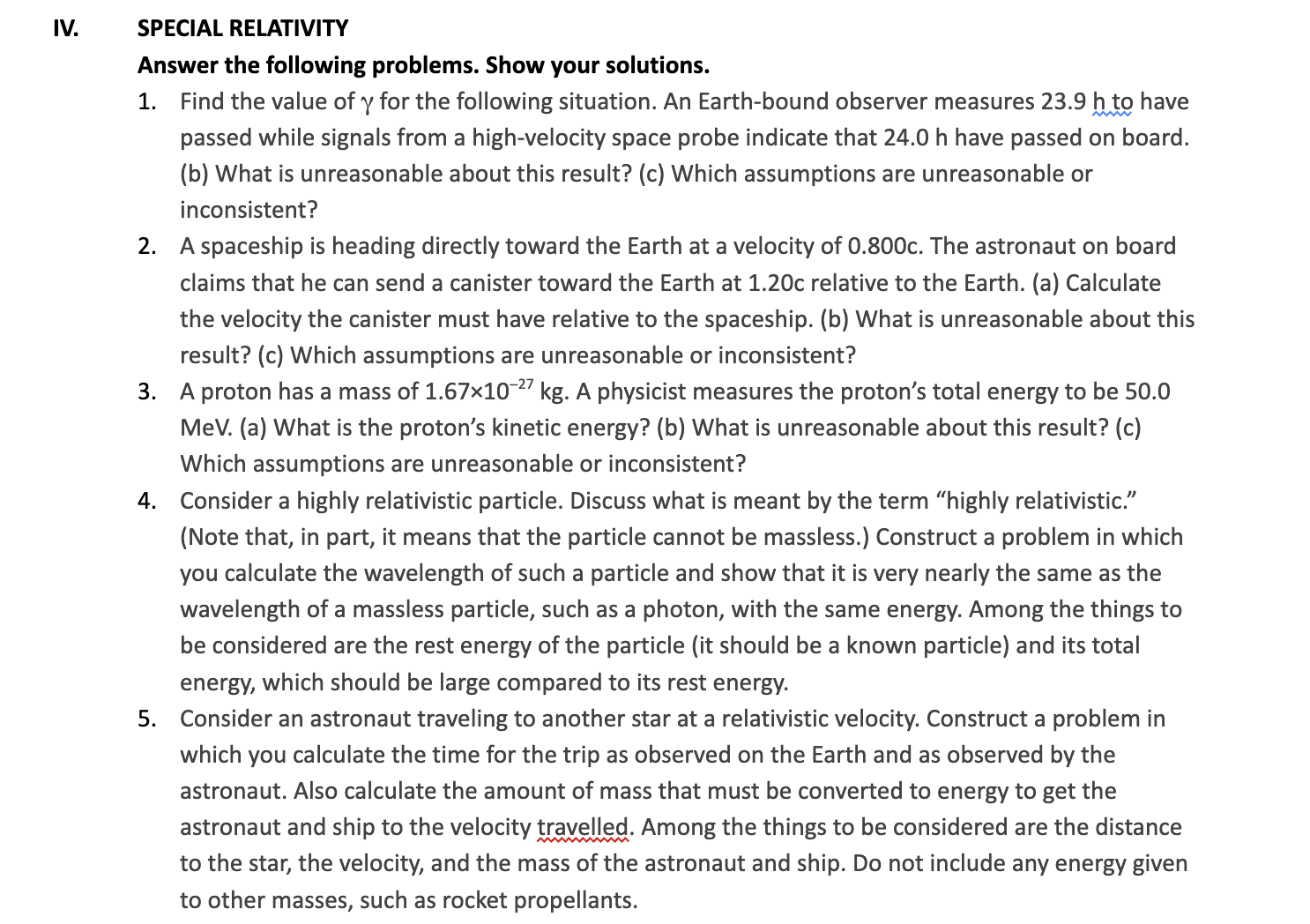
SPECIAL RELATIVITY Answer the following problems. Show your solutions. 1. Find the value of y for the following situation. An Earth-bound observer measures 23.9 I119. have passed while signals from a high-velocity space probe indicate that 24.0 h have passed on board. (b) What is unreasonable about this result? (c) Which assumptions are unreasonable or inconsistent? 2. A spaceship is heading directly toward the Earth at a velocity of 0.800c. The astronaut on board claims that he can send a canister toward the Earth at 1.20c relative to the Earth. (a) Calculate the velocity the canister must have relative to the spaceship. (b) What is unreasonable about this result? (c) Which assumptions are unreasonable or inconsistent? 3. A proton has a mass of 1.67x10'27 kg. A physicist measures the proton's total energy to be 50.0 MeV. (a) What is the proton's kinetic energy? (b) What is unreasonable about this result? (c) Which assumptions are unreasonable or inconsistent? 4. Consider a highly relativistic particle. Discuss what is meant by the term "highly relativistic.\" (Note that, in part, it means that the particle cannot be massless.) Construct a problem in which you calculate the wavelength ofsuch a particle and show that it is very nearly the same as the wavelength of a massless particle, such as a photon, with the same energy. Among the things to be considered are the rest energy ofthe particle (it should be a known particle) and its total energy, which should be large compared to its rest energy. 5. Consider an astronaut traveling to another star at a relativistic velocity. Construct a problem in which you calculate the time for the trip as observed on the Earth and as observed by the astronaut. Also calculate the amount of mass that must be converted to energy to get the astronaut and ship to the velocity travelled. Among the things to be considered are the distance to the star, the velocity, and the mass of the astronaut and ship. Do not include any energy given to other masses, such as rocket propellants
Step by Step Solution
There are 3 Steps involved in it

Get step-by-step solutions from verified subject matter experts
 Study Help