







Question: Specialized serial Processing vs. Generalized Parallel Processing (effect of time variability) A classical operational question is whether to have specialized or generalized workers when processing
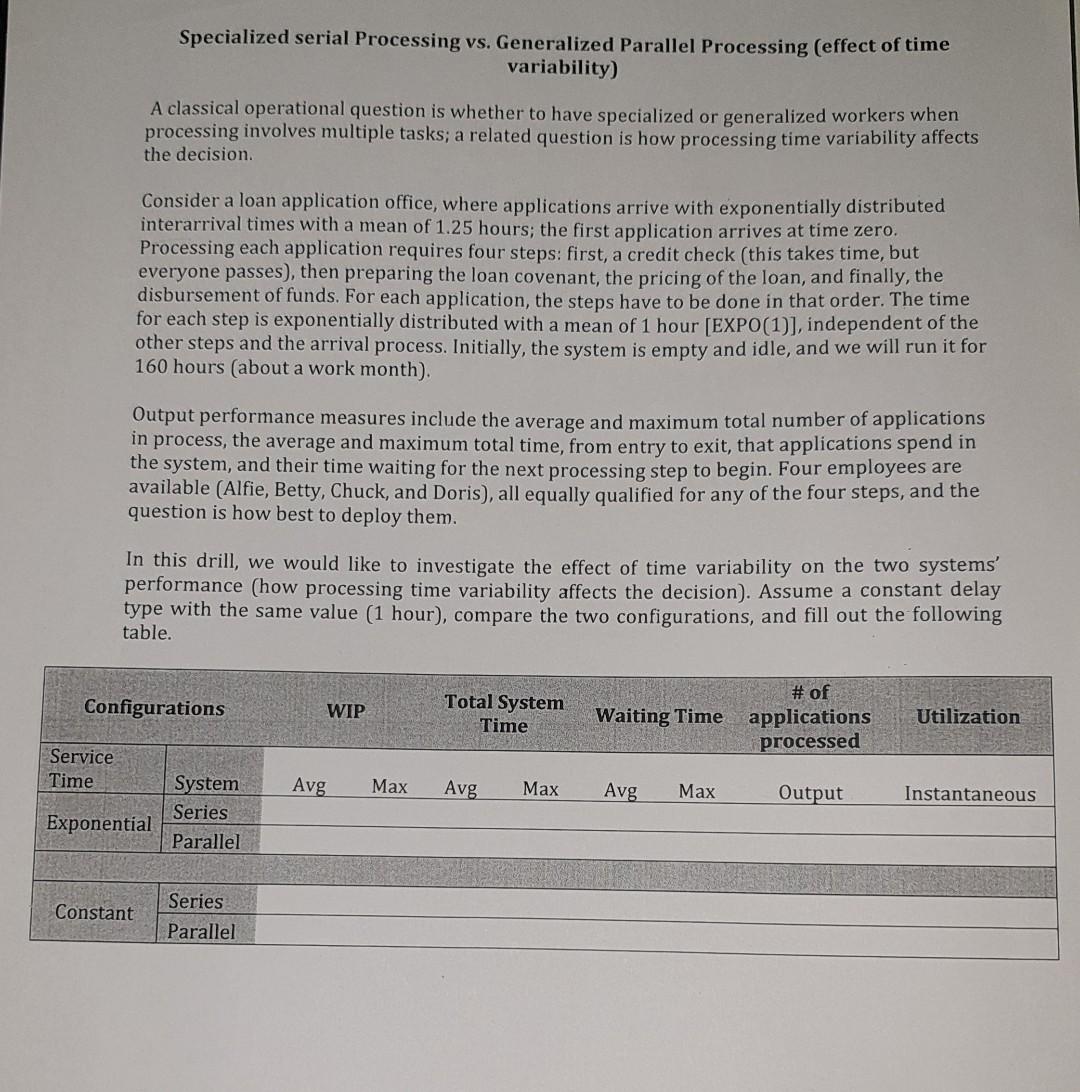
Specialized serial Processing vs. Generalized Parallel Processing (effect of time variability) A classical operational question is whether to have specialized or generalized workers when processing involves multiple tasks; a related question is how processing time variability affects the decision. Consider a loan application office, where applications arrive with exponentially distributed interarrival times with a mean of 1.25 hours; the first application arrives at time zero. Processing each application requires four steps: first, a credit check (this takes time, but everyone passes), then preparing the loan covenant, the pricing of the loan, and finally, the disbursement of funds. For each application, the steps have to be done in that order. The time for each step is exponentially distributed with a mean of 1 hour [EXPO(1)], independent of the other steps and the arrival process. Initially, the system is empty and idle, and we will run it for 160 hours (about a work month). Output performance measures include the average and maximum total number of applications in process, the average and maximum total time, from entry to exit, that applications spend in the system, and their time waiting for the next processing step to begin. Four employees are available (Alfie, Betty, Chuck, and Doris), all equally qualified for any of the four steps, and the question is how best to deploy them. In this drill, we would like to investigate the effect of time variability on the two systems' performance (how processing time variability affects the decision). Assume a constant delay type with the same value (1 hour), compare the two configurations, and fill out the following table
Step by Step Solution
There are 3 Steps involved in it

Get step-by-step solutions from verified subject matter experts
 Study Help