







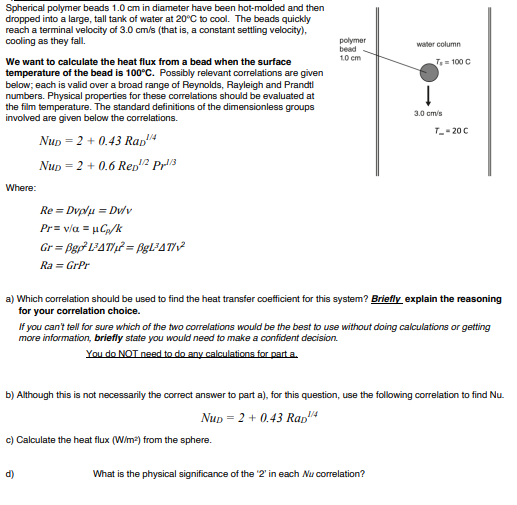
Question: Spherical polymer beads 1 . 0 c m in diameter have been hot - molded and then dropped into a large, tall tank of water
Spherical polymer beads in diameter have been hotmolded and then
dropped into a large, tall tank of water at to cool. The beads quickly
reach a terminal velocity of that is a constant settling velocity
cooling as they fall.
We want to calculate the heat flux from a bead when the surface
temperature of the bead is Possibly relevant correlations are given
below; each is valid over a broad range of Reynolds, Rayleigh and Prandtl
numbers. Physical properties for these correlations should be evaluated at
the film temperature. The standard definitions of the dimensionless groups
involved are given below the correlations.
Where:
a Which correlation should be used to find the heat transfer coefficient for this system? Briefly explain the reasoning
for your correlation choice.
If you can't tell for sure which of the two correlations would be the best to use without doing calculations or getting
more information, briefly state you would need to make a confident decision.
You do NOT need to do any calculations for part a
b Although this is not necessarily the correct answer to part a for this question, use the following correlation to find
c Calculate the heat flux from the sphere.
d
What is the physical significance of the in each correlation?
Step by Step Solution
There are 3 Steps involved in it
1 Expert Approved Answer
Step: 1 Unlock

Question Has Been Solved by an Expert!
Get step-by-step solutions from verified subject matter experts
Step: 2 Unlock
Step: 3 Unlock
 Study Help