







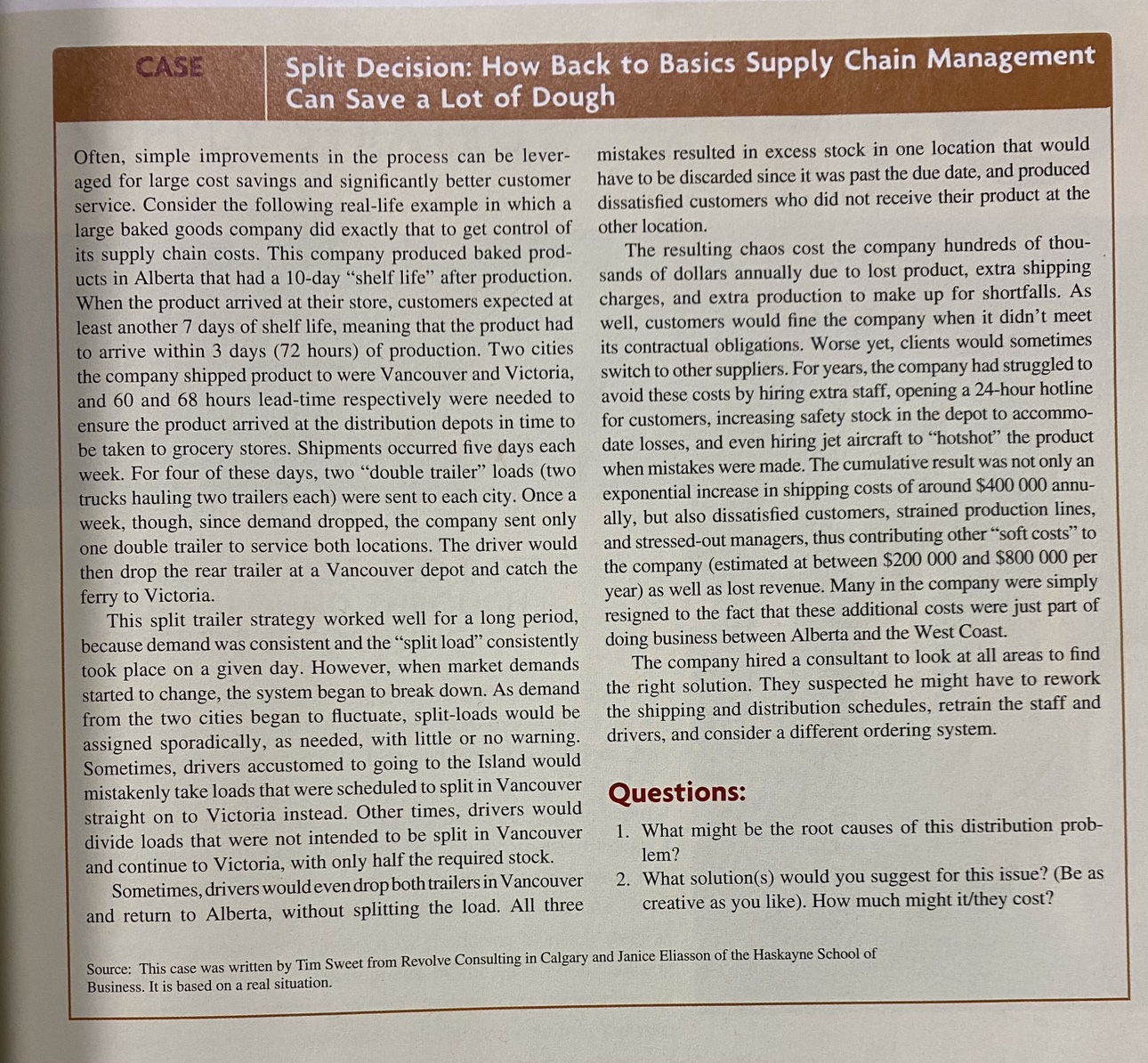
Question: Split Decision: How Back to Basics Supply Chain Management Can Save a Lot of Dough Often, simple improvements in the process can be lever -
Split Decision: How Back to Basics Supply Chain Management
Can Save a Lot of Dough
Often, simple improvements in the process can be lever
aged for large cost savings and significantly better customer
service. Consider the following reallife example in which a
large baked goods company did exactly that to get control of
its supply chain costs. This company produced baked prod
ucts in Alberta that had a day "shelf life" after production.
When the product arrived at their store, customers expected at
least another days of shelf life, meaning that the product had
to arrive within days hours of production. Two cities
the company shipped product to were Vancouver and Victoria,
and and hours leadtime respectively were needed to
ensure the product arrived at the distribution depots in time to
be taken to grocery stores. Shipments occurred five days each
week. For four of these days, two "double trailer" loads two
trucks hauling two trailers each were sent to each city. Once a
week, though, since demand dropped, the company sent only
one double trailer to service both locations. The driver would
then drop the rear trailer at a Vancouver depot and catch the
ferry to Victoria.
This split trailer strategy worked well for a long period,
because demand was consistent and the "split load" consistently
took place on a given day. However, when market demands
started to change, the system began to break down. As demand
from the two cities began to fluctuate, splitloads would be
assigned sporadically, as needed, with little or no warning.
Sometimes, drivers accustomed to going to the Island would
mistakenly take loads that were scheduled to split in Vancouver
straight on to Victoria instead. Other times, drivers would
divide loads that were not intended to be split in Vancouver
and continue to Victoria, with only half the required stock.
Sometimes, drivers would even drop both trailers in Vancouver
and return to Alberta, without splitting the load. All three
mistakes resulted in excess stock in one location that would
have to be discarded since it was past the due date, and produced
dissatisfied customers who did not receive their product at the
other location.
The resulting chaos cost the company hundreds of thou
sands of dollars annually due to lost product, extra shipping
charges, and extra production to make up for shortfalls. As
well, customers would fine the company when it didn't meet
its contractual obligations. Worse yet, clients would sometimes
switch to other suppliers. For years, the company had struggled to
avoid these costs by hiring extra staff, opening a hour hotline
for customers, increasing safety stock in the depot to accommo
date losses, and even hiring jet aircraft to "hotshot" the product
when mistakes were made. The cumulative result was not only an
exponential increase in shipping costs of around $ annu
ally, but also dissatisfied customers, strained production lines,
and stressedout managers, thus contributing other "soft costs" to
the company estimated at between $ and $ per
year as well as lost revenue. Many in the company were simply
resigned to the fact that these additional costs were just part of
doing business between Alberta and the West Coast.
The company hired a consultant to look at all areas to find
the right solution. They suspected he might have to rework
the shipping and distribution schedules, retrain the staff and
drivers, and consider a different ordering system.
Questions:
What might be the root causes of this distribution prob
lem?
What solutions would you suggest for this issue? Be as
creative as you like How much might itthey cost
Source: This case was written by Tim Sweet from Revolve Consulting in Calgary and Janice Eliasson of the Haskayne School of
Business. It is based on a real situation.
Step by Step Solution
There are 3 Steps involved in it
1 Expert Approved Answer
Step: 1 Unlock

Question Has Been Solved by an Expert!
Get step-by-step solutions from verified subject matter experts
Step: 2 Unlock
Step: 3 Unlock
 Study Help