







Question: spreadsheets (such as Microsoft Excel or OpenOffice Calc) are very suitable for calculating recursions. If we put 1 as the value in cell Al and
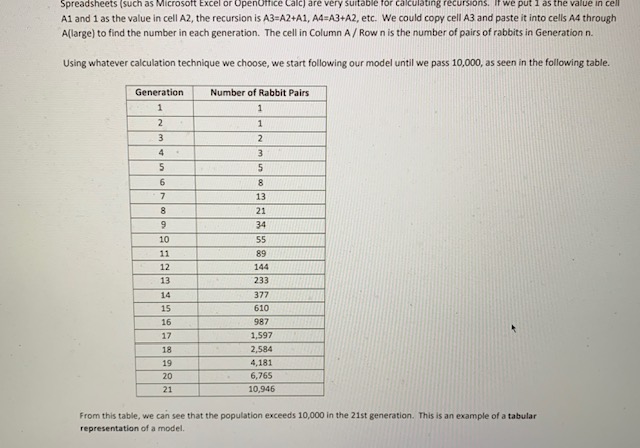
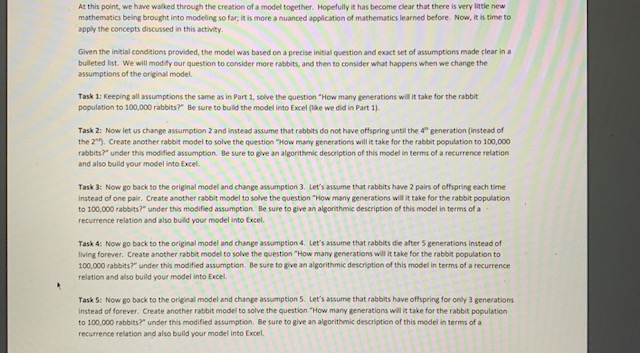
spreadsheets (such as Microsoft Excel or OpenOffice Calc) are very suitable for calculating recursions. If we put 1 as the value in cell Al and 1 as the value in cell A2, the recursion is A3=A2+A1, A4=A3+A2, etc. We could copy cell A3 and paste it into cells A4 through A(large] to find the number in each generation. The cell in Column A/ Row n is the number of pairs of rabbits in Generation n. Using whatever calculation technique we choose, we start following our model until we pass 10,000, as seen in the following table. Generation Number of Rabbit Pairs 1 1 2 3 5 13 21 34 10 55 11 89 12 144 13 233 14 377 15 610 16 987 17 1,597 18 2,584 19 4,181 20 6,765 21 10,946 From this table, we can see that the population exceeds 10,000 in the 21st generation. This is an example of a tabular representation of a model.At this point, we have walked through the creation of a model together. Hopefully it has become clear that there is very little new mathematics being brought into modeling so far, it is more a nuanced application of mathematics learned before. Now, It h time to apply the concepts discussed in this activity. Given the initial conditions provided, the model was based on a precise initial question and exact set of assumptions made clear in a bulleted list. We will modify our question to consider more rabbits, and then to consider what happens when we change the assumptions of the original model. Task 1: Keeping all assumptions the same as in Part 1, solve the question "How many generations will it take for the rabbit population to 100,000 rabbits?" Be sure to build the model into Excel (like we did in Part 1). Task 2: Now let us change assumption 2 and Instead assume that rabbits do not have offipring until the 4" generation (instead of the 2"). Create another rabbit model to solve the question "How many generations will it take for the rabbit population to 100,000 rabbits?" under this modified assumption. Be sure to give an algorithmic description of this model In terms of a recurrence relation and also build your model into Excel. Task : Now go back to the original model and change assumption 3. Let's assume that rabbits have 2 pairs of offupring each time Instead of one pair. Create another rabbit model to solve the question "How many generations will it take for the rabbit population to 100,000 rabbits?" under this modified assumption. Be sure to give an algorithmnic description of this model in terms of a . recurrence relation and also build your model into Excel. Task 4: Now go back to the original model and change assumptions, Let's assume that rabbits cle after 5 generations Instead of living forever. Create another rabbit model to solve the question "How many generations will it take for the rabbit population to 100,000 rabbit?" under this modified assumption, Be sure to give an algorithmic description of this model in terms of a recurrence relation and ato build your model into Excel Task ": Now go back to the original model and change assumption 5. Let's assume that rabbits have offspring for only 3 generations Instead of forever. Create another rabbit model to solve the question "How many generations will it take for the rabbit population to 100,000 rabbits?" under this modified astumption, Be sure to give an algorithmnic description of this model in terms of a recurrence relation and also build your model into Excel
Step by Step Solution
There are 3 Steps involved in it

Get step-by-step solutions from verified subject matter experts
 Study Help