



Question: SPSS Software is used to solve the following question Use the following information to answer (manually) Questions #1 through #7: Businesses commonly purchase copier machines
SPSS Software is used to solve the following question
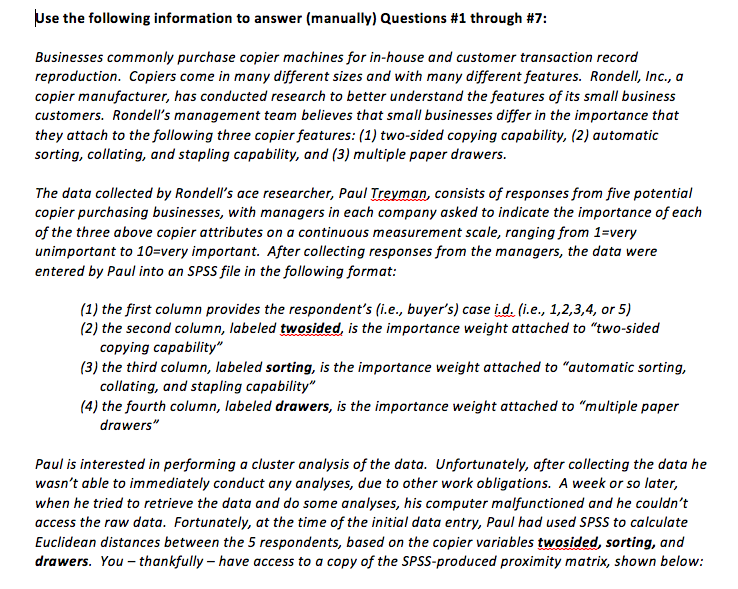
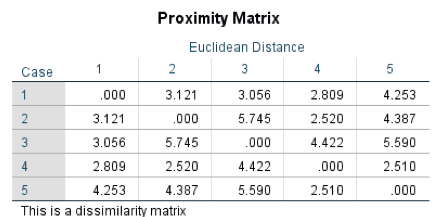
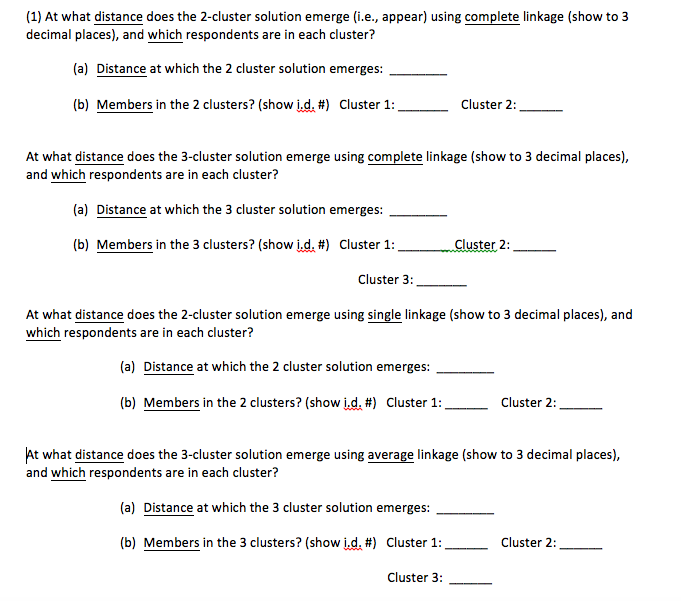
Use the following information to answer (manually) Questions #1 through #7: Businesses commonly purchase copier machines for in-house and customer transaction record reproduction. Copiers come in many different sizes and with many different features. Rondell, Inc., a copier manufacturer, has conducted research to better understand the features of its small business customers. Rondell's management team believes that small businesses differ in the importance that they attach to the following three copier features: (1) two-sided copying capability, (2) automatic sorting, collating, and stapling capability, and (3) multiple paper drawers. The data collected by Rondell's ace researcher, Paul Treyman, consists of responses from five potential copier purchasing businesses, with managers in each company asked to indicate the importance of each of the three above copier attributes on a continuous measurement scale, ranging from 1=very unimportant to 10-very important. After collecting responses from the managers, the data were entered by Paul into an SPSS file in the following format: (1) the first column provides the respondent's (i.e., buyer's) case id.(ie, 1,2,3,4, or 5) (2) the second column, labeled twosided, is the importance weight attached to "two-sided copying capability" collating, and stapling capabilit drawers" (3) the third column, labeled sorting, is the importance weight attached to "automatic sorting, (4) the fourth column, labeled drawers, is the importance weight attached to "multiple paper Paul is interested in performing a cluster analysis of the data. Unfortunately, after collecting the data he wasn't able to immediately conduct any analyses, due to other work obligations. A week or so later when he tried to retrieve the data and do some analyses, his computer malfunctioned and he couldn't access the raw data. Fortunately, at the time of the initial data entry, Paul had used SPSS to calculate Euclidean distances between the 5 respondents, based on the copier variables twosided, sorting, and drawers. You -thankfully- have access to a copy of the SPSS-produced proximity matrix, shown below: Proximity MatriX Euclidean Distance Case 3.121 3.056 3.121 3.056 2.809 4.253 2.809 2.520 4.422 4.253 4.387 5.590 2.510 5.745 5.745 2.520 4.387 4.422 5.590 2.510 This is a dissimilarity matrix (1) At what distance does the 2-cluster solution emerge (i.e., appear) using complete linkage (show to 3 decimal places), and which respondents are in each cluster? (a) Distance at which the 2 cluster solution emerges: (b) Members in the 2 clusters? (show.d. #) Cluster 1: Cluster 2: At what distance does the 3-cluster solution emerge using complete linkage (show to 3 decimal places), and which respondents are in each cluster? (a) Distance at which the 3 cluster solution emerges: (b) Member in the 3 dlsshowluster 1: Cluster 3: At what distance does the 2-cluster solution emerge using single linkage (show to 3 decimal places), and which respondents are in each cluster? (a) Distance at which the 2 cluster solution emerges: (b) Members in the 2 clusters? (show id. #) Cluster 1: Cluster 2: At what distance does the 3-cluster solution emerge using average linkage (show to 3 decimal places), and which respondents are in each cluster? (a) Distance at which the 3 cluster solution emerges: (b) Members in the 3 clusters?(show id,.luster 1: Cluster 2: Cluster 3:_ Use the following information to answer (manually) Questions #1 through #7: Businesses commonly purchase copier machines for in-house and customer transaction record reproduction. Copiers come in many different sizes and with many different features. Rondell, Inc., a copier manufacturer, has conducted research to better understand the features of its small business customers. Rondell's management team believes that small businesses differ in the importance that they attach to the following three copier features: (1) two-sided copying capability, (2) automatic sorting, collating, and stapling capability, and (3) multiple paper drawers. The data collected by Rondell's ace researcher, Paul Treyman, consists of responses from five potential copier purchasing businesses, with managers in each company asked to indicate the importance of each of the three above copier attributes on a continuous measurement scale, ranging from 1=very unimportant to 10-very important. After collecting responses from the managers, the data were entered by Paul into an SPSS file in the following format: (1) the first column provides the respondent's (i.e., buyer's) case id.(ie, 1,2,3,4, or 5) (2) the second column, labeled twosided, is the importance weight attached to "two-sided copying capability" collating, and stapling capabilit drawers" (3) the third column, labeled sorting, is the importance weight attached to "automatic sorting, (4) the fourth column, labeled drawers, is the importance weight attached to "multiple paper Paul is interested in performing a cluster analysis of the data. Unfortunately, after collecting the data he wasn't able to immediately conduct any analyses, due to other work obligations. A week or so later when he tried to retrieve the data and do some analyses, his computer malfunctioned and he couldn't access the raw data. Fortunately, at the time of the initial data entry, Paul had used SPSS to calculate Euclidean distances between the 5 respondents, based on the copier variables twosided, sorting, and drawers. You -thankfully- have access to a copy of the SPSS-produced proximity matrix, shown below: Proximity MatriX Euclidean Distance Case 3.121 3.056 3.121 3.056 2.809 4.253 2.809 2.520 4.422 4.253 4.387 5.590 2.510 5.745 5.745 2.520 4.387 4.422 5.590 2.510 This is a dissimilarity matrix (1) At what distance does the 2-cluster solution emerge (i.e., appear) using complete linkage (show to 3 decimal places), and which respondents are in each cluster? (a) Distance at which the 2 cluster solution emerges: (b) Members in the 2 clusters? (show.d. #) Cluster 1: Cluster 2: At what distance does the 3-cluster solution emerge using complete linkage (show to 3 decimal places), and which respondents are in each cluster? (a) Distance at which the 3 cluster solution emerges: (b) Member in the 3 dlsshowluster 1: Cluster 3: At what distance does the 2-cluster solution emerge using single linkage (show to 3 decimal places), and which respondents are in each cluster? (a) Distance at which the 2 cluster solution emerges: (b) Members in the 2 clusters? (show id. #) Cluster 1: Cluster 2: At what distance does the 3-cluster solution emerge using average linkage (show to 3 decimal places), and which respondents are in each cluster? (a) Distance at which the 3 cluster solution emerges: (b) Members in the 3 clusters?(show id,.luster 1: Cluster 2: Cluster 3:_
Step by Step Solution
There are 3 Steps involved in it

Get step-by-step solutions from verified subject matter experts