







Question: sql Consider the following conceptual schema of a sample database domain that contains information about undergraduate and postgraduate students, subjects, and enrolments performed by the
sql
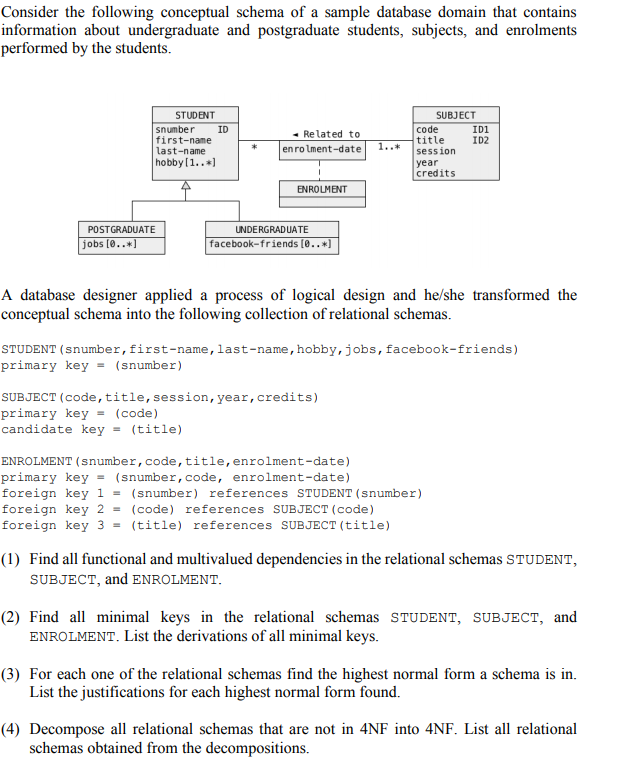
Consider the following conceptual schema of a sample database domain that contains information about undergraduate and postgraduate students, subjects, and enrolments performed by the students. STUDENT SUBJECT ID1 ID2 snumber ID first-name last-name hobby [1..] - Related to enrolment-date code title session year credits ENROLMENT POSTGRADUATE UNDERGRADUATE jobs (0..* facebook-friends [0..* A database designer applied a process of logical design and he/she transformed the conceptual schema into the following collection of relational schemas. STUDENT (snumber,first-name, last-name, hobby,jobs, facebook-friends) primary key -(snumber) SUBJECT (code,title,session,year, credits) primary key -(code) candidate key(title) ENROLMENT (snumber, code, title,enrolment-date) primary key = (snumber, code, enrolment-date) foreign key 1 snumber) references STUDENT (snumber) foreign key 2 (code) references SUBJECT (code) foreign key 3 = (title) references SUBJECT (title) (1) Find all functional and multivalued dependencies in the relational schemas STUDENT SUBJECT, and ENROLMENT (2) Find all minimal keys in the relational schemas STUDENT, SUBJECT, and ENROLMENT. List the derivations of all minimal keys. (3) For each one of the relational schemas find the highest normal form a schema is in. List the justifications for each highest normal form found. (4) Decompose all relational schemas that are not in 4NF into 4NF. List all relational schemas obtained from the decompositions
Step by Step Solution
There are 3 Steps involved in it

Get step-by-step solutions from verified subject matter experts
 Study Help