







Question: SQL, From this case I need answer for letter E and H only E.- Is it possible for deadlock to occur between two Sale Transactions?
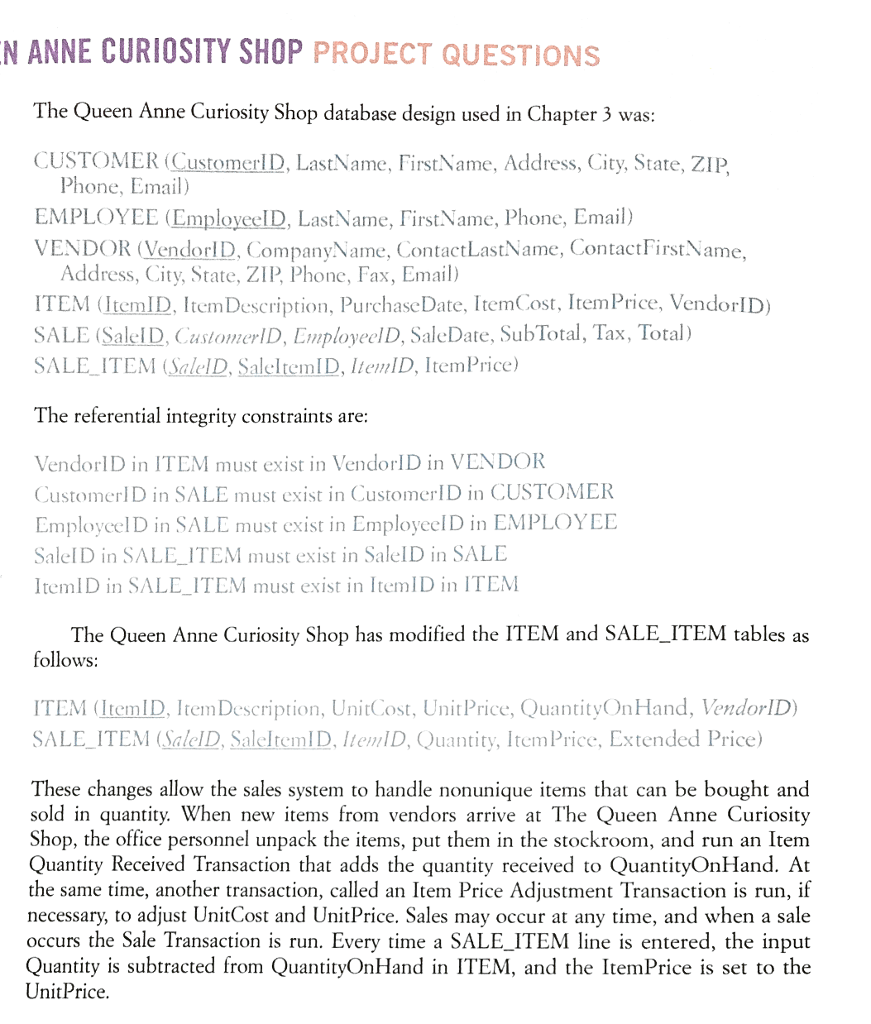
SQL, From this case I need answer for letter E and H only
E.- Is it possible for deadlock to occur between two Sale Transactions? Why or why not? Is it possible for deadlock to occur between a Sale Transaction and an Item Quantity Received Transaction? Why or why not?
H.-The Queen Anne Curiosity Shop has developed the following procedure for backup and recovery. The company backs up the entire database from the server to a tape every Saturday night. The tapes are taken to a safety deposit box at a local bank on the following Thursday. Printed paper records of all sales are kept for 5 years. If the database is ever lost, the plan is to restore the database from the last full backup and reprocess all the sales records. Do you think this backup and recovery program is sufficient for the Queen Anne Curiosity Shop? What problems might occur? What alternatives exist? Describe any changes you think the company should make to this system.
N ANNE CURIOSITY SHOP PROJECT QUESTIONS The Queen Anne Curiosity Shop database design used in Chapter 3 was CUSTOMER (CustomerlD, LastName, FirstName, Address, City, State, ZIP Phone, Email) EMPLOYEE (EmployeelD, LastName, First.Name, Phone, Email) VENDOR (VendorlD, CompanyName, ContactLastName, ContactFirstName, Address, City, State, ZIP, Phone, Fax, Email) ITEM (ItemID, ItemDescription, PurchaseDate, ItemCost, Item Price, VendorID) SALE (SaleD, CustomerlD, EmployeelD, SaleDate, SubTotal, Tax, Total) SALE ITEM SaleID, SaleltemID, ItemlD, ItemPrice The referential integrity constraints are: VendorID in ITEM must exist in VendorID in VENDOR CustomerlD in SALE must exist in CustomerID in CUSTOMER EmploycelD in SALE must exist in EmployeelD in EMPLOYEE SalelD in SALE ITEM must exist in SalelD in SALD temID in SALE_ITEM must exist in ItemID in ITEM The Queen Anne Curiosity Shop has modified the ITEM and SALE_ITEM tables as follows: ITEM (ItemID, ItemDescription, UnitCost, Unit Price, QuantityOnHand, VendorlD) SALE ITEM (SalelD, SaleltemID, ItemD, Quantity, ItemPrice, Extended Price) These changes allow the sales system to handle nonunique items that can be bought and sold in quantity. When new items from vendors arrive at The Queen Anne Curiosity Shop, the office personnel unpack the items, put them in the stockroom, and run an Iterm Quantity Received Transaction that adds the quantity received to QuantityOnHand. At the same time, another transaction, called an Item Price Adjustment Transaction is run, if necessary, to adjust UnitCost and UnitPrice. Sales may occur at any time, and when a sale occurs the Sale Transaction is run. Every time a SALE_ITEM line is entered, the input Quantity is subtracted from QuantityOnHand in ITEM, and the ItemPrice is set to the UnitPrice
Step by Step Solution
There are 3 Steps involved in it

Get step-by-step solutions from verified subject matter experts
 Study Help