







Question: SQL Query Question. Use the PVFC database if you have it. These are my notes: RETRIEVE ALL COLUMNS AND ROWS select * from product_t select
SQL Query Question. Use the PVFC database if you have it.
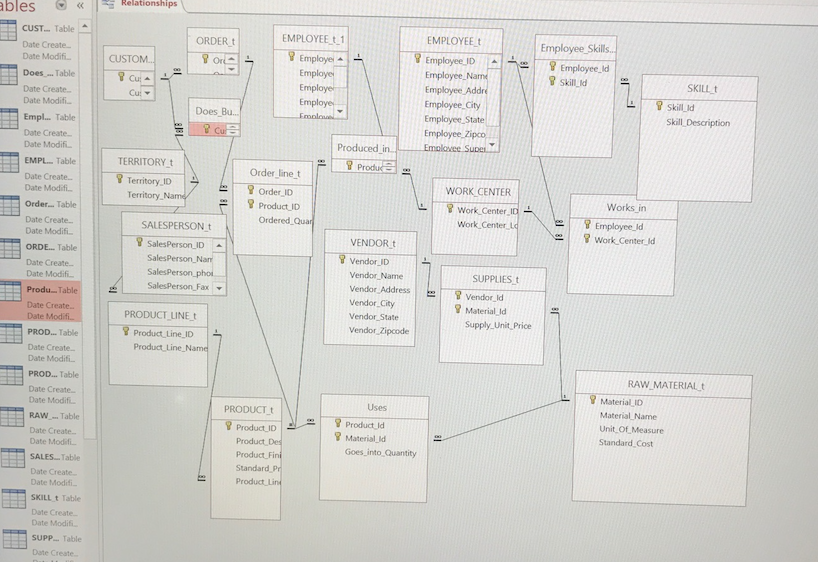
These are my notes:
RETRIEVE ALL COLUMNS AND ROWS
select * from product_t
select * from employee_t
select * from order_t
RETRIEVE INDIVIDUAL COLUMNS
select productid, productstandardprice, productdescription from product_t
RETRIEVE AND RENAME COLUMNS
select productid as id, productstandardprice as price, productdescription as description from product_t
RETRIEVE ROWS WHERE CRITERIA ARE MET
select productdescription, productstandardprice from product_t where productstandardprice
select employeename, employeeaddress from employee_t where employeestate = 'TN'
select salespersonname, salespersontelephone from salesperson_t where salesterritoryid = 2
USING SIMPLE MATH
select productid, productstandardprice, productstandardprice + 100 as plus100 from product_t
select productid, productstandardprice, productstandardprice * 1.1 as plus10percentmarkup from product_t
USING FUNCTIONS
SUM and AVG only for numeric data types; COUNT, MIN, MAX for any data type
AVG
select avg(productstandardprice) as averageprice from product_t
COUNT
select count(*) as numitems from ordelline_t where orderid = 4
MIN / MAX
select min(paymentamount) as minimumpayment, max(paymentamount) as maximumpayment from payment_t
USING COMPARISON OPERATORS
select orderid, orderdate from order_t where orderdate > '1-jan-2010'
select productdescription, productfinish from product_t where productfinish != 'cherry'
RETRIEVING NULL VALUES
select * from customer_t where customerpostalcode is null
USING TEXT WILDCARDS
select productdescription from product_t where productdescription like '%desk'
select productdescription from product_t where productdescription like '%drawer%'
USING BOOLEAN OPERATORS - COMPOUND WHERE STATEMENTS
select productdescription, productstandardprice
from product_t where productstandardprice > 300 and productstandardprice
select productdescription, productfinish, productstandardprice
from product_t
where productdescription like '%table'
or productdescription like '%bookcase'
select productdescription, productfinish, productstandardprice
from product_t
where productdescription like '%table'
or productdescription like '%bookcase'
and productstandardprice > 175
select productdescription, productfinish, productstandardprice
from product_t
where (productdescription like '%table'
or productdescription like '%bookcase')
and productstandardprice > 175
select productdescription, productstandardprice
from product_t where productstandardprice > 300 and productstandardprice
RETRIEVING ROWS WITH DISTINCT VALUES
select orderid from ordelline_t
select distinct orderid from ordelline_t
RETRIEVING ROWS WITH VALUES IN / NOT IN -- LISTS
select customername, customercity, customerstate from customer_t where customerstate in ('FL', 'TX', 'CA', 'HI')
SORTING RESULTS USING ORDER BY
select customername, customercity, customerstate from customer_t where customerstate in ('FL', 'TX', 'CA', 'HI') order by customerstate, customername
GROUPING RESULTS USING GROUP BY
paired with aggregate functions - COUNT, SUM, AVG, MIN, MAX
select productfinish, avg(productstandardprice) as price from product_t where productfinish in ('cherry', 'pine', 'oak', 'birch') group by productfinish
CONSTRAINING AGGREGATE RESULTS WITH HAVING
constraint on aggregate function - like another where clause
select productfinish, avg(productstandardprice) as price from product_t where productfinish in ('cherry', 'pine', 'oak', 'birch') group by productfinish having avg(productstandardprice) > 500
ROUNDING / CASTING
select productid, productstandardprice, productstandardprice * 1.1 as plus10percentmarkup from product_t
select productid, productstandardprice, cast(productstandardprice * 1.1 as decimal(6,2)) as plus10percentmarkup from product_t
select materialname, materialstandardprice, materialstandardprice * 1.33 as markup, round(materialstandardprice * 1.33, 2) as roundedMarkup from rawmaterial_t
DATES
select getdate()
select employeeid, employeename, employeebirthdate, datediff(year, employeebirthdate, getdate()) as age from employee_t
RETRIEVE ROWS WHERE CRITERIA ARE MET
Retrieve names of customers from New York
select customername, customerstate from customer_t where customerstate = 'NY'
Retrieve product description for products with birch finish
select productdescription, productfinish from product_t where productfinish = 'birch'
USING SIMPLE MATH
Retrieve raw material name, standardprice, and a markup of 33%
select materialname, materialstandardprice, materialstandardprice * 1.33 as markup from rawmaterial_t
USING FUNCTIONS
SUM and AVG only for numeric data types; COUNT, MIN, MAX for any data type
AVG / SUM
Return average payment amount and total of all payments
select avg(paymentamount) as avgpayment, sum(paymentamount) as totalpayments from payment_t
COUNT
Count the number of customers in New Mexico
select count(*) as numcustomers from customer_t where customerstate = 'NM'
MIN / MAX
Retrieve the cost of the least and most expensive raw material types
select min(materialstandardprice), max(materialstandardprice) from rawmaterial_t
Retrieve the birthdate of the oldest employee and the date of the most recent employee hire
select min(employeebirthdate), max(employeedatehired) from employee_t
USING COMPARISON OPERATORS
Retrieve names of employees outside of Tennessee
select employeename from employee_t where employeestate != 'TN'
Retrieve product descriptions for products with standard price less than or equal to 200
select productdescription from product_t where productstandardprice
RETRIEVING NULL VALUES
Retrieve product descriptions for products with a photo
select productdescription from product_t where photo is not null
USING TEXT WILDCARDS
Retrieve customers with 'furniture' in their name
select customername from customer_t where customername like '%furniture%'
USING BOOLEAN OPERATORS - COMPOUND WHERE STATEMENTS
Retrieve names of customers with 'furniture' in their name within the state of New York
select customername, customercity, customerstate from customer_t where customername like '%furniture%' and customerState = 'NY'
Retrieve product description and standard price of products with finish of 'oak' or 'walnut' and price greater than 300
select productdescription, productfinish, productstandardprice from product_t where productfinish = 'oak' or productfinish = 'walnut' and productstandardprice > 300
select productdescription, productfinish, productstandardprice from product_t where (productfinish = 'oak' or productfinish = 'walnut') and productstandardprice > 300
RETRIEVING ROWS WITH DISTINCT VALUES
Retrieve the unique skill ids possessed by employees
select skillid from employeeskills_t
select distinct skillid from employeeskills_t
RETRIEVING ROWS WITH VALUES IN / NOT IN -- LISTS
Retrieve the product descriptions and finishes of products with finish of cherry, pine, or leather
select productdescription, productfinish from product_t where productfinish in ('cherry', 'pine', 'leather')
Retrieve the employee ids of employees with band saw (BS12) or router (RT1) skills
select employeeid, skillid from employeeskills_t where skillid in ('BS12', 'RT1')
SORTING RESULTS USING ORDER BY
Retrieve the order ids and dates of orders between '1/1/2010' and '6/1/2010' in ascending order of date
select orderid, orderdate from order_t where orderdate > '1/1/2010' and orderdate
Retrieve the product descriptions and standard prices of products with price greater than 300 in descending order of price
select productdescription, productstandardprice from product_t where productstandardprice > 300 order by productstandardprice desc
GROUPING RESULTS USING GROUP BY
paired with aggregate functions - COUNT, SUM, AVG, MIN, MAX
Retrieve the states and count of customers from each state
select customerstate, count(customerstate) as count from customer_t group by customerstate
Retrieve the material and average material standard price of ash, walnut, pine, birch raw materials
select material, avg(materialstandardprice) from rawmaterial_t where material in ('ash', 'walnut', 'pine', 'birch') group by material
CONSTRAINING AGGREGATE RESULTS WITH HAVING
constraint on aggregate function - like another where clause
Retrieve the states and count of customers from each state; limit results to states with more than one customer
select customerstate, count(customerstate) as count from customer_t group by customerstate having count(customerstate) > 1
Retrieve the material and average material standard price of ash, walnut, pine, birch raw materials; limit results to materials with average material standard price greater than 60
select material, avg(materialstandardprice) from rawmaterial_t where material in ('ash', 'walnut', 'pine', 'birch') group by material having avg(materialstandardprice) > 60
*********************
SUMMARY TEST QUERY
Retrieve the material and average material standard price of ash, walnut, pine, birch raw materials; limit results to materials with average material standard price greater than 60; display in descending order of average material standard price
select material, avg(materialstandardprice) as avgprice from rawmaterial_t where material in ('ash', 'walnut', 'pine', 'birch') group by material having avg(materialstandardprice) > 60 order by avg(materialstandardprice) desc
SUBQUERIES
Retrieve products and quantities ordered in orders placed between 3/10/2010 and 3/12/2010
First, create a subquery for all orders between 3/10/2010 and 3/12/2010
Then use the extracted order ids to retrieve product ids, product descriptions, and ordered quantities
select product_t.productid, product_t.productdescription, ordelline_t.orderedquantity
from product_t, ordelline_t
where product_t.productid = ordelline_t.productid
and ordelline_t.orderid in
(select order_t.orderid from order_t where order_t.orderDate '3/10/2010')
=============================================
EQUI/INNER/NATURAL JOIN
TWO TABLES
Link salesperson information to orders
Order id, order date, salesperson id, salesperson name
select order_t.orderid, order_t.orderdate, order_t.salespersonid, salesperson_t.salespersonname
from order_t, salesperson_t where order_t.salespersonid = salesperson_t.salespersonid
Link product information to order lines
Order id, product id, ordered quantity, product description
select ordelline_t.orderid, ordelline_t.productid, ordelline_t.orderedquantity, product_t.productdescription
from ordelline_t, product_t where ordelline_t.productid = product_t.productid
THREE TABLES
SALESPERSON INFO WITH CUSTOMERS THEY'VE HELPED PLACE ORDERS
First, link salesperson information to orders
Order id, order date, salesperson id, salesperson name, salesperson state
select order_t.orderid, order_t.orderdate, order_t.salespersonid, salesperson_t.salespersonname
from order_t, salesperson_t where order_t.salespersonid = salesperson_t.salespersonid
Now add customer information
Customer id, customer name, customer state
select order_t.orderid, order_t.orderdate, customer_t.customerid, customer_t.customername, customer_t.customerstate, order_t.salespersonid, salesperson_t.salespersonname, salesperson_t.salespersonstate
from order_t, customer_t, salesperson_t where order_t.customerid = customer_t.customerid and order_t.salespersonid = salesperson_t.salespersonid
HOW MANY ORDERS DID EACH SALESPERSON PLACE IN EACH CUSTOMER STATE?
First, how many orders per salesperson?
Salesperson name, count of orders
select salesperson_t.salespersonname, count(order_t.orderid) as numberorders
from salesperson_t, order_t where salesperson_t.salespersonid = order_t.salespersonid
group by salesperson_t.salespersonid, salesperson_t.salespersonname
Now how many orders per salesperson per customer state?
Add customer and state information
Customer state, salesperson state
select salesperson_t.salespersonname, salesperson_t.salespersonstate, customer_t.customerstate, count(order_t.orderid) as numberorders
from salesperson_t, order_t, customer_t where salesperson_t.salespersonid = order_t.salespersonid and order_t.customerid = customer_t.customerid
group by salesperson_t.salespersonid, salesperson_t.salespersonname, salesperson_t.salespersonstate, customer_t.customerstate
ORDER TOTAL
What is the total amount for each order?
Order id, order date, customer id, order total
select order_t.orderid, order_t.orderdate, order_t.customerid, sum(ordelline_t.orderedquantity * product_t.productstandardprice) as ordertotal
from order_t, ordelline_t, product_t where order_t.orderid = ordelline_t.orderid and ordelline_t.productid = product_t.productid
group by order_t.orderid, order_t.orderdate, order_t.customerid
FOUR TABLES
COMPLETE ORDER LINE ITEMS FOR ORDER ID 4
Customer id, customer name, order id, order date,
product id, ordered quantity, product description, product standard price, order line total
select customer_t.customerid, customer_t.customername, order_t.orderid, order_t.orderdate,
ordelline_t.productid, ordelline_t.orderedquantity, product_t.productdescription, product_t.productstandardprice,
(ordelline_t.orderedquantity * product_t.productstandardprice) as linetotal
from customer_t, order_t, ordelline_t, product_t
where customer_t.customerid = order_t.customerid
and order_t.orderid = ordelline_t.orderid
and ordelline_t.productid = product_t.productid
and order_t.orderid = 4
WHAT IS THE AVERAGE ORDER TOTAL FOR EACH CUSTOMER?
Customer id, customer name, average order total
select customer_t.customerid, customer_t.customername,
(sum(ordelline_t.orderedquantity * product_t.productstandardprice) / count(distinct(order_t.orderid))) as avgorder
from customer_t, order_t, ordelline_t, product_t
where customer_t.customerid = order_t.customerid and order_t.orderid = ordelline_t.orderid and ordelline_t.productid = product_t.productid
group by customer_t.customerid, customer_t.customername
order by customer_t.customerid
Retrieve a list of salespersons and the orders they have each facilitated, including order ID, order date, and order total. Each order facilitated by a salesperson contributes to their total sales. Also provide the contribution of each order to the salesperson's total sales, as a percentage of total sales. Round the percentage of total sales to two digits beyond the decimal point using the 'round' function - round(#,2) where # is the number to round. The query should output the salesperson name, order ID, order date, order total, and percentage of salesperson total sales. Sort the list first in alphabetical order of salesperson name, then by ascending order date, and then with larger order totals listed first.
select salesperson_t.salespersonname, order_t.orderid,
order_t.orderdate,
sum(product_t.productstandardprice * ordelline_t.orderedquantity) as
ordertotal,
round(sum(product_t.productstandardprice *
ordelline_t.orderedquantity) / derivedtable.salespersontotal, 2) as
percentoftotal
from product_t, ordelline_t, order_t, salesperson_t,
(select salesperson_t.salespersonid,
sum(product_t.productstandardprice * ordelline_t.orderedquantity) as
salespersontotal
from product_t, ordelline_t, order_t, salesperson_t
where product_t.productid = ordelline_t.productid and
ordelline_t.orderid = order_t.orderid and order_t.salespersonid =
salesperson_t.salespersonid
group by salesperson_t.salespersonid) as derivedtable
where product_t.productid = ordelline_t.productid and
ordelline_t.orderid = order_t.orderid and order_t.salespersonid =
salesperson_t.salespersonid
and derivedtable.salespersonid = salesperson_t.salespersonid
group by salesperson_t.salespersonname, order_t.orderid,
order_t.orderdate, derivedtable.salespersontotal
order by salesperson_t.salespersonname, order_t.orderdate, ordertotal
desc
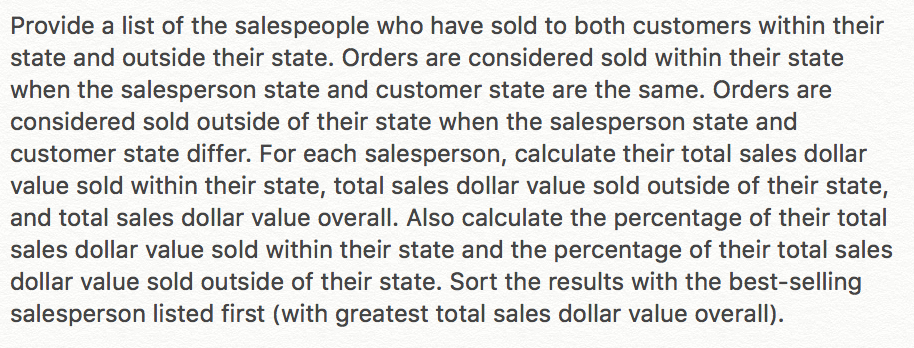
Provide a list of the salespeople who have sold to both customers within their state and outside their state. Orders are considered sold within their state when the salesperson state and customer state are the same. Orders are considered sold outside of their state when the salesperson state and customer state differ. For each salesperson, calculate their total sales dollar value sold within their state, total sales dollar value sold outside of their state, and total sales dollar value overall. Also calculate the percentage of their total sales dollar value sold within their state and the percentage of their total sales dollar value sold outside of their state. Sort the results with the best-selling salesperson listed first (with greatest total sales dollar value overall)
Step by Step Solution
There are 3 Steps involved in it

Get step-by-step solutions from verified subject matter experts
 Study Help