







Question: Square waves are particularly useful in electronics as they can represent low and high states Square waves are particularly useful in electronics as they can
Square waves are particularly useful in electronics as they can represent low and high states Square waves are particularly useful in electronics as they can represent low and high states
they only have states We can also create audio forms with square waves. Like any periodic
waveform, square waves will have an amplitude and frequency. Below is an example of a square
wave.
In WAVE files, this square wave can be represented using the minimum and maximum values of
bit depth, ie in a WAVE file with a bit depth of high states will be represented with the
number and low states will be represented with the number
Write a MIPS program, called questionasm, that will generate square waves. You will need to
obtain, from the user in this order the full output file name the entire path the tone
frequency how many times a wave period will appear within a second, an integer the sample
frequency how many sound samples will be measured in a second, an integer and the length
of the tone an integer in seconds
Your output file should have channel only and a bit depth of You should ignore the
contents of the header: set all bytes of the header to Your tone should always start with the
high state. You may assume that the tone frequency, sample frequency and length will be such
that there will always be an even number of samples per wave period.
Note: for this question, the Automarker will not check your console output and there should not
be console output, only input It will only check your output file. When it prints your output file,
it will convert your binary file to a textual hexadecimal form.
Sample Console Input do not place the comments in the program
input:
homelynnDocumentsCSCSassignqtout.wav
# tone frequency
# sample frequency
# length of the tone
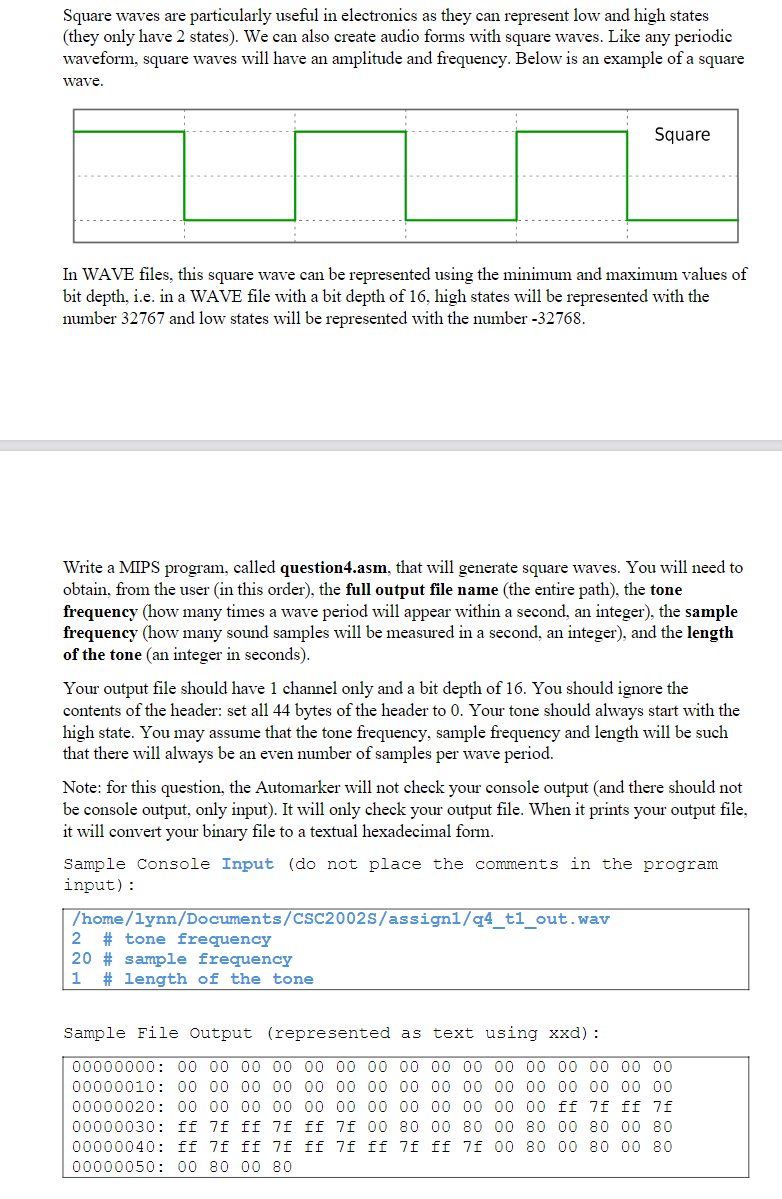
Sample File Output represented as text using xxd:
they only have states We can also create audio forms with square waves. Like any periodic
waveform, square waves will have an amplitude and frequency. Below is an example of a square
wave.
In WAVE files, this square wave can be represented using the minimum and maximum values of
bit depth, ie in a WAVE file with a bit depth of high states will be represented with the
number and low states will be represented with the number
Write a MIPS program, called questionasm, that will generate square waves. You will need to
obtain, from the user in this order the full output file name the entire path the tone
frequency how many times a wave period will appear within a second, an integer the sample
frequency how many sound samples will be measured in a second, an integer and the length
of the tone an integer in seconds
Your output file should have channel only and a bit depth of You should ignore the
contents of the header: set all bytes of the header to Your tone should always start with the
high state. You may assume that the tone frequency, sample frequency and length will be such
that there will always be an even number of samples per wave period.
Note: for this question, the Automarker will not check your console output and there should not
be console output, only input It will only check your output file. When it prints your output file,
it will convert your binary file to a textual hexadecimal form.
Sample Console Input do not place the comments in the program
input:
homelynnDocumentsCSCSassignqtout.wav
# tone frequency
# sample frequency
# length of the tone
Sample File Output represented as text using xxd:
:
:
: ff f ff f
: ff f ff f ff f
: ff f ff f ff f ff f ff f
:
Step by Step Solution
There are 3 Steps involved in it
1 Expert Approved Answer
Step: 1 Unlock

Question Has Been Solved by an Expert!
Get step-by-step solutions from verified subject matter experts
Step: 2 Unlock
Step: 3 Unlock
 Study Help