







Question: Stack and Function Calls Given the following Java code, create the corresponding MIPS assembly program and . . . For a call to wackySum (
Stack and Function Calls
Given the following Java code, create the corresponding MIPS assembly program and
For a call to wackySum show the contents of the stack at each method call and after the
method returns. This will be the next question in the assessment.
You must properly use registers according to the stack. In addition, you are only allowed to use
registers $$ and $$ for storing generalpurpose information. You may also use $$$
$$ and $
You can find Java code for running this function here. A starter test file is available here. You can use the
first Java file to generate answers to tests that you want to add to your test code so that you don't have to
do the computations by hand.
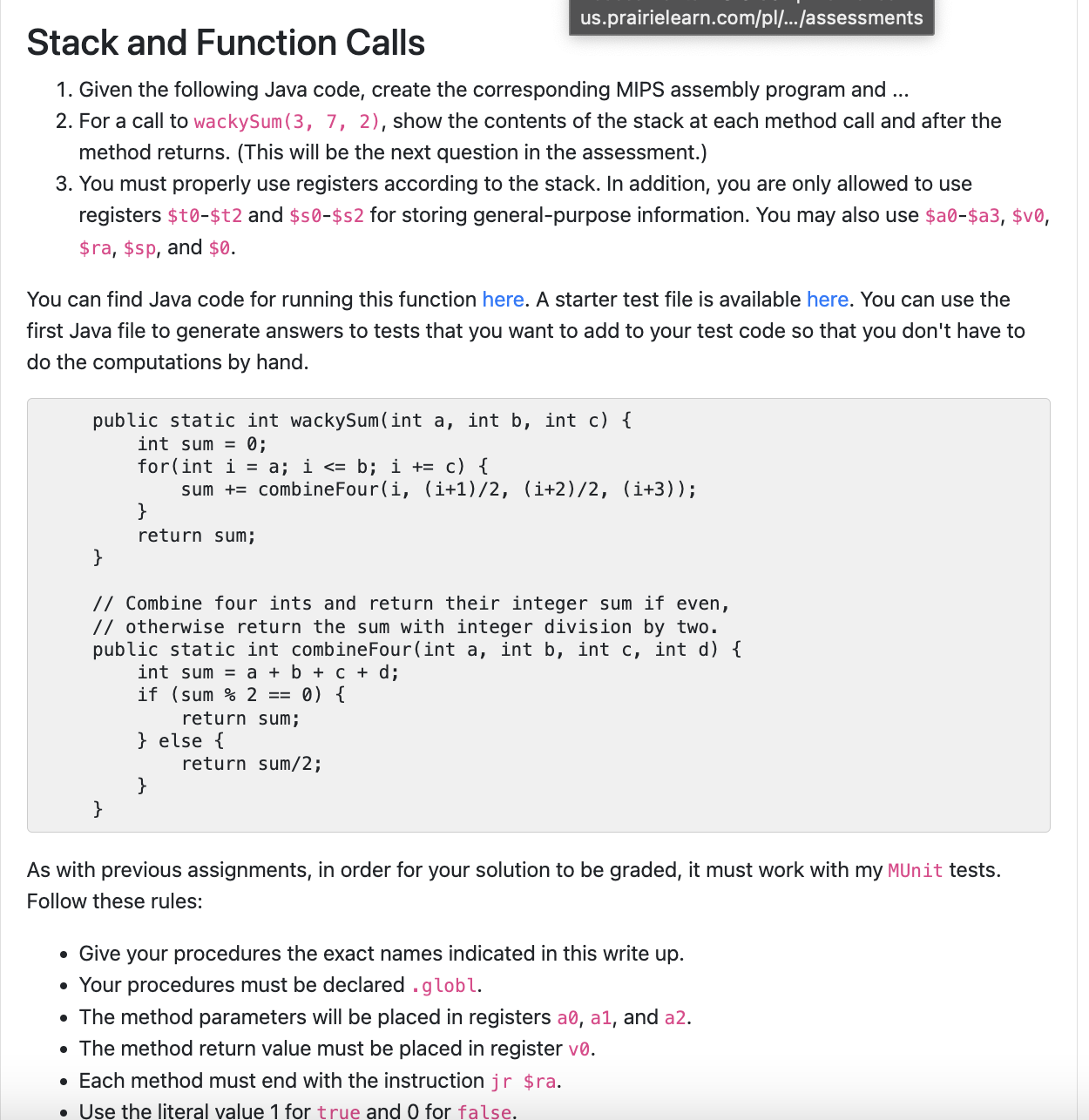
public static int wackySumint int int c
int sum ;
forint ; ;
sum combineFouri;
return sum;
Combine four ints and return their integer sum if even,
otherwise return the sum with integer division by two.
public static int combineFourint int int int
int ;
if sum
return sum;
else
return sum;
As with previous assignments, in order for your solution to be graded, it must work with my MUnit tests.
Follow these rules:
Give your procedures the exact names indicated in this write up
Your procedures must be declared.globl.
The method parameters will be placed in registers a a and a
The method return value must be placed in register v
Each method must end with the instruction jr $ra
Use the literal value for true and for false.
Step by Step Solution
There are 3 Steps involved in it
1 Expert Approved Answer
Step: 1 Unlock

Question Has Been Solved by an Expert!
Get step-by-step solutions from verified subject matter experts
Step: 2 Unlock
Step: 3 Unlock
 Study Help