Question: Stack.h: #ifndef NODEB_STACK_H #define NODEB_STACK_H /* * Stack class * Each Node point to the Node below it * Functionality: push, pop, peek, isEmpty, print

 Stack.h: #ifndef NODEB_STACK_H #define NODEB_STACK_H /* * Stack class * Each

Stack.h:

#ifndef NODEB_STACK_H #define NODEB_STACK_H /*  * Stack class  * Each Node point to the Node below it  * Functionality: push, pop, peek, isEmpty, print  */  #include "Node.h" #include  using namespace std; templatetypename Object> class Stack { private: // Store the address of the top Node in the Stack  Node* top; public: // Constructor  Stack() { // Stack is empty. Top doesn't point at anything.  top = nullptr; } // Deconstructor / Destructor  ~Stack() { // Pop all the Nodes left in the Stack  while (!isEmpty()) { pop(); } } bool isEmpty() const { return (top == nullptr); } void push(Object item) { if (isEmpty()) { // This is the first Node in the Stack  // Allocate memory in the heap to store the new Node  Node* newNode = new Node(item); // Update top  top = newNode; } else { // There is already at least one Node in the Stack  Node* newNode = new Node(item, top); // Update top  top = newNode; } } Object pop() { if (isEmpty()) { // There is no Node to pop. Return the default Object.  // Note: This assumes the Object has a default constructor.  return Object(); } else { // There is at least one Node in the Stack.  // Store a copy of the Object to be returned  Object copy = top->getItem(); // Store a copy of top  Node* topCopy = top; // Update top to point at whatever the Node we are about to delete is pointing at  top = top->getNext(); // Delete the Node from heap memory  // Use the delete keyword with a pointer to the memory you want to deallocate from the heap  delete topCopy; // Return the Object  return copy; } } bool exists(Object item) const { Node* curr = top; while (curr != nullptr) { // Note: This assumes the Object can use the == operator  if (curr->getItem() == item) { // Found the item in the Stack  return true; } curr = curr->getNext(); } // Did not find the item in the Stack  return false; } void printStack() const { Node* curr = top; while (curr != nullptr) { // Note: This assumes that the Object can use the  cout getItem() getNext(); } } }; #endif //NODEB_STACK_H

Node.h:

#ifndef NODEB_STACK_H #define NODEB_STACK_H /*  * Stack class  * Each Node point to the Node below it  * Functionality: push, pop, peek, isEmpty, print  */  #include "Node.h" #include  using namespace std; templatetypename Object> class Stack { private: // Store the address of the top Node in the Stack  Node* top; public: // Constructor  Stack() { // Stack is empty. Top doesn't point at anything.  top = nullptr; } // Deconstructor / Destructor  ~Stack() { // Pop all the Nodes left in the Stack  while (!isEmpty()) { pop(); } } bool isEmpty() const { return (top == nullptr); } void push(Object item) { if (isEmpty()) { // This is the first Node in the Stack  // Allocate memory in the heap to store the new Node  Node* newNode = new Node(item); // Update top  top = newNode; } else { // There is already at least one Node in the Stack  Node* newNode = new Node(item, top); // Update top  top = newNode; } } Object pop() { if (isEmpty()) { // There is no Node to pop. Return the default Object.  // Note: This assumes the Object has a default constructor.  return Object(); } else { // There is at least one Node in the Stack.  // Store a copy of the Object to be returned  Object copy = top->getItem(); // Store a copy of top  Node* topCopy = top; // Update top to point at whatever the Node we are about to delete is pointing at  top = top->getNext(); // Delete the Node from heap memory  // Use the delete keyword with a pointer to the memory you want to deallocate from the heap  delete topCopy; // Return the Object  return copy; } } bool exists(Object item) const { Node* curr = top; while (curr != nullptr) { // Note: This assumes the Object can use the == operator  if (curr->getItem() == item) { // Found the item in the Stack  return true; } curr = curr->getNext(); } // Did not find the item in the Stack  return false; } void printStack() const { Node* curr = top; while (curr != nullptr) { // Note: This assumes that the Object can use the  cout getItem() getNext(); } } }; #endif //NODEB_STACK_H

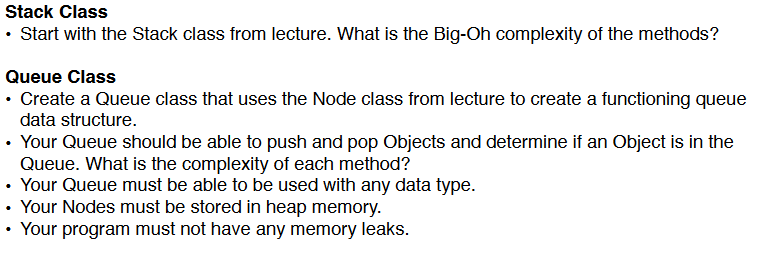
Stack Class Start with the Stack class from lecture. What is the Big-Oh complexity of the methods? Queue Class Create a Queue class that uses the Node class from lecture to create a functioning queue data structure. . Your Queue should be able to push and pop Objects and determine if an Object is in the Queue. What is the complexity of each method? . Your Queue must be able to be used with any data type. Your Nodes must be stored in heap memory. . Your program must not have any memory leaks

Step by Step Solution

There are 3 Steps involved in it

1 Expert Approved Answer
Step: 1 Unlock blur-text-image
Question Has Been Solved by an Expert!

Get step-by-step solutions from verified subject matter experts

Step: 2 Unlock
Step: 3 Unlock

Students Have Also Explored These Related Databases Questions!