


Question: Stakeholders Right to Privacy Ethics Persons Race discrimination Narrowly Codify Gibbons v. Ogden Good Corporate Short Term Citizen Profit Maximization Broadly Kantian Ethics Doctrine of
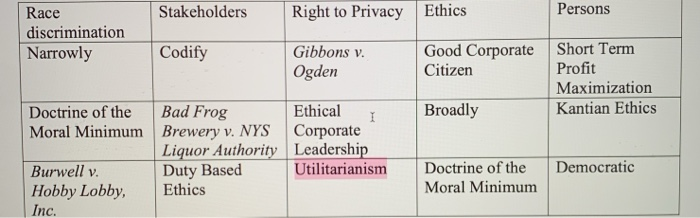
Stakeholders Right to Privacy Ethics Persons Race
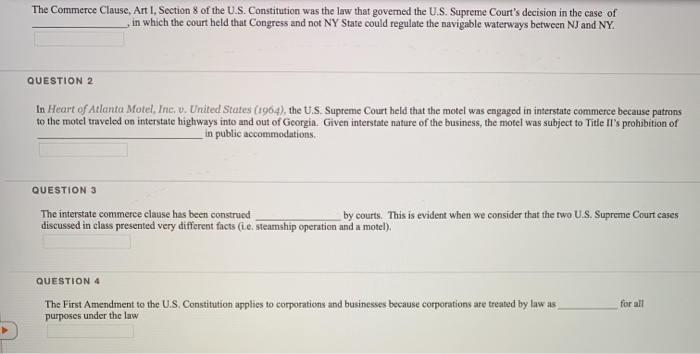
Stakeholders Right to Privacy Ethics Persons Race discrimination Narrowly Codify Gibbons v. Ogden Good Corporate Short Term Citizen Profit Maximization Broadly Kantian Ethics Doctrine of the Bad Frog Ethical I Moral Minimum Brewery v. NYS Corporate Liquor Authority Leadership Burwell v. Duty Based Utilitarianism Hobby Lobby, Ethics Inc. Democratic Doctrine of the Moral Minimum The Commerce Clause, Art 1, Section 8 of the U.S. Constitution was the law that governed the U.S. Supreme Court's decision in the case of in which the court held that Congress and not NY State could regulate the navigable waterways between NJ and NY. QUESTION 2 In Heart of Atlanta Motel, Inc. v. United States (1964), the U.S. Supreme Court held that the motel was engaged in interstate commerce because patrons to the motel traveled on interstate highways into and out of Georgia. Given interstate nature of the business, the motel was subject to Title II's prohibition of in public accommodations QUESTION 3 The interstate commerce clause has been construed by courts. This is evident when we consider that the two U.S. Supreme Court cases discussed in class presented very different facts (i.e. steamship operation and a motel). QUESTION 4 for all The First Amendment to the U.S. Constitution applies to corporations and businesses because corporations are treated by law as purposes under the law

Step by Step Solution

There are 3 Steps involved in it

1 Expert Approved Answer
Step: 1 Unlock blur-text-image

Question Has Been Solved by an Expert!

Get step-by-step solutions from verified subject matter experts

Step: 2 Unlock
Step: 3 Unlock

Students Have Also Explored These Related General Management Questions!